
NanoHubZone

The NanoHubZone project addresses the environmental and logistical challenges of traditional urban delivery systems, which rely heavily on large vehicles that contribute to traffic congestion and high CO2 emissions. Inspired by the growing need for sustainable last-mile delivery solutions, the project introduces modular transshipment zones in Barcelona and Brussels. These zones act as micro-logistics hubs, […]
Micromobility-Infra
The Marma charging stations project is a 12-month initiative addressing operational inefficiencies in shared micromobility services. These inefficiencies, particularly related to battery-swapping logistics, contribute to increased costs, carbon emissions, and operational complexity, posing challenges to sustainable urban mobility. The project aims to create a smarter, more sustainable solution by developing and deploying innovative charging stations […]
LUCID
The LUCID – Data intelligence for cities and urban logistics project aims to transform urban logistics by creating a smart platform that optimises route planning, reduces congestion, and improves the use of loading and unloading spaces. Urban areas are increasingly congested, and logistics operations contribute significantly to this, as well as to emissions and fuel […]
Loge-Hubs
The Loge-Hubs solution enhances urban logistics strategies by focusing on the location and deployment of new or existing urban logistics hubs, delivering environmental, societal, and economic benefits. The Loge-Hubs project is active in Las Rozas de Madrid, Spain, and Braga, Portugal, each representing distinct urban environments shaped by logistics. Las Rozas, a growing city with […]
Interact
This project, named Human machine interaction for automated public transport buses (InterAct), focuses on driving with automated buses, which are conventional full-sized buses with automated driving technology. These buses have higher capacity and are further in the development towards driving without safety driver onboard. The project partners have the ambition to make urban spaces more […]
H2TOWTRACTOR
Large logistics hubs face significant challenges in transitioning to electrification due to insufficient charging infrastructure and power supply capacity. This issue risks delaying the clean energy shift in critical locations such as ports, and large markets. H2TowTractor addresses this problem by promoting the adoption of hydrogen-powered vehicles and integrating them with renewable energy sources available […]
EASE
As the EU is transitioning to a sustainable and low-carbon economy; decarbonisation of transport is at the centre of this transition, with electric vehicles (EV) leading the change. Not only is this creating a new energy dependency but it is also important to note that EV chargers require a stable power supply to function effectively, […]
BCMS
Buses often experience overcrowding and bunching along the route, leading to reduced seating chance, denied boarding, and long waiting and journey times. Currently no product exists for operators to control crowding along the route. To address this, the project aims to commercialise Theoremus’s AI passenger crowding counting technology, which is currently a primitive and specialist […]
BaselineNC
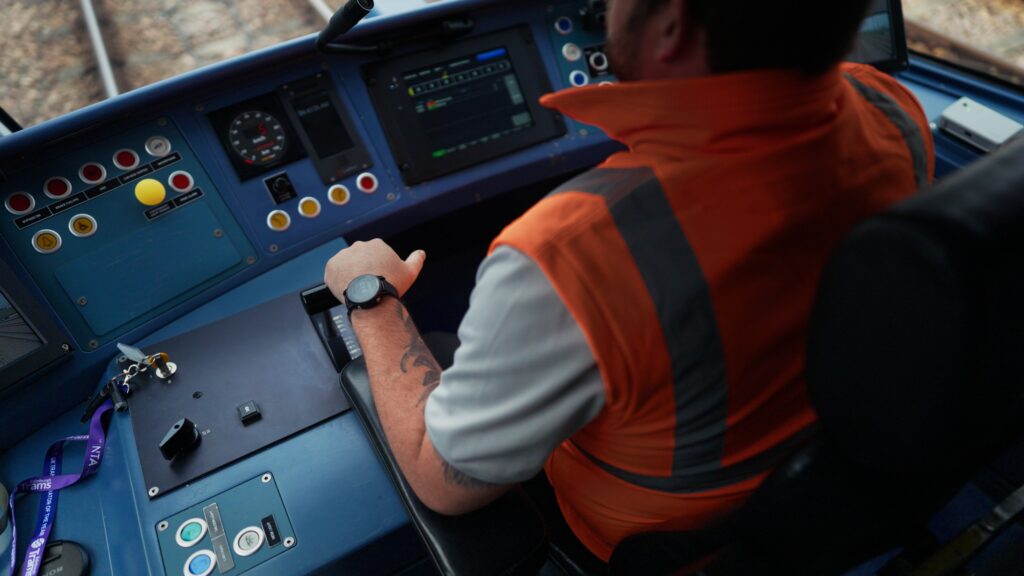
The Croydon Tram Accident killed seven people and was caused by driver incapacitation. The investigation by UK Tram identified the need for new technology that predicted and prevented depreciated physiological performance (fatigue, inattention, and incapacitation) at work. There is currently no technology in the market capable of doing this. IHF DIGITAL Ltd has developed the […]
ARISE
Tram systems are vital for sustainable urban mobility but face challenges such as accidents, inefficiencies, and staff shortages. The ARISE project addresses these issues by showcasing OTIV.TWO, an advanced driver assistance system that enhances safety, efficiency, and reliability through real-time information and intelligent decision support, reducing delays and improving operations. Rail transport, as the most […]
ARIA

ARIA addresses the need for improved energy management in urban mobility. Existing solutions do not fully optimise energy use and reduce emissions effectively. This solution integrates artificial intelligence (AI) with e-mobility, focusing on car-sharing operators and charging points, to create an innovative energy flexibility platform. This platform will optimise charging schedules, support peak shaving, and […]
AI MOVE
Current public transport prioritisation relies on vehicle-installed transponders communicating with traffic lights, a system limited to municipal transport. This project proposes an innovative solution using CCTV cameras at intersections and transit zones to recognise and prioritise all high-occupancy vehicles, expanding efficiency across diverse transport providers. Our approach leverages advanced image recognition technology, enhancing traffic flow […]
VELOSAFE
The rapid growth in e-bike adoption across Europe has created new challenges in bicycle security. As e-bikes become increasingly popular for urban mobility, their higher value makes them particularly attractive targets for theft. Traditional insurance and recovery methods have proven inadequate, with low recovery rates for stolen bikes. This not only causes financial losses but […]
TC05
Tyre wear and non-exhaust emissions (NEEs) are the dirty secret of the transport industry and a significant contributor to urban air and ocean microplastic pollution. Despite targeted policy measures in cities (Euro 7), there has been a consistent rise in NEEs caused by tyre, brake and road wear, especially in electric vehicles. The Tyre Collective […]
Spinovate
This project unlocks the potential of connected e-bikes to promote a sustainable European cycling industry. While e-bikes are growing rapidly, they lack the “connected experience” seen in the automotive sector. See.Sense’s patented technology transforms e-bikes into fully connected devices, capturing sensor data on rider safety and road conditions beyond basic GPS. The project will pilot […]
SAQM TRIAL
Improving air quality on the London Underground and Paris Metro is a priority for Transport for London (TfL) and RATP, and is increasingly a focus of activity for other subway systems around the world. Whilst there is extensive knowledge and understanding of surface level Particulate Matter (PM), less is known about the type of PM […]
SAFELY
Each year, over 1.3 million fatalities and 50 million injuries occur on roads globally, with vulnerable road users (VRUs)—pedestrians, cyclists, and motorcyclists—accounting for over half of these deaths. Current solutions often fail to provide localised, actionable insights to mitigate risks. Inspired by the EU’s Vision Zero goal, the SAFELY project aims to enhance urban road […]
SAFELIGHT
European cities have a big challenge to achieve Vision Zero and safety for vulnerable urban road users. Fatalities due to accidents are increasing in cities due to the use of new micromobility vehicles (scooters, bicycles, etc.) and their interaction with private and delivery vehicles. Some of the accidents are caused by users’ negligence but an […]
ROADSCOR
As cities grow and transportation evolves, ensuring safety has become a critical challenge. Vulnerable road users are particularly at risk, emphasising the need for innovative solutions in road design. A safe infrastructure is fundamental to achieving Vision Zero goals: a 50% reduction in fatalities by 2030 and 100% reduction by 2050. Making informed, data-driven, qualitative […]
MOBIRE
The MOBIRE project aims to transform the micromobility sector by addressing key challenges in battery repairability, sustainability, and lifecycle management. The primary objectives of the project are:
MDSInternational

This new market data product — as it already does in its launch market, the UK — will provide retail sales and inventory data to improve supply chain management and cash flow. The data is collected via the major POS systems, cleaned, organised and made useful via a dashboard that is configurable and responsive to […]
Life Cycle
The project enhances digital bicycle lifecycle management by integrating innovative features into the MIOO platform, a proven solution in Sweden’s cycling industry. This extension incorporates new features such as ownership transfer, QR code-based registration, and AI-powered bike specifications, to get prepared for upcoming EU regulations like the Digital Product Passport (DPP). By digitising bicycle service […]
HYIPTRAIN
The project seeks to demonstrate and introduce to the market a cutting-edge hydrogen retrofit kit designed specifically for diesel trains. By substantially reducing the upfront cost of hydrogen adoption and simultaneously improving performance, the kit enables the conversion of traditional diesel trains into sustainable, hydrogen-powered counterparts. It not only helps train operators align with the […]
ACTIVA H2

The ACTIVA H2 project aims to make hydrogen mobility more accessible by creating a compact, modular hydrogen refuelling station (HRS) that is easier and more affordable to install. Traditional stations are costly, complicated, and require heavy infrastructure. This often discourages operators and fleet owners from investing in hydrogen technology. Inspired by Europe’s ambitious decarbonisation targets, […]