European Mobility Week 2026 brought cities and citizens across Europe together to explore how everyday mobility can become healthier, more sustainable and more inclusive. From the European Steps Challenge to webinars on better commutes and citizen engagement, EIT Urban Mobility supported initiatives encouraging people and cities to rethink how we move.
With the week now concluded, its momentum will continue in Barcelona at Tomorrow.Mobility World Congress, taking place from 3–5 November, where the four winning cities of the Steps Challenge will be recognised.
1.3 billion steps for more active cities
The European Steps Challenge, organised by Walk15 with support from EIT Urban Mobility and the International Federation of Pedestrians, brought together walkers from 972 cities across Europe between 16 and 22 September.
Together, participants walked more than 1.3 billion steps, covering approximately 935,747 kilometres, surpassing last year’s challenge by more than 310 million steps.
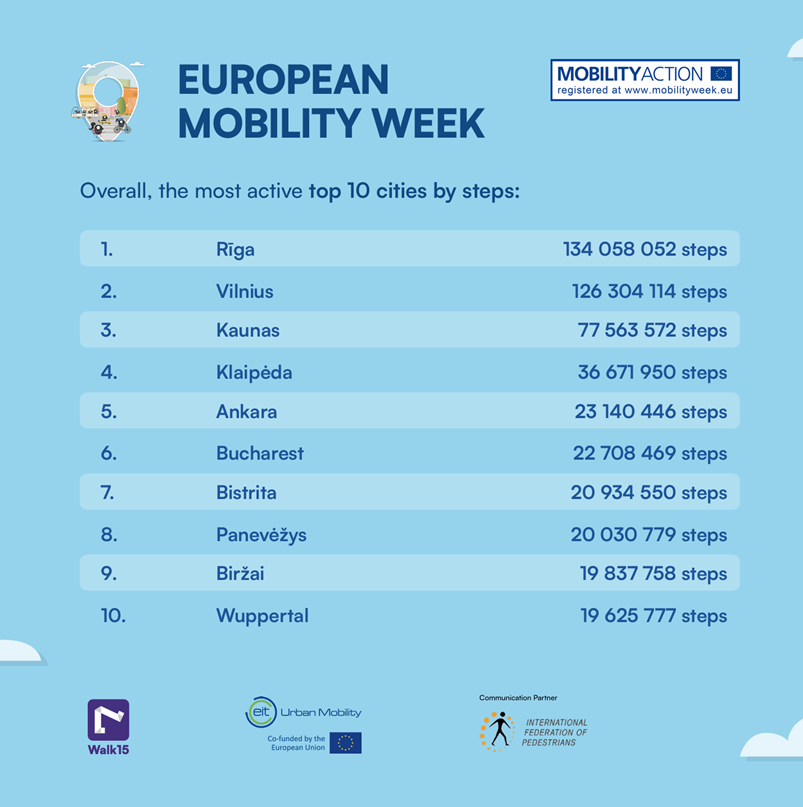
Rīga emerged as Europe’s most active city, recording more than 134 million steps, followed by Vilnius with 126 million and Kaunas with more than 77 million. Ankara recorded the highest average number of steps among cities with at least 700 participants. Lithuania ranked as the most active country, followed by Latvia and Romania.
The four winning cities (Rīga, Vilnius, Kaunas and Ankara) will be invited to a recognition ceremony in Barcelona during Tomorrow.Mobility, bringing the European Mobility Week celebration to the heart of one of Europe’s leading urban mobility gatherings.
Exploring better everyday mobility
Beyond encouraging people to walk, EIT Urban Mobility used European Mobility Week to explore some of the questions shaping everyday journeys through two online webinars.
On 14 September, Building better commutes: how European cities are improving everyday mobility examined the challenges commuters face, from safety and reliability to congestion and overcrowding. Drawing on an EIT Urban Mobility survey of 1,503 commuters across Barcelona, Munich and Bucharest, the session looked at practical ways to make public transport and active mobility more attractive. Watch it here.
On 22 September, Citizen engagement across the circle of life focused on another essential part of creating better transport systems: listening to the people who use them. The session explored how cities can involve citizens at different stages of life and use their experiences to develop more inclusive, accessible and people-centred mobility solutions. Participants also received a practical Citizen Engagement Across the Life Course Miro Board to support engagement activities in their own cities. Watch it here.
Moving towards more people-centred cities
From more than a billion steps to conversations about commuting and citizen participation, this year’s European Mobility Week highlighted that sustainable mobility is not only about how we move, but also about creating cities that work better for the people who live in them.
And this is not the end. The conversation continues at Tomorrow.Mobility World Congress 2026 (Barcelona, 3–5 November), bringing together cities, industry, innovators, researchers and policymakers to explore the solutions that can turn mobility challenges into real-world impact.