The project, funded by EIT Urban Mobility, will create an AI platform to help cities draft, update, and monitor their sustainable urban mobility and logistics plans.
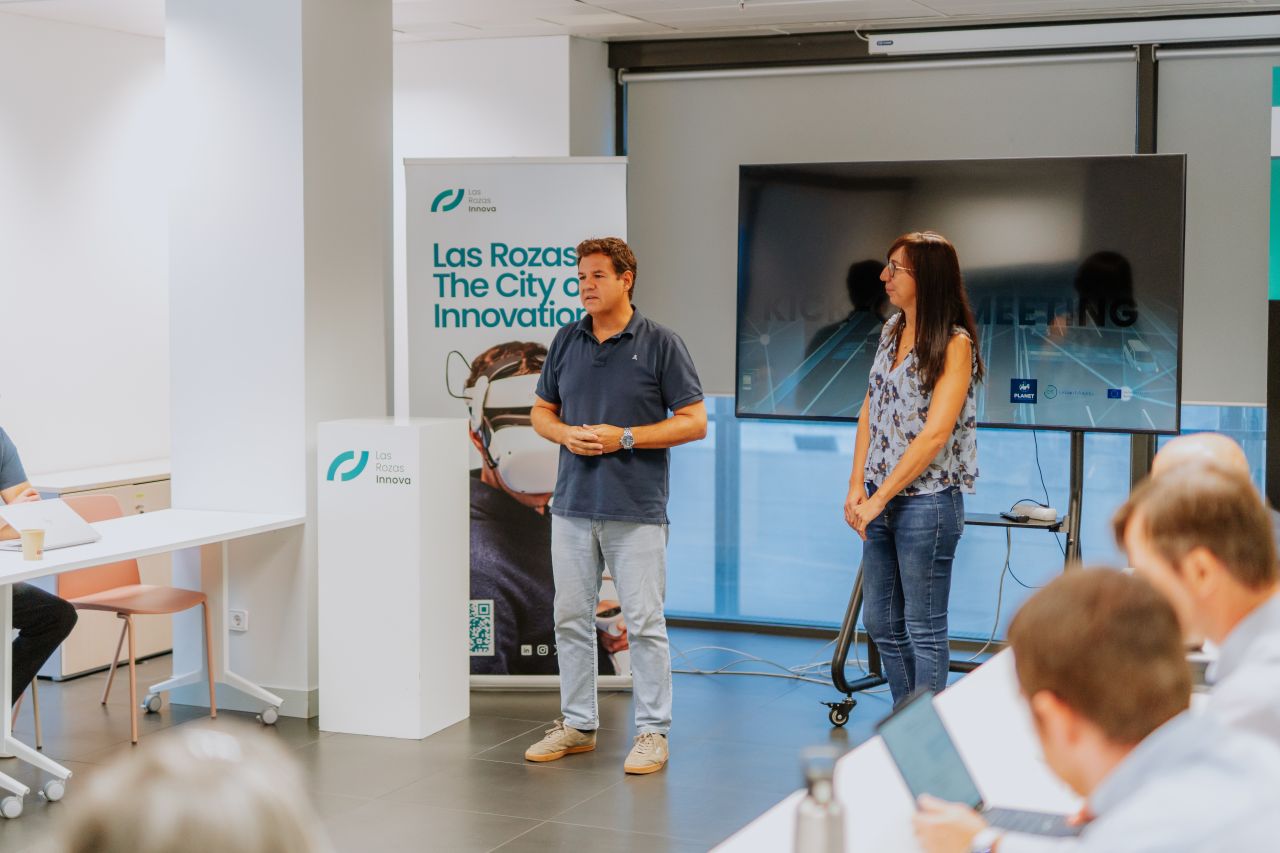
The PLANET project—Planning with AI for Next-generation, Equitable Transport—was formally launched in Las Rozas, Spain, at the consortium’s first meeting on 24 September. Co-financed by EIT Urban Mobility through the Main Call, the project will last two years and end in August 2028.
PLANET will establish a platform that will assist cities in preparing, updating, and monitoring their Sustainable Urban Mobility Plans (SUMPs) and Sustainable Urban Logistics Plans (SULPs). The platform will automatically produce indicators, dashboards, and relevant supporting documentation by combining local transport plans, mobility data, geographic information, and city-specific regulations.
The project aims to help public authorities make more informed decisions and ensure their mobility plans stay current as transport patterns, policies, and urban conditions change; it will also make planning more flexible, more inclusive, and based on reliable data.
Testing the technology in two European cities
The development and testing of the technology will take place in two pilot cities, namely Las Rozas in Spain and Wiesbaden in Germany. The pilots will enable the consortium to evaluate how the platform works in real municipal settings and whether its results are useful, clear, and appropriate for public-sector decision-makers.
Las Rozas will take part via EIT Urban Mobility’s partner Las Rozas Innova, the municipality’s innovation and technology development company. The city will provide mobility data, local context, and user access, and will help validate the platform’s requirements, indicators, and results. It will also promote citizen involvement and determine if the solution can be replicated in other urban areas. Wiesbaden will act as the project’s second demonstration site, with assistance from Rupprecht Consult.
European consortium
Urban Radar leads the PLANET consortium; Tema Ingeniería will lead the pilot project in Las Rozas, while the Transport Research Centre (TRANSyT) at the Technical University of Madrid will develop the methodology, evaluate the project’s impact, and carry out quality control. CityFi will provide support with communication, dissemination, and introducing the technology to the market.
The aim of the project is to develop a methodology which other European cities can apply in order to use AI to improve mobility planning; its wider objective is to enable local authorities to manage their ever-more complex transport systems through the use of more efficient tools, better data and a greater ability to respond to citizens’ needs.
José de la Uz, mayor of Las Rozas and president of Las Rozas Innova, stated that “PLANET will aid in introducing artificial intelligence into public-sector mobility management and will make planning more agile, participatory and data-driven”.
He also said that the project shows the value of international collaboration in testing and validating technologies which can transform urban mobility and development.