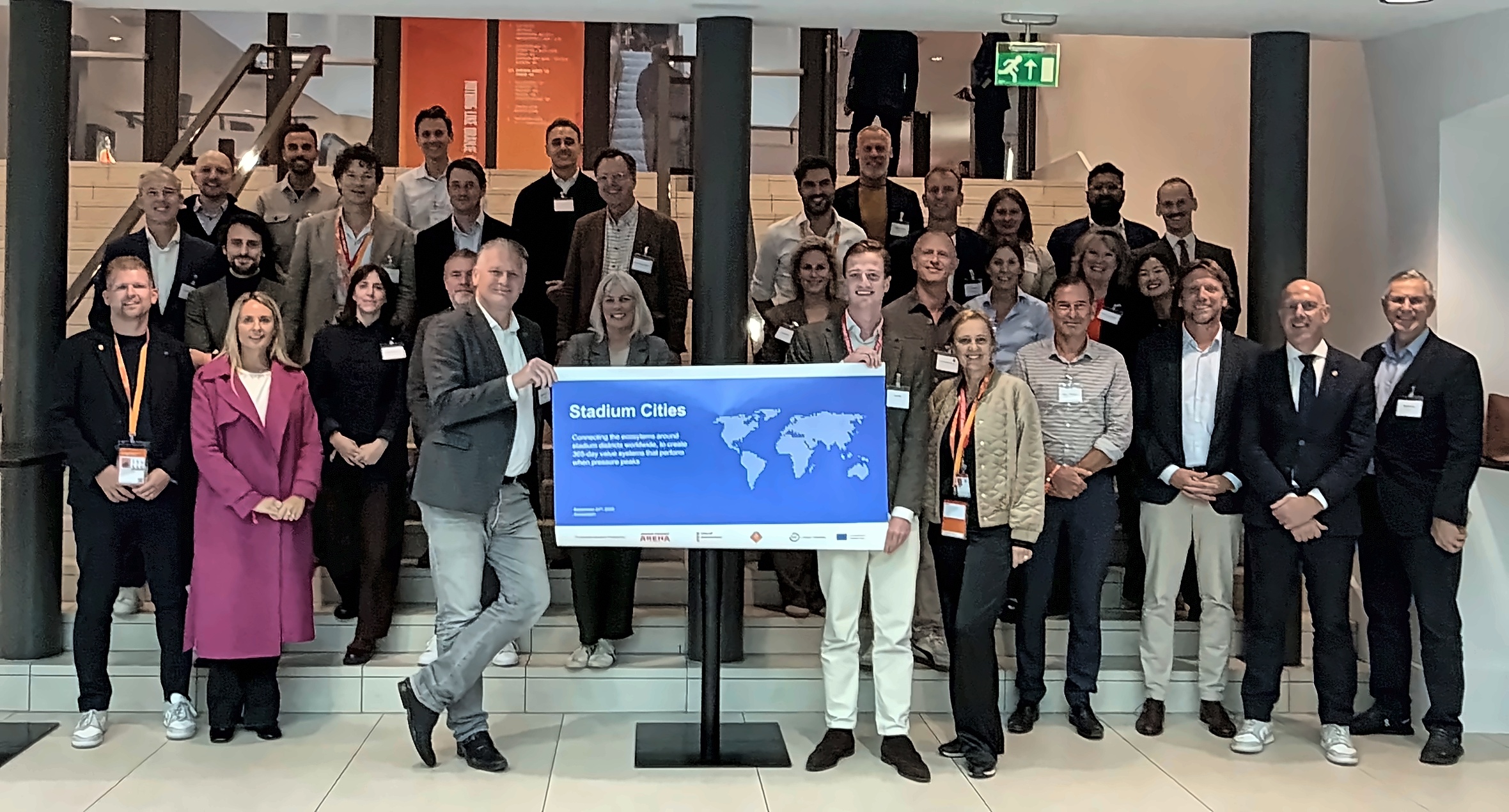
Johan Cruijff ArenA, KNVB, the City of Amsterdam and EIT Urban Mobility launched Stadium Cities, a movement connecting stadium districts across Europe to share knowledge, develop practical solutions and scale what works. Initiated in the Netherlands, the movement brings together cities, stadiums, transport operators and other local partners around a shared ambition: creating stadium districts that generate value 365 days a year and perform when demand peaks.
Around 40 senior leaders and decision makers from across Europe attended the kick off at Johan Cruijff ArenA this 24 September. Cities and local coalitions including Amsterdam, Rotterdam, Eindhoven, London, Manchester, Stockholm, Frankfurt, Paris, Turin, Brussels, Antwerp, Dortmund and Dublin are already present or in conversation about the movement, alongside transport operators including Transport for London, Transport for Greater Manchester, Deutsche Bahn and Dutch Railways.
Stadium districts are becoming increasingly important parts of European cities. As cities grow denser, these areas concentrate many of the challenges facing urban environments: mobility, economic activity, public space, liveability and the ability to manage major peaks in demand. Stadium Cities uses these districts as practical environments where solutions can be developed, tested and scaled for the wider city.
The movement works on two tracks: the long-term development of areas around stadiums, and the more immediate challenge of how fans travel to, from and around these districts. It brings demand together around shared challenges, then moves from knowledge and evidence to tangible, investable projects and the scaling of proven solutions.
The aim is to connect local ecosystems while making it easier for solutions developed in one stadium city to be applied in another. The movement starts in Europe, with contact already established with several stadium cities in the United States.
The Amsterdam kick off marks the first step. The next stop is Barcelona in November, as Stadium Cities continues to build a European network around shared urban challenges.
Prasana Uthayakumar, Innovation & Advisory Manager, Strategy Directorate TRANSPORT FOR LONDON: “Incredible what progress can be made when diverse minds in different environments get together to compare notes on how we can improve our cities together!” – even with this session really being just the inception, it’s incredibly how much I’ve learned about how familiar, but also uniquely different, our city challenges are!”
Willem Frederik Metzelaar, Director at EIT Urban Mobility of Hub West: “A stadium district is a city under pressure. On event days, we can see immediately where mobility works and where it fails. Stadium Cities brings cities, operators and businesses together to turn those lessons into solutions that improve the district every day of the year—and can work in other cities too.”
Steve Gilholme, Event Transport Managment, Transport for Greater Manchester,: “Initiatives like this are important in helping Manchester learn from and collaborate with other leading cities. By sharing ideas, innovation and best practice, we can strengthen our ambition to be a world-class destination for world-class events and continue delivering exceptional experiences for residents and visitors alike.”
Tim Hofman, Head of sustainability, KNVB: “For the Royal Netherlands Football Association, it is very important to guarantee a comfortable journey for the fans and visitors of both club team as national team matches. Mobility is a crucial part of the fan journey and asks for smart solutions to be ready for the next decade.”
Join the movement. Organisations that want to get involved can get in touch via Stephan Poelsma, partner manager EIT Urban Mobility, [email protected], or Ydze Rijff, Johan Cruijff ArenA, [email protected]