
The European Innovation Scoreboard (EIS) is the European Commission’s annual assessment of innovation performance across EU Member States, neighbouring countries and selected global competitors. It measures how effectively countries create, invest in, commercialise and benefit from innovation through 32 indicators covering education and skills, research excellence, digitalisation, investment, business innovation and economic impact.
Based on their innovation performance relative to the EU average, countries are grouped into four categories:
- Innovation Leaders: above 125% of the EU average.
- Strong Innovators: between 100% and 125% of the EU average.
- Moderate Innovators: between 70% and 100% of the EU average.
- Emerging Innovators: below 70% of the EU average.
The recently published European Innovation Scoreboard 2026 highlights both Europe’s continued progress and the need to further strengthen innovation capacity in regions that remain below the EU average. The report confirms that all EU Member States have improved their innovation performance since 2019, while Sweden, Denmark and the Netherlands remain Europe’s Innovation Leaders. Malta moved into the Strong Innovators group, while Croatia shifted to the Emerging Innovators category. Countries such as Italy, Spain, Lithuania, Greece and Cyprus recorded some of the strongest growth rates among Moderate Innovators, demonstrating the increasing innovation potential of widening regions.
RIS: A Key Tool for Strengthening Regional Innovation
While Europe continues to make significant progress in digitalisation, skills development and sustainability, the EIS 2026 report highlights the need to further strengthen entrepreneurship, access to investment, innovation ecosystems and the commercialisation of research. These are challenges that are particularly relevant for many Moderate and Emerging Innovator countries.
One of the key initiatives addressing these challenges is the EIT Regional Innovation Scheme (RIS), which was established to help bridge Europe’s innovation divide. Through education, innovation and business creation activities, RIS supports innovators, startups, universities, cities and public authorities, helping them connect with European networks, access opportunities and bring innovative solutions closer to market.
EIT Urban Mobility’s RIS network is supported by 11 Country Representatives, who act as local connectors between regional stakeholders and European innovation opportunities. In 2025, the network was active in Croatia, Bosnia and Herzegovina, Slovenia, Greece and Cyprus, Hungary, Latvia, Lithuania, Malta, Poland, Portugal, Romania, Slovakia and Türkiye, helping local innovators, startups, universities, cities and public authorities access EIT Urban Mobility programmes and initiatives.
How Is EIT Urban Mobility contributing?
Most RIS countries belong to the Moderate and Emerging Innovator groups identified by the European Innovation Scoreboard 2026. While these countries are making strong progress, they continue to face challenges related to innovation financing, business growth, research commercialisation and ecosystem connectivity. Through its RIS activities, EIT Urban Mobility helps address these challenges by supporting entrepreneurship, developing innovation talent, strengthening collaboration and fostering more resilient regional innovation ecosystems.
In 2025, the EIT Urban Mobility RIS network delivered strong results across its key activity areas.
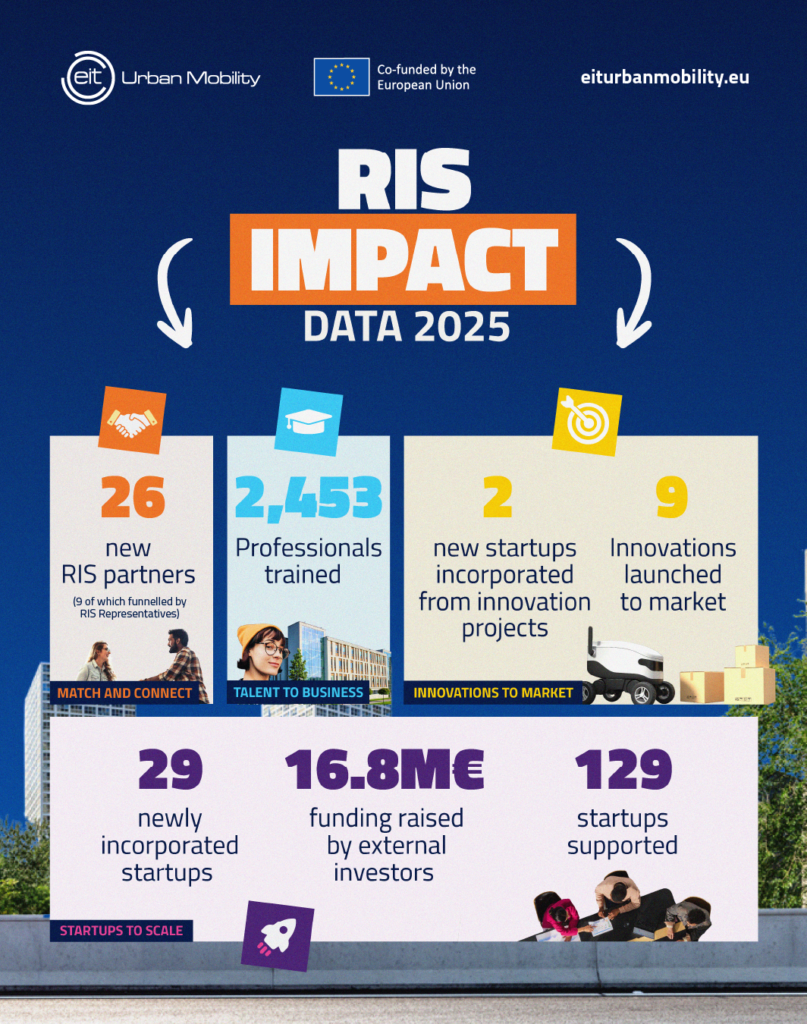
Through Match & Connect, 26 new RIS partners joined the network, including nine organisations directly identified and engaged by Country Representatives, highlighting their role as key ecosystem builders across RIS regions.
Under the Support to Startups pillar, 29 new startups were incorporated, with 27 benefiting directly from the support and outreach of Country Representatives. In addition, six startups secured support through Innovation and Impact Ventures programmes, strengthening the pipeline of investment-ready mobility ventures.
In the area of Education and Training, 2,453 professionals participated in RIS learning activities across Europe, while four new RIS Education projects were selected, helping address skills gaps and build innovation capacity in the urban mobility sector.
Meanwhile, under the Innovations to Market pillar, nine innovations were successfully launched to market, two startups emerged from innovation projects, and two new RIS Innovation projects were awarded, reinforcing the development of market-ready mobility solutions with strong regional impact.
Several success stories illustrate this impact. The MOBIRE project demonstrated how circular economy approaches can transform micromobility battery management, increasing battery repairability while creating green jobs and reducing emissions. At the same time, the inVest Urban Mobility Accelerator in Romania helped strengthen the entrepreneurial ecosystem in Western Romania and laid the foundations for future regional investment capacity. In education, RIS-supported initiatives continued to equip learners, researchers and professionals with the skills needed to drive innovation and sustainable mobility solutions.
These achievements demonstrate how EIT Urban Mobility is translating European innovation objectives into tangible regional impact. By empowering local innovators, supporting startups, building skills and strengthening innovation ecosystems, the RIS network is helping ensure that talent, ideas and entrepreneurial ambition can flourish across all regions of Europe.