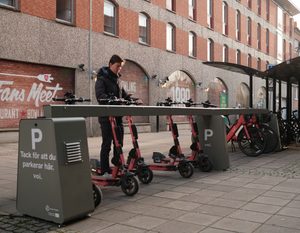
Shared micromobility can play a valuable, sustainable role in cities’ urban mobility mix.
On the other hand, mobility devices like e-scooters and e-bikes bring operating and environmental costs associated with their lithium-ion batteries.
“We have about one million shared vehicles in Europe, and about 10% to 12% have a failure each year — that’s over a hundred thousand batteries,” stressed Prins Doornekamp, CEO and Founder of NOWOS. “We had a lot of questions from our clients. What are we going to do when our batteries reach the end of their lives? Most lithium batteries were being thrown away instead of being repaired.”
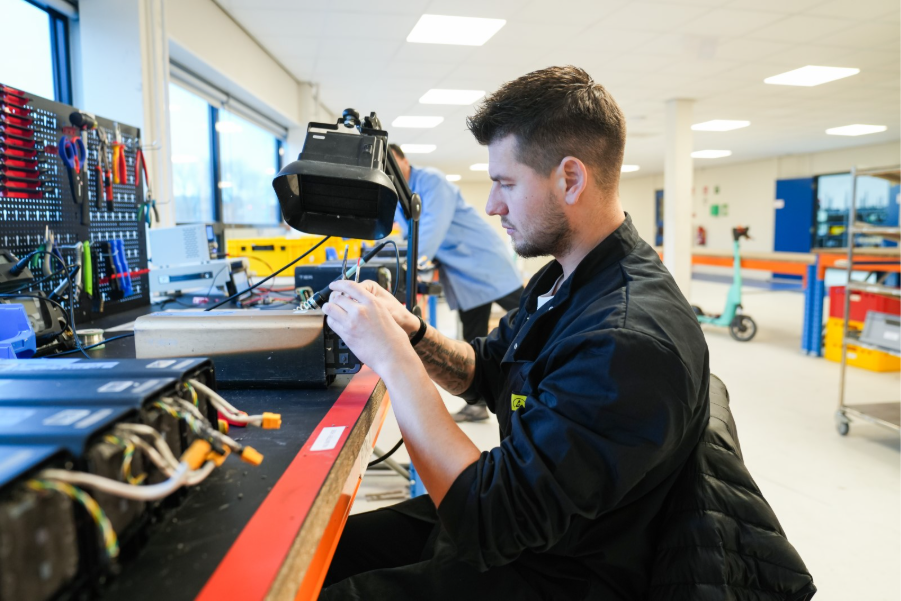
The EIT Urban Mobility-supported MOBIRE project met these challenges by advancing a market-ready, sustainable solution for lithium-ion battery repairability and lifecycle management, helping to extend battery life and reduce costs.
MOBIRE made key contributions to the micromobility sector: establishing a dedicated lithium-ion battery repair hub in Poland and implementing a battery passport system that can track every battery’s repair history, compliance and lifecycle.
With these initiatives, MOBIRE supports micromobility providers to better manage fleet battery performance and satisfy EU regulations with a cost-saving solution.
Upscaling to the industrial level
MOBIRE brought together micromobility experts Dott and lithium-ion battery service and repair leader NOWOS.
“We see significant growth in the expansion of fleet owners. And to maintain all these batteries, we need to do it at the industrial scale,” Doornekamp emphasised.
A key challenge facing the MOBIRE consortium was how to increase the share of batteries that get repaired. To do so, they developed and validated advanced repair processes for some of the most common lithium-ion batteries currently used in micromobility in Europe.
“The collaboration with NOWOS was a great success. We were able to go from 20% to about 80% of our batteries being successfully repaired. And this means, for instance, that next year we will be able to repair about 6,000 to 9,000 batteries,” highlighted Maxim Romain, President and Co-founder of Dott,
“It was a pleasure to work with EIT Urban Mobility and Dott together on the MOBIRE project,” Doornekamp said, “We had good support from EIT Urban Mobility and the cooperation with Dott worked great. We learned a lot from the project, and it gave us the opportunity to scale to a more industrial level.”
Circular batteries for reduced emissions
By gaining more predictability over vehicle downtimes, improved battery management can support fleet operators to lower overall maintenance costs. These savings are seen as vital in a sector with tight profit margins.
“With repairable batteries and an optimised repair process, we can cut down the cost by 30% and have better traceability,” Doornekamp noted.
More repairable batteries promise sizeable environmental benefits, an important pillar of the MOBIRE project.
“For environmental impacts it makes total sense to repair. You save 2.28x the emissions compared to buying new batteries, based on a recent Life Cycle Assessment*,” Doornekamp pointed out.
The battery passport system — which Europe wants to implement by February 2027 — forms part of this effort. The digital passport will encompass a record of a battery’s materials, components and lifecycle, and the requirement will apply to e-bikes and e-scooters, as well as electric vehicle batteries. In addition to integrating the upcoming battery passport system, MOBIRE also ensured compliance with EU battery regulation on sustainability, safety and lifecycle requirements.
Resilient transition for sustainable mobility
“For EIT Urban Mobility, it’s important for us that innovative solutions in the transport sector are able to be disseminated around Europe,” underscored EIT Urban Mobility Innovation Officer Marcin Chojnacki.
Poland was a natural home for the repair hub given the presence of many fleet owners in the country.
“Opening a battery repair hub in Poland is a great step in the right direction, ensuring that the innovations we support aren’t confined to one region of Europe, but spread around the continent,” he explained.
By supporting more widespread battery repairability, the project supports Europe to be more competitive and sustainable amid the rise of light electric vehicles’ prevalence.
And as battery lifecycles are extended, the industry can support the resilient growth of micromobility while reducing demand for raw materials, which in many cases are sourced from outside Europe.
“We hope that this project helps to spur the entire industry to put an emphasis on battery repairability going forward. Not only in micromobility but in other transport sectors too – accelerating the transition to a more sustainable and resilient mobility ecosystem,” Chojnacki emphasised.
*Life Cycle Assessment finalized & audited January 2026, with the Rainbow Standard Methodology for Second-Life Batteries