Public transport authorities and operators can face a range of challenges when they want to make their networks more sustainable, efficient and smarter.
Solving these challenges often requires a better understanding of how people move through the transport network as a whole. However, older forms of data collection such as travel surveys can be expensive and might only offer limited insight into how people really move from day to day.
Norwegian startup Asistobe is helping cities overcome these hurdles with its Software-as-a-Service platform that integrates AI and machine learning for a powerful combination of data analysis.
The platform demonstrated its value through the EIT Urban Mobility URBANITE project, in which several pilots were conducted across six cities in Estonia, Hungary, Norway, Spain and Sweden.
“We received tremendous feedback. The cities were playing around with it and there was quite a lot of ‘Oh, wow, is that how things are?’” shared Asistobe CEO Johan Haveland, who previously served as Director of Passenger Transportation in Bergen, Norway.
Actionable insights
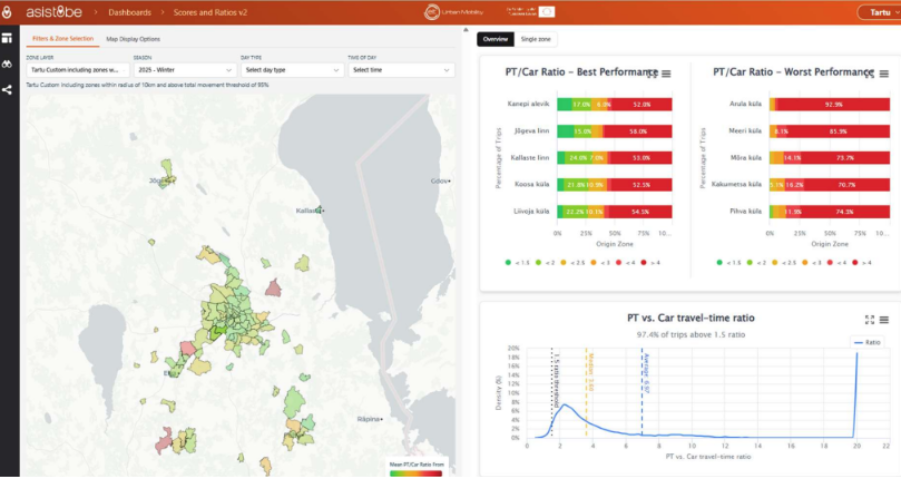
Asistobe’s user-friendly solution is able to supports transport planners to see how people are moving around by breaking their city map into a grid of small cells for greater understanding. It then draws on multiple data sources including GPS, mobile networks and passenger data, to see how people actually move between these cells.
“You need a much more granular model, because obviously people are moving differently in winter and summer, on weekends, or when there are football games,” Haveland pointed out.
One of the project’s partner cities was looking to develop a large new residential area and thus needed to predict mobility demand scenarios for its future inhabitants. The startup worked with the city to enhance their strategic planning by exploring what data was available, assessing its quality and utility, and uncovering valuable insights.
“If you are using a bad data source then you’re almost blindfolded. With our platform we are changing how people view how people move,” Haveland underscored, “When I started in the public transport industry around 20 years ago, I think we revised the network every 10 years. But during COVID, we learned we needed to change faster, and it proved that we could change faster. Then we just kept that momentum.”
The platform can offer numerous insights including which transport modes people use and the duration of journeys, which can highlight previously unknown weaknesses in public transport systems.
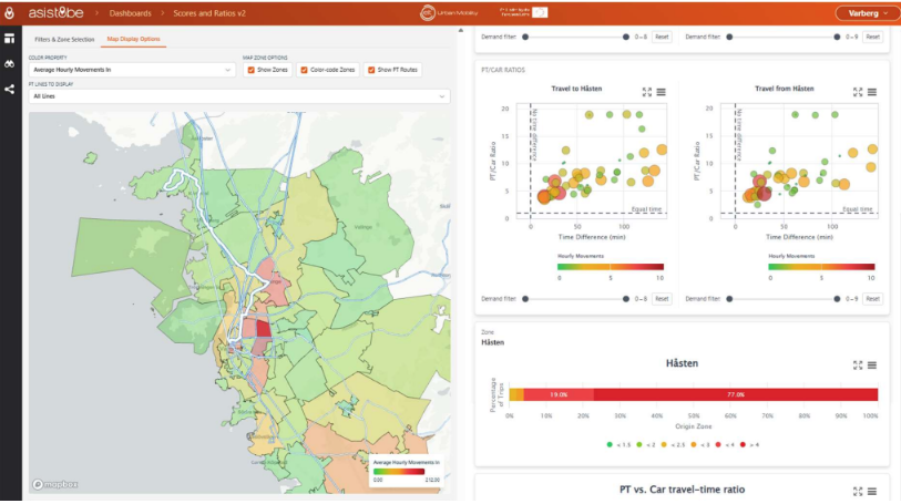
It also allows planners to see where they should take practical actions like reallocating resources or reducing car traffic. Planners can see, for example, if they should change a 50-minute frequency bus line down to seven minutes due to demand, or whether they should extend or shorten a line.
These tweaks can deliver considerable savings in cost and efficiency, and the platform can help planners define whether they would see a justifiable increase in revenue for their desired changes.
Global ambition
“The funding from EIT Urban Mobility was crucial. We couldn’t have done the project without them,” Haveland highlighted, “The project made it possible to test our solution throughout Europe in five different countries. Now we’re working with many different data sources,” he added. Input from different cities also enabled Asistobe to improve its offer further, including streamlining the on-boarding process.
When it comes to scaling up, the startup sees a large available market among small- to medium-sized cities that lack the internal capacity to create their own mobility models.
“Now we’re onboarding Edinburgh and we’re onboarding German cities based on what we built for this project. And we are getting help from EIT Urban Mobility to reach out to new cities with this new software,” Haveland reported.
Asistobe has global ambitions. The team recently held meetings in Japan and have more set up in North America. It has also collaborated with Deloitte to develop technology to compare public transport in different cities. The goal is for this tech to feed into a future global ranking website, with initial plans to complete this for 25 European countries.
“Funding of public transport is more and more difficult for every city to prioritise, and I think they are all keen on getting a much better understanding of how people are really moving,” Haveland stressed.