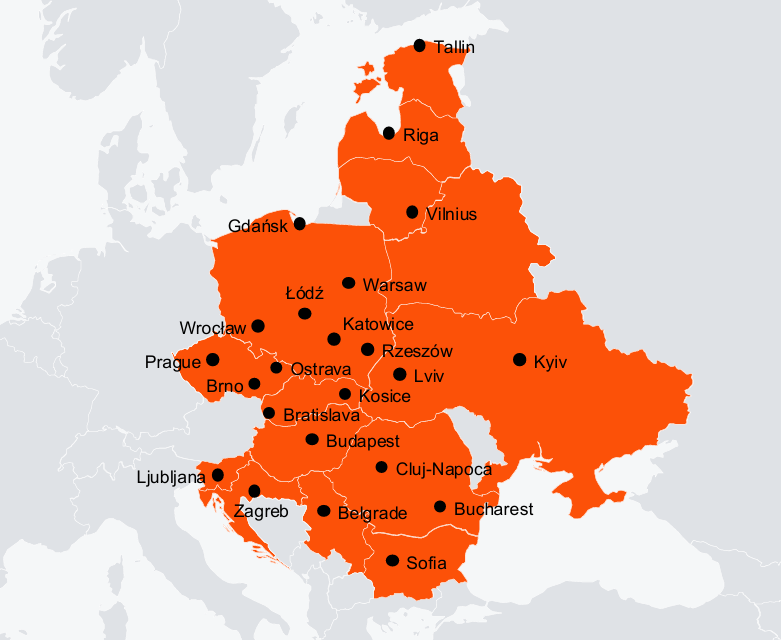
How are CEE cities preparing for the next phase of urban mobility? A new study looks at how 18 cities across Central and Eastern Europe (CEE) are preparing for the next phase of sustainable urban mobility.
New rules for urban mobility, different starting points
Planning for sustainable urban mobility is no longer optional. Under the revised Trans-European Transport Network (TEN-T) Regulation, 431 cities designated as urban nodes have to adopt a Sustainable Urban Mobility Plan (SUMP) by the end of 2027. A SUMP is a long-term plan that covers passenger and freight transport across the whole city region. Air quality rules are also getting stricter: the revised Ambient Air Quality Directive sets new limits for 12 pollutants, to be met by 2030.
The study draws on interviews with local authorities from 18 cities in 11 countries. Most cities treat mobility planning as a high priority. However, their ability to fund and deliver their plans differs from city to city. The study covers five areas:
- governance and social engagement
- data, digital and artificial intelligence (AI)
- funding and financing
- competitiveness, resilience and security
- environment
Strong plans, but funding lags behind
Five cities recognised
The Sprint was launched on 23 September 2026 at the New Mobility Congress in Katowice. Five cities received special recognition for innovative smart mobility solutions: Rzeszów, Prague, Bratislava, Ljubljana and Riga.
For instance, Prague was recognised for making its public transport facilities more energy efficient. Bratislava was recognised for starting a joint SUMP for its metropolitan region together with local, regional and national partners.
And what about Riga, Rzeszów and Ljubljana? The full CEE Smart Cities Mobility Sprint 2026 tells their best practices, shared challenges and the opportunities ahead.