For passengers wanting to get around their cities quickly and comfortably, bus overcrowding can mean more than just discomfort. Overcrowding can mean little chance of a seat, extended waiting and journey times, or even denied boarding.
Sofia-based enterprise, Theoremus targets overcrowding, on-time performance and overall service reliability with its AI passenger crowding measurement technology, supported by EIT Urban Mobility’s BCMS project.
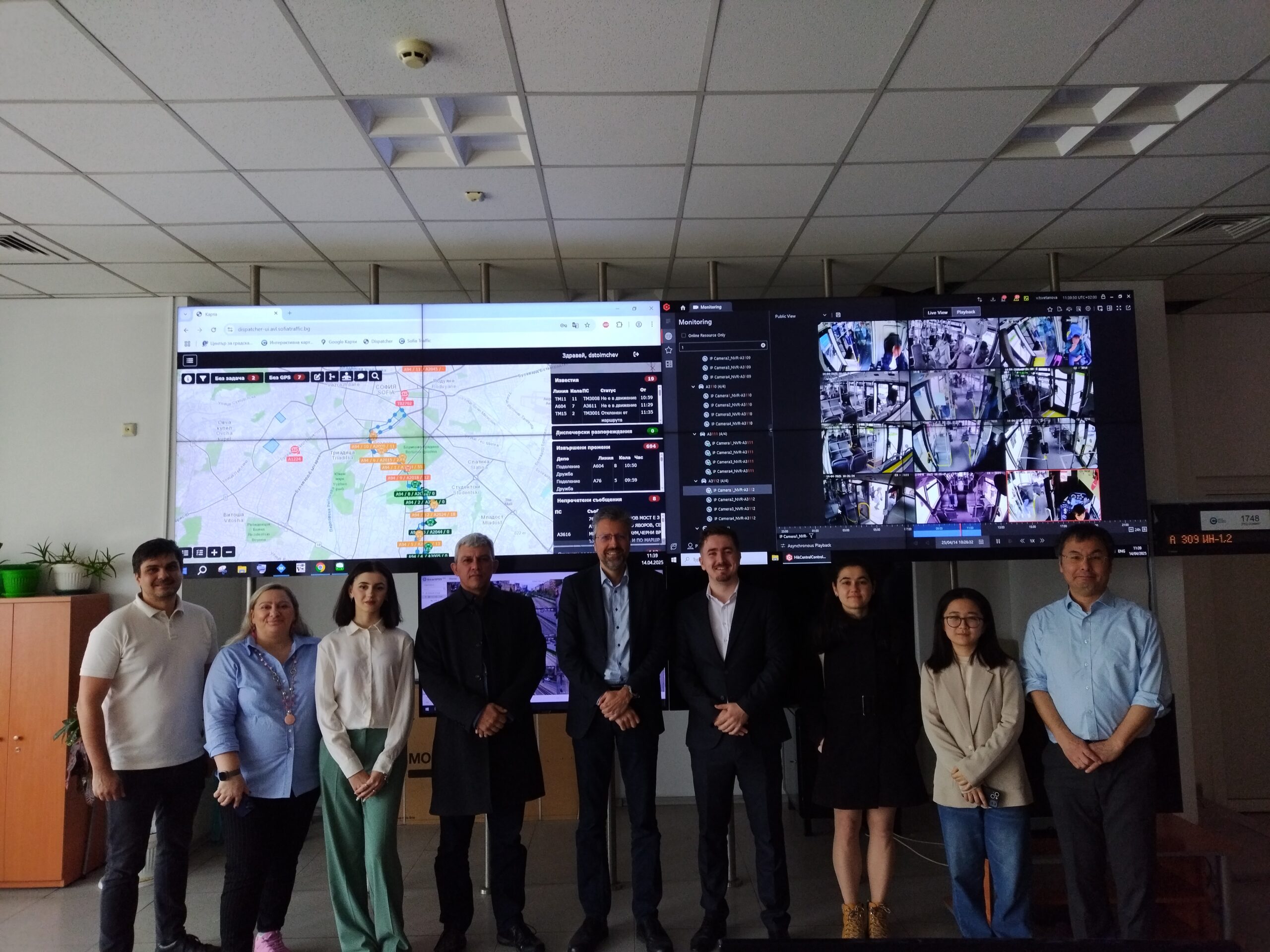
The solution was piloted with bus fleets in the Bulgarian and Romanian capitals, Sofia and Bucharest, and supported by a team of data scientists from University College London.
“A lot of cities are using systems that were developed 10 years ago in software language that probably isn’t utilised much today. So, a lot of that UI, usability, and understanding of what people want to see in their systems is more limited. So, our platform has had a really positive reception,” highlighted Matthew Kendrick, Theoremus’ Business Development Partner in the United Kingdom.
By making bus journeys more reliable, more punctual and more comfortable, the solution can help cities grow the number of passengers opting for sustainable public transport.
“Things like knowing when your bus is going to arrive and when it’s going to get somewhere can improve your impression of the journey by about 33%. As a result, we feel that our journeys are shorter than they actually are,” Kendrick explained
Granular detail
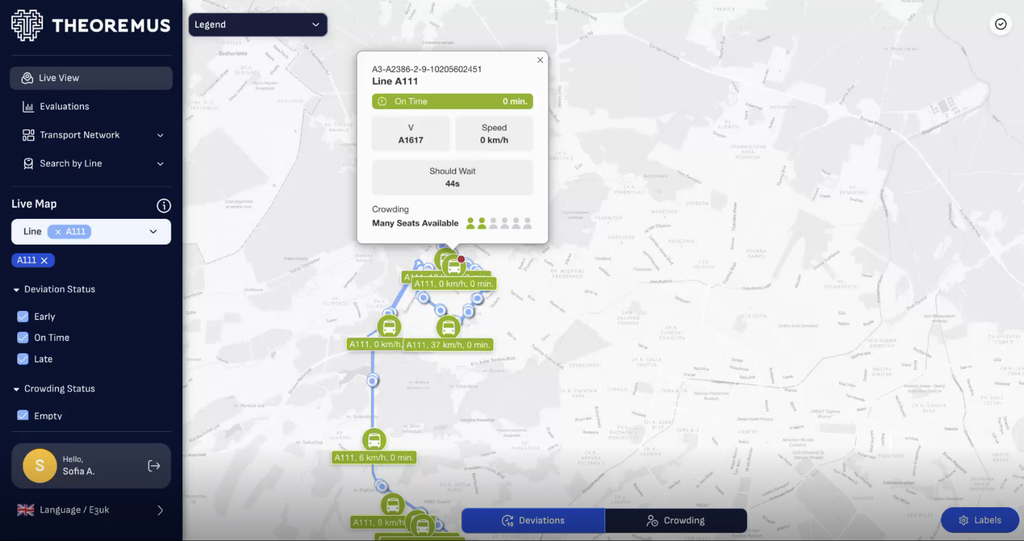
The data analytics-driven insights allow cities to see new possibilities for service improvements. Platform users can simply click bus icons on the map to see in a vehicle’s speed, how crowded it is, and whether it is running on time in real time.
This transparency can help operators avoid one of their biggest problems: bus bunching, when one vehicle is packed with passengers while the one behind is almost empty.
Another key feature is the intervention function. If a bus network experiences bunching, the system can detect it, trigger an alert, and offer recommended actions to even out the flow of vehicles, such as requesting a longer pause at the next stop.
Additionally, operators can zoom in to capture precise, granular detail: deviations from scheduled times, specific segments of the line where buses run ahead of schedule, or which parts of which routes could achieve time savings with minor adjustments.
“It’s a very low-cost option for a rapid improvement of your services and of your customer experience,” noted EIT Urban Mobility Innovation Lifecycle Officer Pavel Vrba, “We are not just talking about convenience or comfort; we are also talking about security, the overall experience, and the motivation to not use a car but use public transport instead. The city where you can move easily is the city where you would like to live.”
The system’s segment-by-segment analysis helps operators make tangible differences to passenger journeys, improving the image of public transport stop by stop in cities while increasing ridership.
Environmental gains
These efficiency gains have a positive impact on the environment. Advanced data analytics from the platform can help operators see, for example, where increasing bus speed by five minutes could save 100 bus hours over a year, translating into meaningful CO₂ emissions and operating cost savings.
The retrofit-friendly, modular solution is also cost-effective for operators. It uses existing bus hardware, adding only a software layer on top, allowing operators to bring ageing fleets up to speed.
“A lot of these analytics and monitoring solutions are usually coupled together between hardware and software. And they’re usually for long periods of time, more than 10 years or so,” Kendrick pointed out, “When you buy something back in 2010 that runs until 2020, the world’s a very different place between those two times.”
Thanks to platform data, operators are better placed to make evidence-based decisions about future bus network developments.
Mobility zeitgeist
The project was run with support from local partners Societea De Transport Bucaresti, the Romanian Smart City and Mobility Association (ARSC), and the Sofia Urban Mobility Centre.
“It was really great to do that cross-border collaboration. We kicked off the project by going to Bucharest, Romania. We got a look inside the buses, saw how their hardware was set up and what any limitations were,” Kendrick recalled.
“I think EIT Urban Mobility is quite unique in that there is buy-in from all parties to get things done, and the support is present for success. They explain how the collaboration works and what each partner is doing. It makes the project such a pleasure,” he shared.
Theoremus is now in discussions to work out how to take the solution forward commercially and integrate it more fully into fleet operations.
Theoremus AD is also developing a corridor feature that would help cities identify problematic route segments that consistently cause bus delays and pinpoint opportunities for interventions, such as priority bus lanes.
“I think it’s something that is becoming more in the zeitgeist of operators to say, ‘hey, we need to figure out how to optimise what we’re using rather than just adding buses of cancelling routes based on average passenger miles,” Kendrick underscored.
With GPS signals becoming more available, along with improvements in data transmission and data analytics, optimisation is expected to complement the introduction of zero emission buses. “Those two things will really push public transport forward,” Kendrick said.