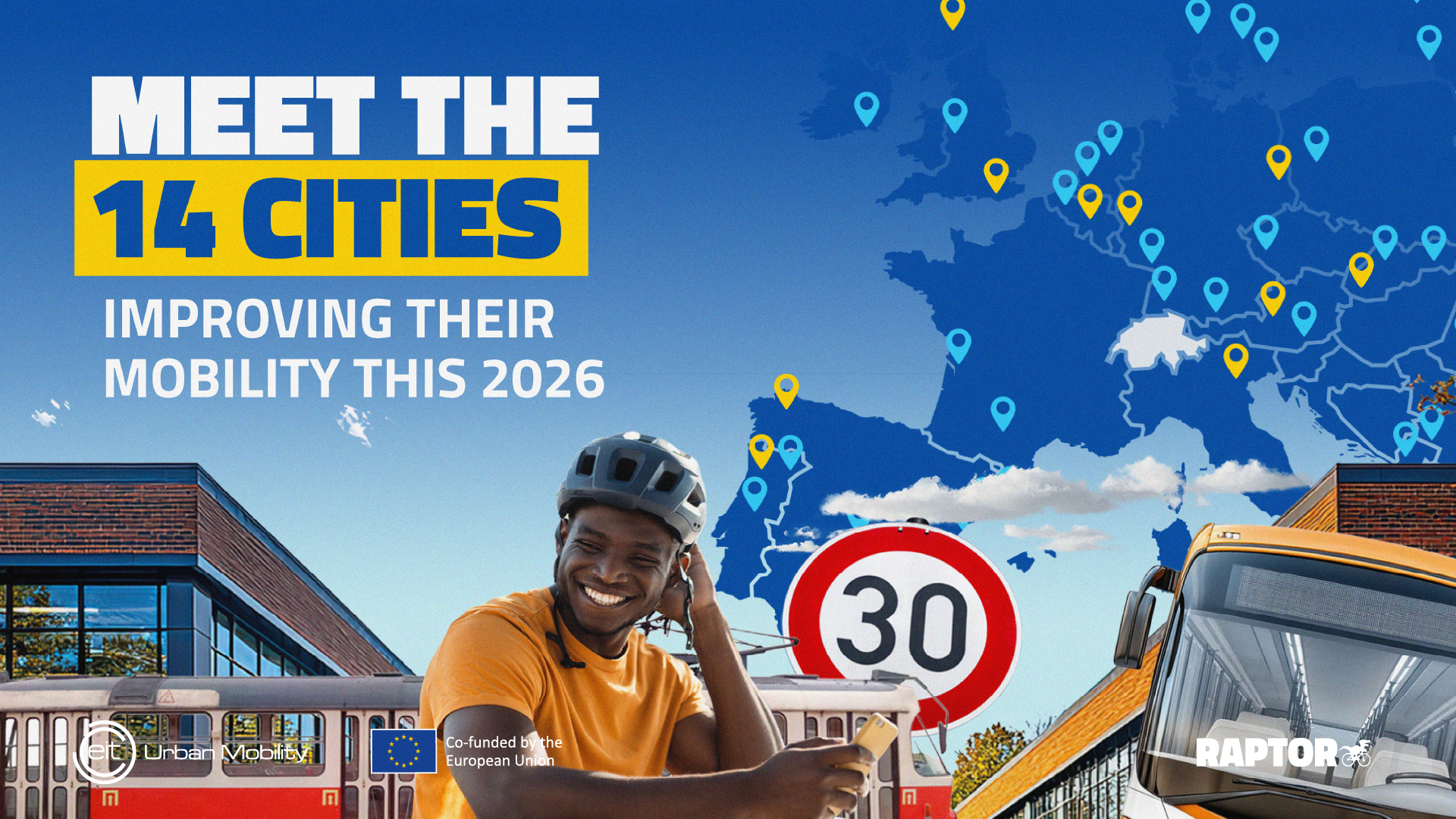
EIT Urban Mobility is excited to announce the selected startups and SMEs for the 2026 edition of its flagship RAPTOR (Rapid Applications for Transport) programme. This year, 14 European cities have selected innovative solutions to address locally identified mobility challenges, working directly with startups and SMEs to test them in real urban environments.
By opening their urban environments to real-world testing, participating cities are playing a leading role in accelerating mobility innovation. RAPTOR enables cities and startups to co-create, validate and refine solutions together. From electrification and active mobility to urban logistics, public transport optimisation, road safety, and data-driven decision-making, this year’s pilots reflect the diverse priorities of cities across Europe.
Adriana Diaz, Director of Innovation at EIT Urban Mobility, said:
“RAPTOR continues to demonstrate the power of collaboration between cities and innovators and the key role of agile innovation programmes. By focusing on locally identified challenges and enabling rapid testing in real-world conditions, RAPTOR helps cities access highly innovative solutions while giving startups the opportunity to validate and scale their innovations. Together, they are shaping more sustainable, inclusive and resilient urban mobility systems across Europe.”
A city-by-city look at the RAPTOR 2026 projects
Arteixo, Spain: Nommon Solutions and Technologies (Spain) will deploy a data-driven platform that combines mobility, accessibility and energy data to help the city identify optimal locations for future EV charging infrastructure, supporting smarter investment decisions and accelerating the rollout of electric mobility.
Bălți, Moldova: Zexsoft (Romania) will introduce a smart mobility platform providing real-time vehicle tracking, arrival predictions, occupancy estimates and service alerts to improve the reliability and passenger experience of the city’s public transport network.
Berlin, Germany: Initiative for Safer Roads (Germany) will deploy a platform that combines mobility and infrastructure data to identify the most frequently used school routes, helping the city prioritise targeted safety improvements for children travelling to school.
Brussels, Belgium: WTP Technologies (Serbia) will implement a solution that collects and publishes EV charging accessibility data, making it easier for drivers with reduced mobility and adapted vehicles to identify suitable charging points.
Edinburgh, United Kingdom: STAM (Italy) will deploy a data-driven parking management platform that enables differentiated parking charges based on vehicle weight and emissions, supporting fairer parking policies and encouraging more efficient use of public space.
Guimarães, Portugal: Carchain (Italy) will launch a platform that coordinates fresh-goods deliveries from the Municipal Market using the city´s shared electric logistics vehicles, reducing congestion and emissions through more efficient, consolidated deliveries.
Helsinki, Finland: Arkensight (Croatia) will deploy an AI-powered fleet monitoring solution that turns existing public fleet vehicles into mobile sensors, providing city authorities with continuous real-time insights to improve road safety, traffic management, and infrastructure planning.
London (Lambeth), United Kingdom: EYYA Group (United Kingdom) will introduce a platform combining AI, smart sensors and digital twin technology to optimise kerbside space and support safer, more accessible, people-centred streets.
Luleå, Sweden: Infrared City (Austria) will deploy an AI-powered platform that assesses wind and thermal comfort and ice risk across walking and cycling networks, helping city planners improve infrastructure while providing residents with safer and more comfortable route recommendations throughout the year.
Lviv, Ukraine: Loki (Italy) will implement a solution that uses AI-powered cameras and geospatial mapping to create a live digital inventory of traffic signs and road markings, enabling faster maintenance and more effective road safety management.
Nitra, Slovakia: Flowy (Italy) will deploy an AI-powered passenger monitoring system that uses passive Wi-Fi sensors to estimate occupancy levels and travel patterns, providing transport authorities with better data to optimise public transport operations.
Salzburg, Austria: Bikewave (Spain) will test a digital platform that streamlines the management of shared municipal bikes and light electric vehicles, making sustainable staff mobility easier while reducing reliance on private cars.
Trento, Italy: Superurbanity (Italy) will pilot a digital cycling navigation service that combines data on traffic, lighting, infrastructure, weather and topography data, helping cyclists choose safer and more comfortable routes while generating valuable insights for future cycling infrastructure planning.
Wiesbaden, Germany: Dencity France (France) will implement a smart curbside monitoring solution that provides real-time insights into loading zone usage, supporting more efficient urban logistics and freight operations.
Looking ahead
The projects will run from July to December 2026, during which startups and cities will work closely together to test, refine and validate their solutions in real-world conditions and each city´s challenge.
The RAPTOR programme highlights the value of collaboration between cities and startups in addressing urban mobility challenges. By testing innovative solutions in real-world conditions, participating cities gain access to new approaches that can inform future policy and investment, while startups generate the evidence needed to scale their innovations across Europe.