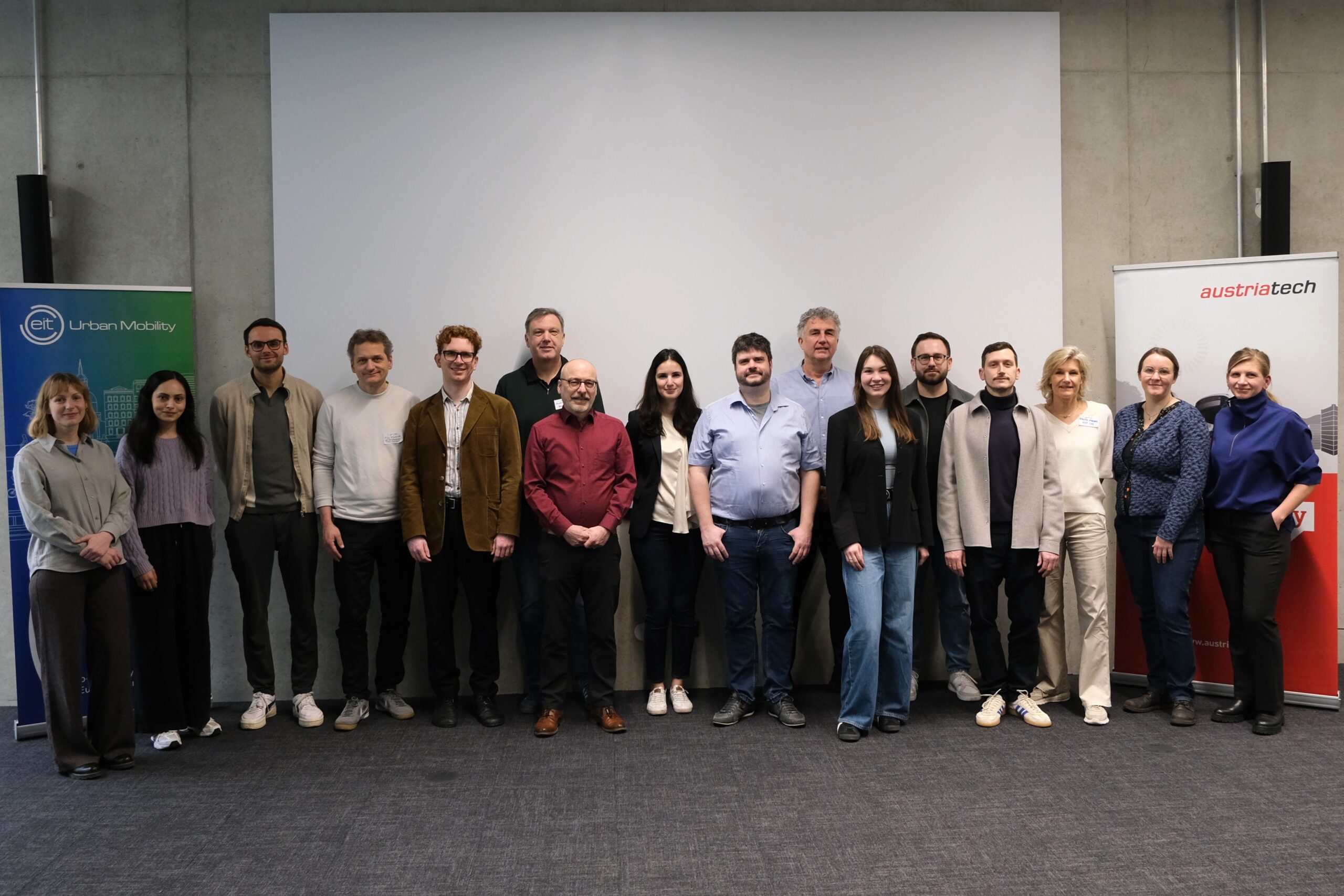
A two-day expert workshop brought together city authorities, public transport operators, research institutions and experts on autonomous mobility from Austria and Germany to map the barriers and chart a path forward for deploying automated driving systems in urban areas.
Participants from Bogestra (Public Transport Operator Bochum), City of Bochum, City of Hannover, City of Munich, DEKRA, DLR, Graz Holding (Public Transport Operator Graz), Region Vorarlberg and SteuernLenkenBauen (Project Management Hannover) convened under the facilitation of EIT Urban Mobility and AustriaTech, with Munich, Graz and Turin presenting their current agendas and POLIS and the European Commission providing insights into the European perspective. Working across structured group sessions, the attendees identified the most pressing technical, operational and regulatory obstacles and explored what coordinated action at the European, national and local levels could look like.
The consensus was clear: the technology is moving, but the surrounding ecosystem – e.g. governance, funding, procurement, and type approval – has not yet caught up. The following five areas crystallised as the key challenges and opportunities.
1. The vehicle and type approval gap
No EU-type-approved automated bus currently exists – and that is the single biggest blocker to scaled deployment.
Every automated bus operating in Germany and Austria today does so with a safety driver on board. While pilots are underway in several cities across the DACH region, these remain mostly in test mode. A vehicle that can carry full passenger loads on a fixed line, without human supervision, has not yet received EU type approval under an Automated Driving System (ADS) framework.
The market compounds this problem. Most commercially available automated vehicles are small shuttles designed for low passenger volumes, while cities claim the need for full-size buses and long-term certainty on governance and funding. Manufacturers such as MAN are beginning to move in this direction, but the economics are challenging: automotive production lines become viable only at very high volumes, and the bus market – already smaller than the car market – risks being further fragmented by the rise of on-demand services. The question participants posed directly: should cities wait for a single manufacturer to deliver a complete solution, or is it time to rethink the model, separating vehicle hardware from the software stack and operating ecosystem?
Type approval also leaves unresolved a question of profound legal and commercial consequence: who is responsible when something goes wrong? The boundary between operator liability and manufacturer liability remains poorly defined, and until it is settled – either through regulation or through case law – it will continue to cast a shadow over investment decisions on both sides. Artificial intelligence, which underpins most ADS approaches, compounds this difficulty further. Because AI systems are inherently difficult to audit through traditional testing protocols, regulators face a conceptual challenge: how do you certify a system whose decision-making cannot be fully traced? This is where Technical Inspection and Certification (TIC) organisations – bodies such as TÜV and DEKRA – become indispensable: they are uniquely positioned to bridge the gap between regulatory intent and technical reality, developing the audit methodologies and assessment frameworks that neither manufacturers nor public authorities are equipped to produce alone. A promising approach: measuring outcomes rather than inspecting the algorithmic black box is gaining traction, but has yet to be formalised in EU-type approval frameworks.
A concern that cuts across both technology and policy is the provenance of the systems themselves. Automated driving technology developed outside Europe, and dependent on non-European data infrastructure, raises legitimate questions about data sovereignty and resilience. Several participants argued that a genuinely European approach – not merely to regulation, but to the technology stack itself – should be an explicit objective if public transport authorities are to retain meaningful control over the systems they operate.
2. Operational readiness: from safety drivers to remote control centres
The transition from supervised pilots to genuinely driverless operation requires a wholesale transformation of how public transport operators work.
A crucial step is the shift from on-board safety personnel to remote control centres. This is technically feasible today, but it depends on a chain of prerequisites: city-wide secure data transmission infrastructure, standardised interfaces between vehicles and control systems, and a new professional role – the remote operator – for which no recognised training pathway yet exists.
Driverless operation does not eliminate the need for passenger contact, it transforms it. Similar to subway systems, interior monitoring, mechanisms for social security incidents, and remote assistance capabilities become essential substitutes for the human presence previously provided by a driver. Inclusivity is equally non-negotiable: ensuring accessibility for all passenger groups, including those with mobility impairments, visual or cognitive disabilities, or limited digital literacy, must be designed into the operational concept from the outset.
A structural tension surfaced repeatedly during discussions: most vehicle manufacturers retain operational sovereignty over their systems and are currently unwilling to hand control to transport operators. Therefore, public transport companies cannot run their own control centres, reducing their incentive to invest in and champion these projects. Participants argued that resolving this question of operational sovereignty is as important as the vehicle technology itself and that interoperability between different manufacturers’ systems remains an unsolved prerequisite.
Cybersecurity represents a further underappreciated risk. Manufacturers have not yet systematically addressed the vulnerabilities that come with permanently connected, automated and remotely operated vehicles. As fleet sizes grow, this will become an increasingly critical concern – one that will likely require regulatory pressure to resolve.
3. Infrastructure: the physical layer that is often overlooked
Automated buses do not operate in isolation – they depend on a physical infrastructure that is, in most cities, not yet ready for them.
The technical demands of automated driving extend well beyond the vehicle itself. Vehicle-to-everything (V2X) communication enables buses to interact in real time with traffic signals, other road users, and road infrastructure. This requires substantial investment in the roads, intersections, and satellite systems they depend on – currently, those investments are not being made at the necessary scale. HD mapping presents a related challenge: the high-resolution spatial data that automated systems rely upon must be continuously updated to reflect construction sites, lane changes, and other dynamic conditions.
Depot structures present an equally concrete challenge. They must be redesigned to accommodate vehicles that navigate and park autonomously. Also, charging processes for electric autonomous vehicles require integration into both the operational schedule and the built environment – a logistical challenge growing more complex at scale. These physical requirements are rarely factored into early-stage feasibility assessments, yet they represent some of the longest lead times in any deployment programme.
4. Procurement and market structure
Public procurement frameworks were not designed for technology that does not yet fully exist – and the mismatch is creating a structural impasse.
Transport operators face a dilemma: they can tender for a complete, operational automated bus system, but no European supplier can credibly bid for such a tender today. Alternatively, operators can procure vehicle hardware and software separately, but this creates integration challenges and contractual complexity that most procurement teams are not well-equipped to handle. Meanwhile, ready-made automated vehicle solutions are increasingly available from manufacturers outside Europe, particularly in China, raising questions about supply chain resilience and the strategic importance of building European capability in this space. Leasing models, which would allow operators to access vehicles without long-term capital commitment, are often excluded from public subsidy frameworks – a constraint that discourages experimentation at a moment when experimentation is most needed.
Participants identified interface standardisation as a prerequisite for coherent procurement strategies. When different tenders award contracts to different manufacturers, interoperability between fleet management systems, control centres and ticketing platforms cannot be taken for granted. Without agreed standards, every new project risks becoming a closed, proprietary island.
5. Governance: acting across three levels simultaneously
Progress on automated public transport requires coordinated action at EU, national and local levels – yet each level currently faces its own bottlenecks.
At the European level, implementing regulations such as 2022/1426 provide a useful basis, but the absence of a fully harmonised type approval framework – one that bridges UNECE regulations, EU requirements and national conditions – means that a vehicle approved in one member state cannot automatically operate in another. National frameworks should be harmonised to a meaningful extent, or mechanisms for mutual recognition established, to facilitate cross-border deployment.
Investment in a shared European technology stack for automated public transport remains insufficient, and funding is spread too thinly across too many small-scale initiatives. This coordination challenge extends to adjacent regulatory frameworks: the AI Act, which governs the ethical deployment of automated decision-making systems, and the Data Act, whose provisions on data access and sharing, have direct implications for how automated transport systems can be designed and operated. These interdependencies are not yet resolved on European level.
At national level in Germany and Austria, there is limited funding for pilot projects and model regions operating only at small scale. Test permits in Germany are issued by the Kraftfahrt-Bundesamt (KBA) on a case-by-case basis, resulting in slow processes and the question of who is responsible for ongoing technical supervision of automated fleets remains unresolved. A further constraint is becoming increasingly apparent: national public funding is reaching its limits in this domain precisely because automated driving software is becoming sufficiently mature to be considered commercially viable. As the technology crosses the threshold from research to market, the expectation is shifting from public investment to private risk-taking at a moment when the regulatory and operational frameworks needed to attract that private investment are still being established.
At city level, approval authorities are not fully prepared for ADS operating permit applications, and cities should plan for approximately one year of lead time for each. A more immediate concern is the emergence of robotaxi services, which cities are finding difficult to regulate effectively: minimum pricing rules exist in principle but have proven hard to enforce in practice. If robotaxis offer a more comfortable experience than conventional public transport, they risk drawing away passengers – a competitive dynamic that cities need to anticipate, and also an opportunity to explore how autonomous ride-hailing could complement rather than compete with automated bus networks.
Underlying many of these local hesitations is a broader political discomfort that participants were candid about: elected decision-makers remain deeply uncertain about autonomous vehicles because the ethical and legal consequences of accidents involving ADS are unresolved and controversial. Until clearer liability frameworks exist and public discourse matures, many politicians will be reluctant to champion these projects – making leadership at the city level as much a question of political will as of administrative capacity.
Conclusions
- Close the type approval gap – urgently and collectively. A coordinated input from transport authorities, cities and manufacturers is needed to develop a workable ADS certification framework that handles AI-based systems without requiring full algorithmic transparency, and that is explicitly aligned with the AI Act and Data Act from the outset.
- Separate the vehicle from the ecosystem. Cities and operators should explore models that decouple vehicle hardware from the software stack, control centre infrastructure, and service integration layer. This opens the market to more participants, gives operators greater sovereignty, and requires standardised interfaces across vehicle, control and ticketing systems as a baseline condition.
- Resolve operational sovereignty, not just vehicle technology. Manufacturers retaining control over vehicle operating systems is a structural obstacle as significant as the technology itself. Procurement conditions and regulatory frameworks should mandate open, standardised interfaces that allow public transport authorities to govern the services they are responsible for.
- Get ahead of cybersecurity before scale forces the issue. As fleets grow and vehicles become permanently connected and remotely operated, cybersecurity becomes a critical infrastructure concern. Proactive security standards covering the full operational lifecycle should be developed now, in parallel with type approval frameworks.
- Invest in the workforce and design for all passengers from the outset. Remote operator roles need recognised training and certification pathways – this cannot be left to individual operators to solve alone. Accessibility for all passenger groups must be treated as a design requirement from the start, not retrofitted later.
- Build public and political trust as a precondition, not an afterthought. Political hesitancy is a genuine blocker. Clearer liability frameworks – establishing responsibility between operators, manufacturers and authorities – are needed to give decision-makers the confidence to act, alongside visible demonstration projects that build public familiarity.
- Coordinate and consolidate across cities and across borders. A structured European approach with shared methodology, pooled learning (e.g. model regions), and sufficient scale to be meaningful to manufacturers is needed. European technological sovereignty in automated public transport – covering infrastructure, data systems and software – should be an explicit policy objective.
- Anticipate and integrate robotaxis early. Cities are not yet ready to regulate or absorb robotaxi services, which risks modal shift away from public transport unless they are proactively governed and integrated into the wider mobility system as a complement rather than a competitor.