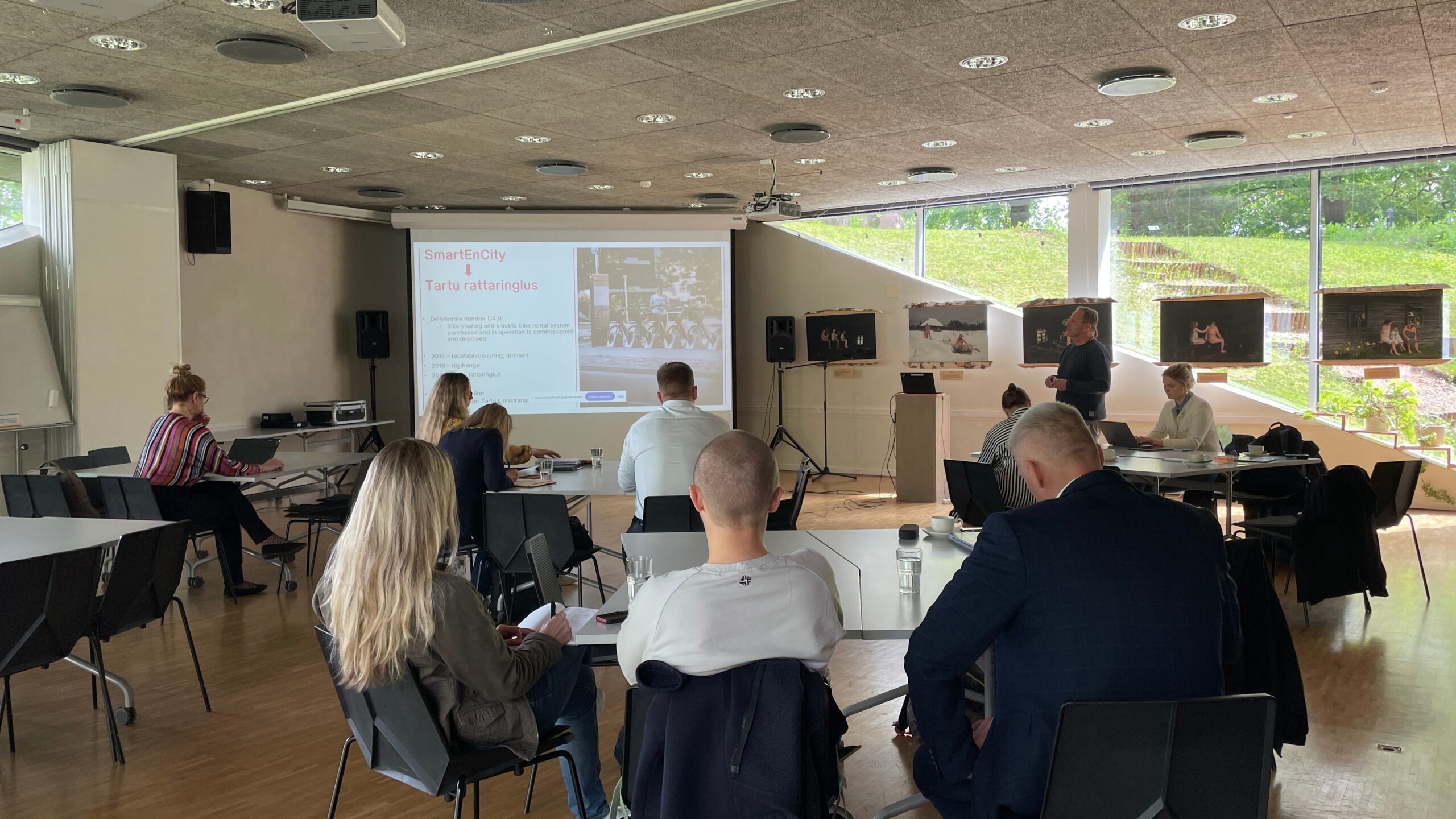
Procuring innovation in mobility and transport remains a significant challenge for many cities and regions in Europe. In 2025, a series of workshops in Estonia brought together public and private stakeholders to explore this issue as part of a new initiative by EIT Urban Mobility, Estonian Business School and Estonian Cleantech Association.
The initiative arose from a clear and shared need: Estonian cities and municipalities require stronger and more confident approaches to mobility innovation procurement. Three in-person workshops created a space to exchange knowledge, identify gaps and map the key actors involved. The outcomes later informed the panel discussion “Accelerating innovation procurement for green urban mobility” at Impact Day 2025 on 9 October 2025.
What is innovation procurement?
Innovation procurement enables the public sector to access new and advanced solutions that meet medium- and long-term needs. It generally takes two forms: Pre-Commercial Procurement supports the development of solutions that do not yet exist, while Public Procurement of Innovative Solutions allows authorities to purchase innovations that have already been tested.
Innovation procurement in the Estonian context
In recent years, the Estonian government has adopted strategic public procurement as a policy tool. Innovation and sustainability feature strongly in its laws and strategies. The Public Procurement Act (2024), for example, encourages the use of innovative, sustainable and social criteria in tenders.
Public authorities receive support from the Estonian Business and Innovation Agency (EIS) and InnoFund, a public sector innovation programme. These organisations offer guidance, co-financing and practical tools. EIS also provides technical resources such as the “Innovation Procurement Handbook.”
Key constraints holding back innovation procurement
Despite strong strategic intentions, smaller Estonian cities often face constraints in capacity, expertise and risk appetite for innovation procurement compared to larger cities.
“We often have the fear of making mistakes or failing, especially when EU funding is involved, and that’s a big barrier,” said Kati Eller, Head of the Public Procurement Department at the State Shared Service Centre, during the Impact Day panel, suggesting that the risk of legal disputes or political backlash can stifle efforts to pursue innovation procurement.

Missing knowledge platforms and gaps in long-term support
Participants in the workshops also noted the lack of a central platform to gather information on solutions, suppliers, pilots and successful projects in Estonia. Without such a resource, teams repeat work and overlook opportunities to build on existing efforts.
A mismatch between long-term innovation processes and short political terms can further hinder experimentation, making sustained political support essential. As Eller noted, “There has to be a safe environment […] even if we fail, it’s okay, because failing is part of every innovation process.”
Recommendations for a stronger innovation ecosystem
Through the workshop discussions, the organisers and participants developed several recommendations for how to strengthen innovation procurement in Estonia.
One of these recommendations calls for the establishment of a national competence centre for innovation procurement, along with an export marketplace, to help collect knowledge on national cases and provide advisory services, including information on available solutions and relevant stakeholders.
This is also about encouraging cities to engage more in innovation procurement, said Jaanus Tamm, Project Manager at Tartu City Government, during the panel discussion at Impact Day 2025: “I think [support for the municipalities] will raise motivation because it will feel more secure during such procurements.”
Funding innovation from idea to scale
Another recommendation calls for a pilot and scaling fund to support innovation across its entire lifecycle, from early ideas to pilot projects and scaling solutions. Consistent funding would reduce the risk of so-called pilot graveyards where promising solutions struggle to grow from piloting to procurement.
Cooperation across borders is another important recommendation. Joint innovation procurement within the wider Nordic-Baltic region and the European Union would reduce risk, help avoid duplication and speed up access to effective solutions. EIT Urban Mobility offers support tools that can strengthen these collaborations, such as the RAPTOR programme.
Innovation procurement is more than a legal or procedural tool; it is an organisational capability that requires alignment across multiple dimensions. Practitioners are ready to engage in innovation when barriers are lowered and risk-taking is recognised.
Interested in learning more about the initiative? Download the recommendations in English and Estonian here.