Madrid gathers the European Commission, international experts, and public administrations around the DAVER project, the new regulation, and the first technical standard in the EU to measure vehicle emissions on the road.
Madrid, April 22, 2026. The remote measurement of traffic emissions is consolidating as one of the key tools to transform air quality policies in Europe. This was highlighted today during the conference “The Vehicle Emissions Remote Sensing Revolution in Europe,” held at the European Commission headquarters in Madrid.
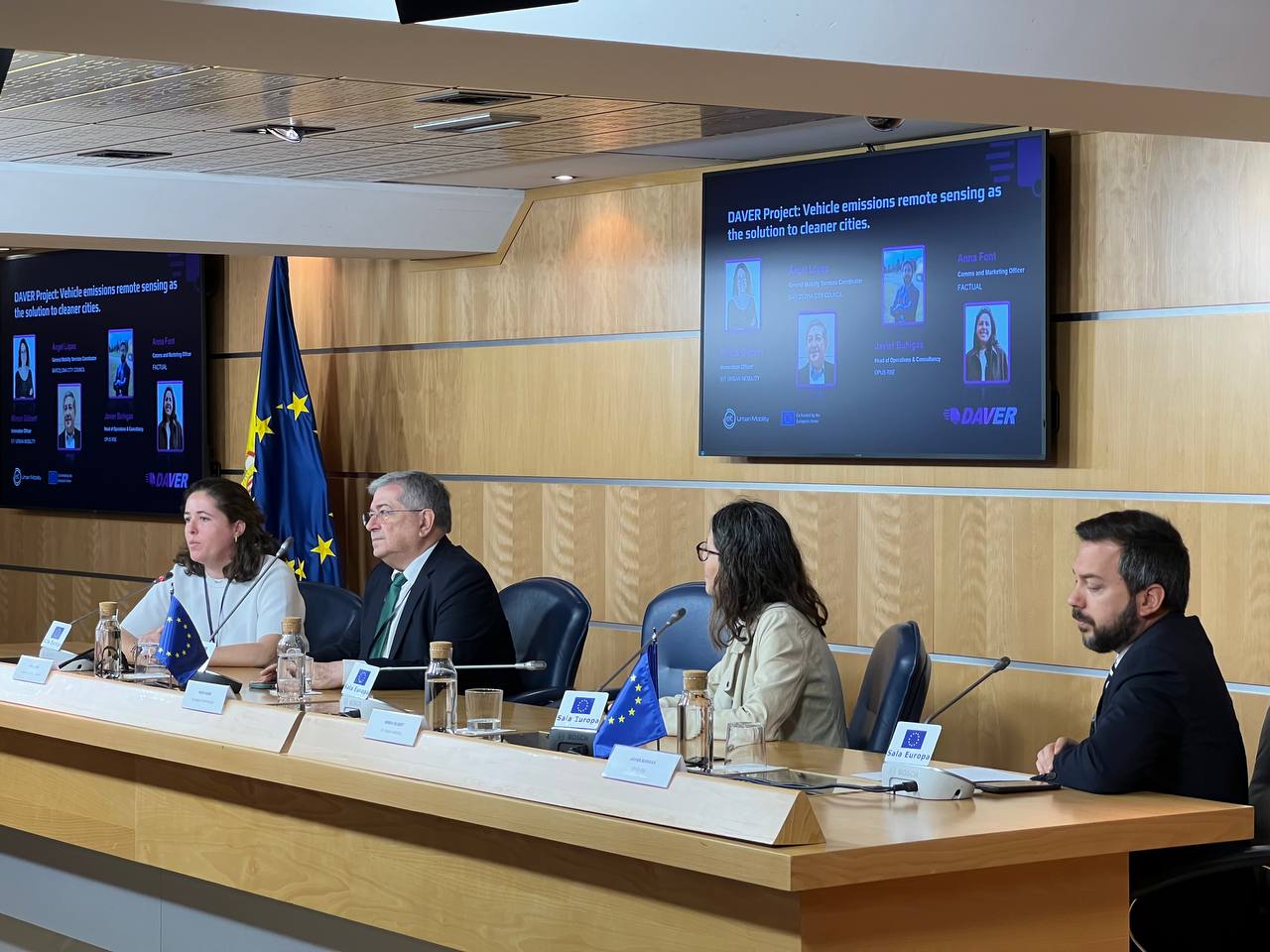
The meeting brought together European institutional representatives, public administrations, technical experts, and social entities to address a paradigm shift: moving from generalist controls to supervision based on real measurements of each vehicle in circulation. In this context, the European project DAVER (Data for Vehicle Emissions and Noise Remote Sensing) was presented; promoted by EIT Urban Mobility an initiative of the European Institute of Innovation and Technology (EIT), a body of the European Union, it aims to accelerate the operational deployment of remote sensing for emissions and noise in Europe. The project presentation featured participation from part of the consortium, including Javier Buhigas from OPUS RSE, Ángel López from the Barcelona City Council, Anna Font from FACTUAL, and Mireia Gilibert, representing EIT Urban Mobility.
A Regulatory Change Underway
One of the central axes of the conference was the evolution of the European regulatory framework. Peter Szatmári, policy officer at the European Commission’s Directorate-General for Mobility and Transport, presented the “Roadworthiness Package” legislative proposal, which introduces mandatory remote measurement of vehicle emissions to identify “high-polluting” vehicles on public roads in a non-intrusive manner. The legislative proposal is in its final phase of negotiation.
From the scientific field, Kaylin Lee, a researcher at the International Council on Clean Transportation (ICCT)—the entity that uncovered “Dieselgate”—highlighted the role of this technology in designing more effective and evidence-based public policies, especially in identifying so-called “high emitters.” For his part, Roel Vaneerdeweg, head of public policy at the Flanders Government Environment Agency, provided practical experience from the Belgian region, where remote sensing has already demonstrated significant emission-reduction results and where the plan is for a massive deployment to reinforce technical inspections (ITVs).
Identifying High Emitters: An Urgency in Europe
One of the most relevant data points discussed during the meeting is that a small portion of the vehicle fleet accounts for the majority of the environmental impact. It is estimated that around 2% of vehicles generate more than 40% of polluting emissions, reinforcing the need for more selective and evidence-based policies.
Remote sensing technology allows precisely that: finding the most polluting vehicles in real driving conditions without affecting traffic or the majority of drivers, acting only on the few vehicles that are truly the problem for atmospheric pollution. The DAVER project is presented as a large-scale implementation solution for Europe, enabling public authorities to use this technology in a simple, automated way with real impact on citizens.
Europe Decided, Spain at the Forefront
Europe is moving toward an environmental control model that is fairer, more efficient, and based on real data. In April 2025, the European Commission put forward a legislative proposal that requires all EU countries to equip themselves with these systems and conduct continuous surveillance on public roads to identify “high emitters.” This new legislation will radically improve emission control in Europe, with zero impact on responsible citizens.
On the other hand, Spain positions itself as one of the leading countries in this field, thanks to the approval of the UNE 82509:2026 standard and the development of RSD technology by Opus Remote Sensing, a Spanish company based in Madrid that manufactures the market-leading technology. The Spanish Metrology Center (CEM) presented the standard, consolidating Spain’s technical leadership in this field.
The conference also highlighted Spain’s role in this area. Matías González, Secretary General of the Ministry for Digital Transformation and Public Function, emphasised the Government’s commitment to promoting technologies applied to sustainable mobility.
Technology in Real Operation
The event included a real-time demonstration of remote vehicle emission measurement technology, which evidenced its capacity to operate continuously (24/7) and analyse each vehicle individually and accurately. These devices combine advanced optical spectroscopy systems for remote measurement of CO, NOx, HC, NH3, and PM for each vehicle, analysis of the noise emitted by each vehicle, and state-of-the-art artificial vision solutions, thereby enabling automated, total supervision of every vehicle on streets and highways.
Impact on Public Health: The Voice of Civil Society
The conference also incorporated social and health perspectives. Mariano Pastor, president of FENAER, along with Juan Ortiz (ECODES) and Ana Gutiérrez (ITS España), underlined the urgency of acting against traffic pollution. In Spain, atmospheric pollution causes around 25,000 premature deaths per year, making this problem one of the main threats to public health.
The institutional closing was handled by Santiago González Muñoz from the Ministry of Health, who highlighted the importance of integrating new technological tools into air quality strategies.
In Summary: A New Model for Europe
The institutional opening of the meeting, by Nikolaos Isaris from the Representation of the European Commission in Spain, set the tone for a day that consolidates the progress toward a fairer, more efficient environmental control model based on real data. The DAVER project, the new European regulatory framework, and technical standardisation configure a scenario in which Europe advances toward more precise policies, centred on the vehicles that truly generate the greatest impact while minimising burdens for the citizenry. These pillars consolidate a new inspection model in which vehicles will be evaluated not only during periodic ITV reviews but also continuously, remotely, and non-intrusively on the road.
About DAVER
DAVER (Data for Vehicle Emissions and Noise Remote Sensing) is an innovation strategy project co-funded by EIT Urban Mobility.
- Project Duration: January 2026 – June 2027.
- Total Budget: €1,529,056 (65% funded by EIT Urban Mobility).
- Consortium: Coordinated by FACTUAL Consulting, the work team includes OPUS Remote Sensing, Barcelona City Council, CERTH, MDAT, Homan-Brinkman / Sensedata, Gemeente Groningen, and Vinces Consulting.
- Visit the project’s website for more information