
While the end-of-year holiday season offers a peak in global logistics, the beginning of the year sees a surge of delivery traffic with consumers returning gifts and placing new orders. Due to this increase in ecommerce returns, city streets become congested and local air quality worsens. According to a 2024 World Economic Forum report, last-mile logistics, the final leg of delivery from an urban logistics hub to the customer’s doorstep, or from their doorstep back to the logistics hub, can comprise up to 30% of traffic in busy areas. Last-mile logistics in vehicles in urban areas not only account for a significant share of traffic, but are also projected to make up to a 54% share of the transport sector’s emissions, and 13% of overall city emissions by 2030, assuming a business-as-usual scenario.
As e-commerce continues to grow, with last-mile deliveries expected to increase by up to 78% globally by 2030, the challenge of reducing congestion and pollution becomes even more acute. Responding to these pressures, innovative startups and projects are developing solutions to decarbonise last-mile logistics across Europe.
Bruntor & GreenDASH: compact electric delivery scooters for city logistics
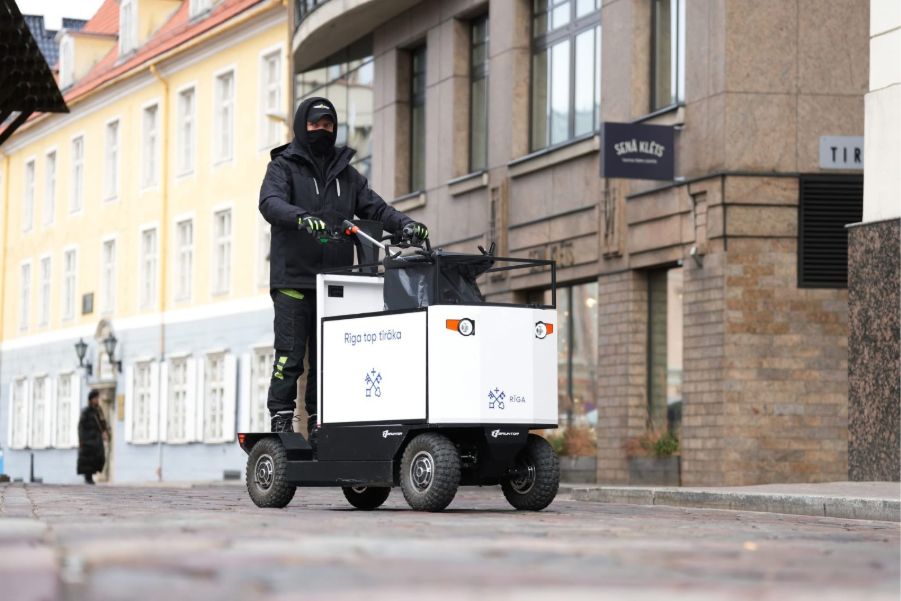
Bruntor, a Latvian startup with an innovative new electric scooter purpose-built for last-mile logistics allows delivery operators to navigate dense city centres more efficiently while reducing noise and air pollution. The scooter’s compact design and high load capacity responds directly to the challenges of urban delivery: congestion, limited parking and high emissions from conventional delivery vans.
From 2024-2025 GreenDASH project allowed Bruntor to collaborate with national postal operators including Denmark’s PostNord and Latvia Post to test the vehicle in real operational conditions in Aarhus and Riga. Supported by EIT Urban Mobility, the project enabled real-world validation and data collection, demonstrating how purpose-built electric scooters can outperform traditional vans in urban environments.
Moby Bikes & Spinovate: leveraging e-bikes for sustainable delivery
Irish startup Moby Bikes provides electric bike solutions for shared mobility and professional fleet use, including urban deliveries. Its e-bikes are designed for short, frequent trips in city environments where cars and vans are often inefficient and space-intensive.
By enabling deliveries via electric bikes, Moby Bikes supports a shift away from fossil-fuel vehicles for small and medium parcels, helping reduce congestion, emissions and noise while making better use of cycling infrastructure. With support from EIT Urban Mobility, Moby Bikes has also contributed to the Spinovate project, aiming to enhance micromobility fleets with connected sensor technology and advanced data analytics. This integration improves safety, route planning and fleet performance, strengthening the case for e-bikes as a viable logistics solution.
Loge-Hubs: smarter placement of urban logistics infrastructure
The recently completed Loge-Hubs project, a collaboration between ALICE (the Alliance for Logistics Innovation through Collaboration in Europe), Urban Radar, Las Rozas Innova, Braga Municipality and supported by EIT Urban Mobility focused on strategic planning and optimisation of logistics hubs within urban environments, recognising that infrastructure location significantly influences emissions and congestion. The initiative used real-time data and AI tools to map and optimise the placement of hubs, loading zones and delivery routes, improving the flow of goods across cities like Las Rozas, Spain and Braga, Portugal.
By integrating logistics real estate data, sensor inputs and city planning insights, Loge-Hubs worked to maximise efficiency and reduce unnecessary travel distances to improve both environmental and economic outcomes.
Moova: AI-driven optimisation for flexible deliveries
EIT Urban Mobility portfolio startup Moova is reimagining last-mile logistics through a digital platform that offers smart routing, AI optimisation and real-time tracking. While Moova’s operations span multiple global regions, its platform embodies key principles that can accelerate decarbonisation in European cities such as intelligent delivery planning, dynamic routing and integration with e-commerce systems.
By using AI-powered optimisation, the platform helps logistics operators improve delivery efficiency, reduce fuel consumption and better match supply with demand. The startup’s innovation demonstrates how smarter planning and coordination can significantly lower the environmental footprint of last-mile deliveries.
A multi-pronged strategy for more liveable cities
Last-mile logistics is a complex challenge requiring a balance of the needs of various stakeholders and city users. As e-commerce demand grows and cities continue to push for cleaner air and less traffic congestion, traditional delivery models must evolve.
The startups and projects highlighted here, from electric cargo scooters to AI-powered logistics platforms, showcase a holistic shift toward decarbonised last-mile logistics. By combining zero-emission vehicles, smart infrastructure, and digital optimisation, last-mile logistics operators can mitigate the negative externalities of congestion and pollution without compromising service.