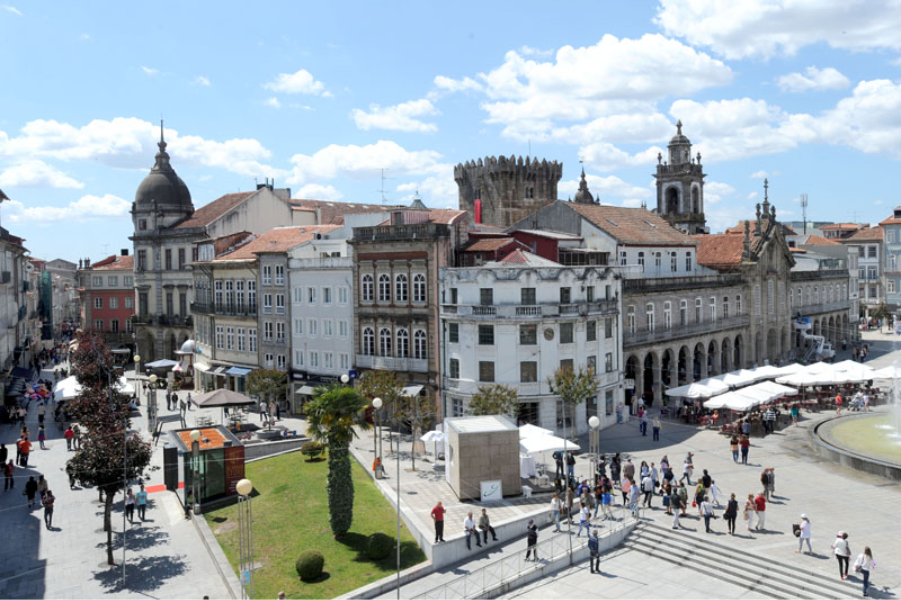
How can cities respond to continued car dominance while meeting residents’ needs?
For Braga — Portugal’s fourth largest city — embracing innovation and optimisation to promote active mobility has been key.
With support from EIT Urban Mobility, the city is in touch with startups and other forward-thinking companies from across Europe that want to implement mobility pilots to support urban change. And other cities are now coming to learn from Braga’s success.
“For us it was an opportunity to be put on the map as a city that wants to innovate. Most cities don’t have that opportunity to be a lab for startups,” noted Pedro Moreira, Head of the Transport Authority and Mobility Management Unit at the City of Braga, “We can select the startups that are most aligned with our strategy and the solution that we are looking for. They also offer new solutions for problems we didn’t know we had.”
Gamification
To help foster a culture of cycling, Braga hosted the EIT Urban Mobility-backed BICIFICATION. This 2022 pilot project — which also ran in Estonia and Türkiye — paired a smartphone app and Bluetooth-equipped bikes to reliably monitor everyday commuting trips of 400 bike users.
The project embraced gamification: for each kilometre cycled, users were rewarded with a €1 voucher to spend in local shops, capped at €30 per month.
With Italian startups Nextome and Pin Bike adding their location-intelligence expertise and gamification know-how to the mix, the city’s approach was an all-round hit. Some participants even competed to pedal to the top of the ‘most kilometres cycled’ ranking.
“There are a lot of cities that come to us to understand what happened with BICIFICATION,” Moreira highlighted.
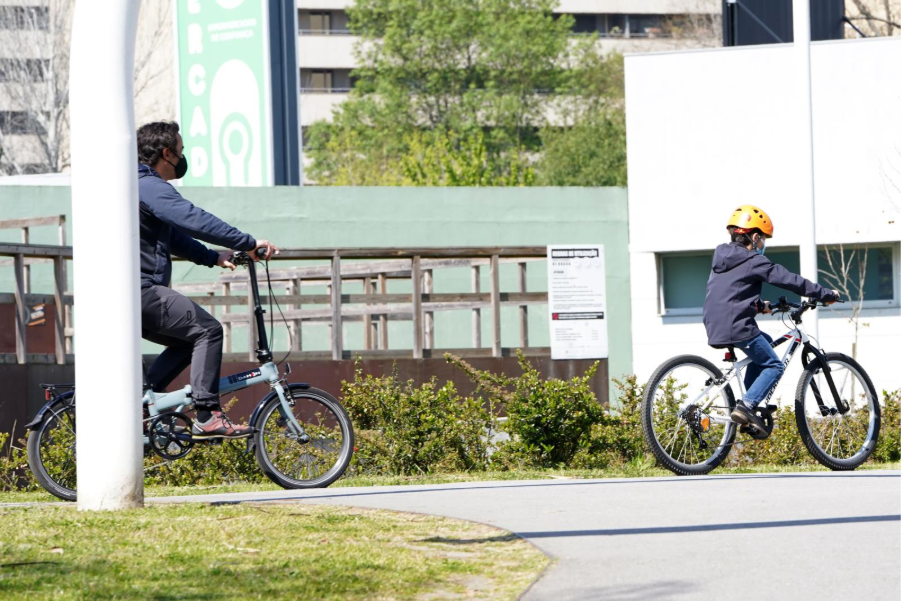
More than that, the pilot helped deliver lasting change. One third of participants who had not been frequent cyclists were converted through the pilot, becoming everyday bike-users.
“Because they were incentivised, they incorporated that behaviour into their everyday life. They discovered that cycling was much easier for them than using the car or even public transport,” Moreira shared.
Chain reaction
The city found using vouchers as a reward made a big difference. Their value was simple for users to grasp, and vouchers meant participants could get things they really wanted. Thus, the concept snowballed even further: many small local businesses experienced a surge in traffic with customers coming to spend the vouchers they had won.
There were other valuable findings too. Data from the app revealed that one of the city’s main avenues — that lacked any cycling infrastructure — was heavily used by participants during the pilot.
“That told us we needed to do something to make it much safer to cycle in Braga, so there was major construction work on that avenue. We changed it completely because the data from the application showed us that we needed to do that,” Moreira stressed. “Now we have cycle lanes, we have all the crossings very well designed for cycling, and that has made the avenue much more appealing for cycling than before.”
Logistics puzzles
In an era of home delivery convenience Braga is also focused on the urban logistics sector, increasingly present in urban areas, impacting residents’ daily lives. To help cut pollution and make cargo transport more efficient, Braga took part in the Standtrack pilot, supported by EIT Urban Mobility.
“At least 30% of movement in a city is for logistics purposes. And that’s been growing since COVID,” Moreira noted.
By focusing on the lack of collaboration among logistics actors, Standtrack developed a single-label solution for end-to-end parcel traceability.
“The product is market-ready and being used. Now it needs to scale to other companies so that this standardisation could be used all over Europe…For us it was very good to be part of the project because our local partners contributed to the standardization too. We were also engaged with Madrid and Milan,” Moreira reported.
The NIMBLE project, also aiming to create more efficient and sustainable urban logistics, enabled Braga to offer local businesses an alternative to van deliveries. The 2024 pilot was launched with support from EIT Urban Mobility and included Spanish partners CARNET, Smart Point, and the municipality of Esplugues de Llobregat in Barcelona.
“We have quite a large pedestrian area where we don’t want vans or trucks. So, we need to find a solution that works for both shop owners and the economy, as well as for sustainable mobility,” Moreira explained.
At the same time, the aim was to reduce the negative impacts of convenient home deliveries that can harm residents’ quality of life, such as congestion, noise, and air pollution.
In addition to the last-mile delivery service powered by cargo bikes, the city also set up a handy, centralised smart locker service. In the end, dozens of small stores integrated NIMBLE into their daily operations and the lockers helped cut delivery times, traffic, congestion and pollution.
NIMBLE also shed light on the hurdles that scaling presents, helping create a greater understanding within the pilot-environment.
New perspectives
“Nimble showed us that we didn’t know where the trucks came from, where they stopped, where they wanted to go,” Moreira reflected.
If NIMBLE highlighted that the city needed a better understanding of its own logistics needs, then LogE-Hubs was all about building a tool for finding answers.
Where should a new loading and unloading zone be created? Where is the most efficient site for a logistics hub? These are questions that are being addressed by data from the LogE-Hub platform, developed by technology partner Urban Radar piloted throughout 2025. The resulting data is expected to help Braga find more efficient ways of getting deliveries to local shops and residents and reduce both emissions and kilometres travelled.
“LogE-Hubs is helping us to change internal procedures and to look at logistics in a different way,” Moreira said, “We presented it to the shopkeepers’ association in the city and what they said was: ‘I know you have a lot of different innovation projects, but for us this one is the one that is going to make a difference in the future.’”
Brightest minds
Ongoing collaboration with EIT Urban Mobility has been a “game-changer” for Braga, Moreira highlighted. “It was an opportunity to collaborate with an organisation that is focused on at least three pillars: cities, companies, universities; and enabling startups to implement directly in cities…EIT Urban Mobility supported us a lot in this process of engaging with startups but also in learning from other cities.”
Moreira sees it as critical for cities to be involved with wider networks of like-minded municipalities, particularly for smaller cities who can get the chance to work with “brightest minds” in Europe. This networking, facilitated by EIT Urban Mobility, has supported Braga to discuss results of projects implemented in other cities and the prospects of trying them on home turf too.
“If we as technicians are not aware of what is being done in other places, we will always do the same things, and get the same results,” Moreira pointed out.
A living lab for future mobility
Braga’s urban mobility pilot projects have underscored how important tech-enabled optimisation will continue to be for the future of urban mobility. That means understanding “how the city moves and what we need to change to make it move better,” Moreira explained, including by tapping the potential of digitalisation and AI solutions.
Communication with residents, too, is critical for the city. “We have to change mentalities in Portugal,” Moreira emphasised, “If we don’t give residents information, they will never change their habits. So, we need to make mobility much more public, clear and understandable for people so we can change for the better.”