
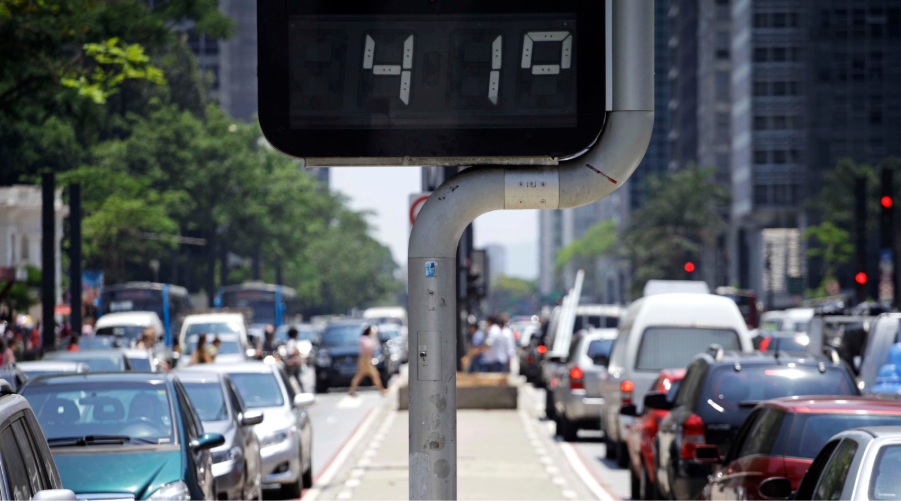
According to the World Meteorological Organisation at least 95% of Europe experienced above-average annual temperatures in 2025. As such, the World Health Organisation (WHO) recently published the second edition of their Heat-Health Action Plan Guidance for cities, urging action and explaining that “extreme heat is an urgent and growing public health threat, driven by climate change and exacerbated by urbanization and population ageing.”
While the WHO has focused on the impacts of heat and the need for public health response, its effects on urban mobility are also worth investigating.
High temperatures can significantly alter how people move through cities. As explained by the authors of research article Hot and bothered: Exploring the effect of heat on pedestrian route choice behavior and accessibility “The walkability of a city is affected by its thermal environment, whereby the outdoor thermal comfort for pedestrians plays a key role in determining the quality of urban life.” As such, walking and cycling rates often decline during periods of extreme heat, particularly during the hottest hours of the day. A recent study entitled Extreme heat reduces and reshapes urban mobility found that “mobility falls by as much as 10% on hot days generally and 20% on hot afternoons specifically, when temperatures peak.”
Thus, public transport users may change travel times to avoid uncomfortable conditions, while private vehicle use can increase as people seek air-conditioned alternatives. Heat can also affect transport infrastructure itself, causing rail tracks to buckle, roads to deteriorate and vehicles to operate less efficiently.
For transport authorities, these shifts create a major planning challenge as traditional travel patterns become less predictable when weather conditions influence mobility choices in real time. Demand can fluctuate across routes, modes and times of day, placing pressure on systems that were designed around historical travel behaviour rather than climate-driven disruptions.
To build climate-resilient mobility systems, cities need to move beyond reactive responses to develop tools that anticipate changing travel patterns before they occur. Advances in artificial intelligence, demand forecasting, digital twins and flexible transport services are providing new opportunities to adapt mobility networks to the realities of a climate change-impacted environment.
Understanding demand before it happens
As cities seek to anticipate changes in travel demand during extreme weather events, AI-driven tools such as Asistobe are enabling public transport operators to make more informed operational decisions.
The startup’s AI-driven platform analyses multiple data sources to optimise public transport operations, enabling operators to better understand passenger demand patterns and allocate resources more effectively.
Traditional transport planning often relies on historical data and fixed schedules. However, extreme heat can rapidly alter travel behaviour, making past patterns a less reliable predictor of future demand. By incorporating real-time and predictive analytics, AI-powered systems can identify emerging trends and help operators adjust services before overcrowding or underutilisation occurs.
This capability becomes increasingly valuable as climate-related disruptions become more common. Whether a heatwave causes passengers to shift travel times, avoid certain modes or seek alternative routes, predictive systems can help transport authorities respond proactively rather than reactively. Better forecasting tools that can account for dynamic environmental conditions alongside traditional transport data can enable more resilient and dynamic transport systems.
Flexible services for changing travel patterns
While forecasting helps cities understand demand, flexibility is equally important when travel patterns become less predictable.
Demand-responsive transport offers one potential solution. Unlike traditional fixed-route services, demand-responsive transport systems adapt routes and schedules based on real-time passenger requests. Through digital platforms, users can book journeys when needed, allowing operators to deploy vehicles more efficiently and respond to fluctuating demand.
The DigitalBus project, supported by EIT Urban Mobility, explored how demand-responsive transport can complement conventional public transport networks. By matching services more closely to actual demand, demand-responsive transport can improve accessibility while reducing operational inefficiencies. Demand-responsive systems could also be targeted to provide services for vulnerable populations who may face greater health risks during heatwaves. Offering ‘closed’ or ‘co-mingled’ demand-responsive transit options for specific groups is already a common practice, explains the International Association of Public Transport in their knowledge brief – allowing for flexibility tailored to the needs of certain populations and ensuring that safe access to essential services remains available to these groups.
Expanding modal choices through water-based mobility
Climate adaptation is not only about improving existing transport systems; it can also involve expanding the range of mobility options available to residents.
Across Europe, many cities possess rivers, canals and waterfront infrastructure that could support passenger transport, yet urban waterways often remain underutilised.
Several innovative solutions are already demonstrating how waterways can become a meaningful part of urban mobility networks. Finnish startup Bout has developed a platform that connects passengers with boat operators, making waterborne transport as easy to book as a ride-hailing service. The company expanded into Paris ahead of the 2024 Olympic Games, helping to integrate the Seine more closely into the city’s transport network and providing an alternative way to move around the city during periods of high demand.
Norwegian company Hyke has created fully electric smart city shuttles designed to operate as an extension of existing public transport systems. With capacity for up to 70 passengers and features that accommodate wheelchair users, cyclists and families with strollers, their autonomous navigation systems optimise routes based on weather and water conditions, improving operational efficiency.
Meanwhile, Zeabuz’s Zeam ferries are exploring the potential of autonomous, electric passenger transport. Operating in Stockholm, the service uses AI and sensor technology to navigate waterways while offering on-demand travel that reduces waiting times and increases flexibility. By creating faster cross-water connections, the ferries can provide a viable alternative to longer road-based journeys while helping reduce congestion and emissions.
While waterways will not replace conventional public transport, they can complement existing networks, absorb changing travel demand and provide cities with additional flexibility as extreme weather events become more common.
Using digital twins to plan for climate resilience
One powerful tool emerging in urban mobility planning is the digital twin. The EIT Urban Mobility-supported TWINOPT project is developing advanced digital twin technology to help cities simulate, analyse and optimise transport systems. By creating virtual representations of real-world mobility networks, planners can test different scenarios and evaluate how transport systems might respond to various disruptions and policy interventions.
For extreme heat planning, this capability is particularly valuable. Digital twins can help cities model how travel demand might change during heatwaves, assess the impacts on different transport modes and identify potential bottlenecks before they occur.
Rather than relying on assumptions, decision-makers can explore multiple scenarios and evaluate the effectiveness of different interventions. For example, cities could assess whether increasing public transport frequency, expanding demand-responsive services, adjusting operating hours or introducing new mobility options would help maintain service quality during prolonged periods of extreme heat.
Building climate-ready mobility systems
Extreme heat is changing how people travel, and cities must adapt to offer services accordingly. As temperatures rise, mobility systems will face growing pressure from shifting demand patterns, infrastructure stress and evolving user expectations.
Technology can play a critical role in helping cities respond: AI-driven forecasting tools can improve demand prediction, demand-responsive transport can provide operational flexibility, waterborne services can expand travel options and digital twins can support long-term resilience planning.
As heatwaves become a defining feature of urban life, the challenge for cities will be ensuring that mobility networks remain reliable, accessible and responsive in a world where weather increasingly shapes how, when and why people travel.