Despite significant progress in the electrification of Europe’s railways, diesel powered trains still play a sizeable role carrying passengers and freight. And simply replacing these diesel trains is often not cost-effective given the decades-spanning longevity trains offer.
“There is a European requirement to be carbon neutral by 2050. So, for vehicles with such a long lifespan, at a certain point, you have to decide what to do,” emphasised Andrea Costa, Domain Lead: Electrification and Alternative Fuels at EIT Urban Mobility.
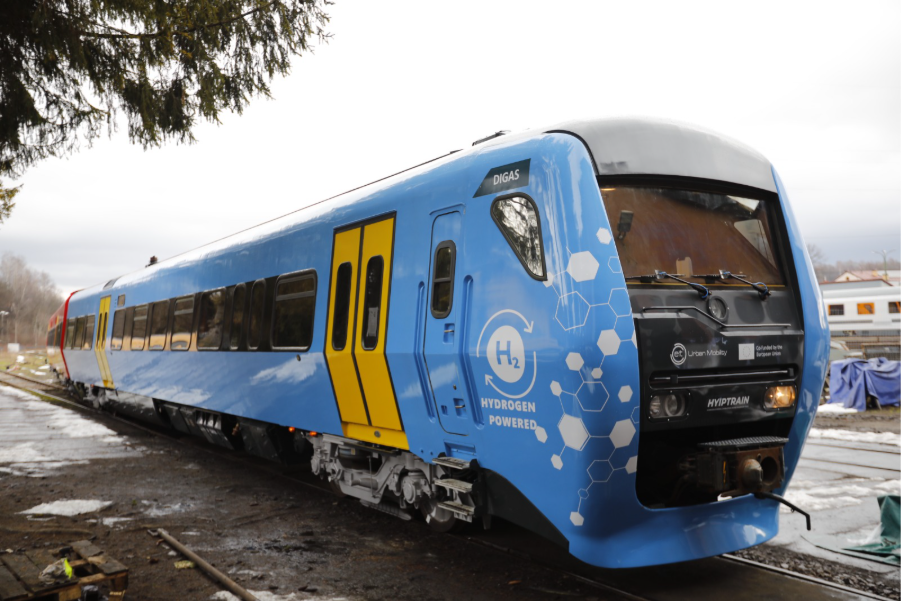
Now a cutting-edge retrofit solution has successfully converted diesel trains to low-emission hydrogen power, as part of the EIT Urban Mobility-supported HYIPTRAIN pilot in Poland.
The project successfully demonstrated the assembly, rapid installation and certification of a hydrogen internal combustion engine upgrade kit for diesel locomotives.
“You are giving a second life to a train, and retrofitting a diesel train into a hydrogen combustion engine train can be much cheaper for the operator than buying a completely brand-new train that is battery or fuel cell hydrogen-powered,” Costa underlined.
Decarbonisation
Led by DIGAS in cooperation with Mikroluch, the HYIPTRAIN consortium filled a market gap for retrofit solutions, leading the way for wider hydrogen adoption throughout Europe.
“The railway sector is not the most interesting sector for VCs to invest in. If not for EIT Urban Mobility’s funding and support, we believe this product would have never made it into the market. We are very grateful,” explained Robert Strods, Co-founder and Head of Business Development at DIGAS.
By supporting a cost-effective and sustainable shift of rail transport, HYIPTRAIN showed how hydrogen adoption can help train operators achieve their decarbonisation goals and deliver better air quality in urban areas.
The pilot gave Polish rail operator SKPL — that ran an almost entirely diesel fleet — an opportunity to test this new technology. The retrofit was completed in under two months, with the diesel tank replaced with a hydrogen tank and additional modifications to make the existing engine work properly on hydrogen.
A first train was commissioned and tested on private tracks in the summer of 2025 followed by a pilot in December on public tracks. The retrofit engine ran smoothly in freezing weather conditions, validating the impression that hydrogen combustion technology is a tried and tested reliable technology.
Cleaner air
However, the cost of hydrogen adoption has traditionally been seen as a challenge for the rail sector. But with HYIPTRAIN’s innovative retrofit kit, the existing engine is converted to consume hydrogen instead of diesel, offering a more affordable option than hydrogen fuel cells.
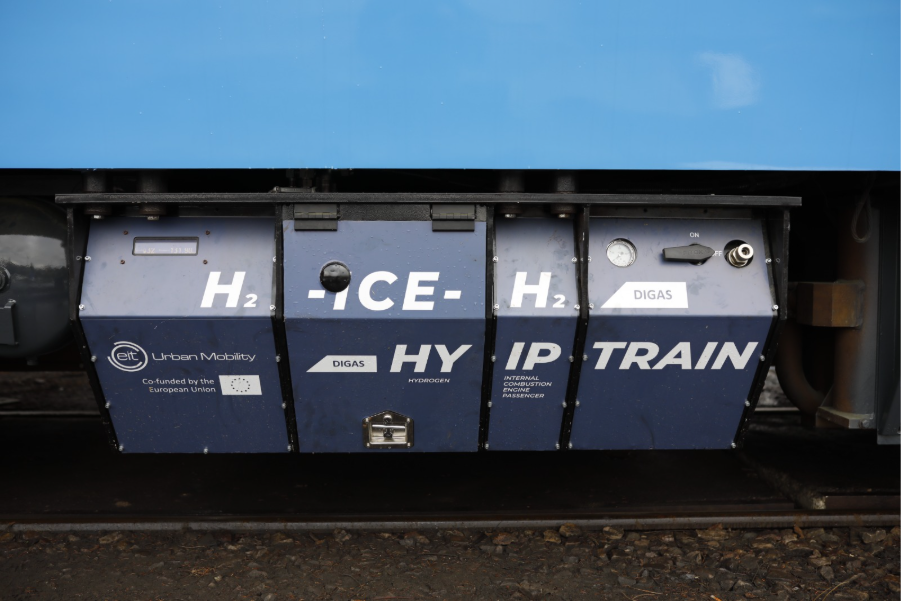
In addition, the required maintenance is similar, meaning operators do not need to invest in retraining staff to get to grips with new tech.
For passengers, the change from diesel internal combustion engines to hydrogen is expected to be imperceptible, with the only difference being improved air quality. “If you go and retrofit the engine from diesel to hydrogen, you reduce particulate matter pollution by 90%, and you reduce nitrogen oxides by roughly 60%”, Strods underlined.
Diverse use cases
There is expected to be strong potential for hydrogen retrofit adoption, particularly in Eastern Europe, where electrification is less widespread.
“When we talk about decarbonisation, you always have to think, what am I going to do with what I already have?” Costa said.
Other strong use cases are seen for converting freight locomotives in port areas, and for operators of small fleets of diesel vehicles, especially in mountainous areas.
“Potential customers want to save as much money as possible and at the same time comply with their internal requirements for decarbonisation,” Costa explained.
Battery power-up
The next step DIGAS plans to undertake is to add batteries into the hydrogen retrofit mix — further cutting urban emissions by allowing trains to arrive and depart from city centres running on battery power, with the engine turned off.
The battery itself would be charged through regenerative braking as the locomotive enters a station, and by using the battery, train operators could save by reducing hydrogen consumption.
“On the secondary rail lines, there are still 40% which are not electrified, and there are no plans to electrify them. However, those railways are still used for more or less ‘last-mile delivery,’ which is also an important strategic aspect of transitioning from trucks to rail. This is where we come in. We can provide cost-effective decarbonisation solutions to those lines,” Costa explained.