Reclaiming the use of urban waterways with autonomous technology
Europe’s waterways are not merely scenic backdrops. They are underutilised transport corridors with untapped capacity and significant potential to contribute to competitiveness, resilience and emissions reduction. As cities struggle with congestion, air quality concerns, and the urgent need to decarbonise, urban waterways offer a strategic alternative that has been largely overlooked in modern mobility planning.
Yet, reclaiming waterways for sustainable urban mobility requires addressing multiple challenges, from digitalisation and multimodal integration to skilled workforce availability. Autonomous technology plays a central role in this transition. Zeabuz sits at the heart of this shift, providing the intelligent navigation solutions that enable diverse vessels to operate safely, reliably, and cost-effectively.
Highlights of why we invested in Zeabuz
- Proven commercial deployment: Zeabuz technology powers MF Estelle in Stockholm, the world’s first commercial autonomous electric passenger ferry, demonstrating that intelligent waterborne transport is operational today and ready to scale across European cities.
- Unlocking underused waterways: Zeabuz’s autonomous navigation enables predictable, high-frequency crossings that complement land-based public transport, integrating waterways into multimodal mobility systems.
- Operational efficiency that scales: Zeabuz solutions deliver up to 20% energy savings through optimised speed and routing, whilst enabling crew optimisation, addressing both decarbonisation and workforce shortage challenges simultaneously.
- Dual-use technology for resilience: Through its recent NORDSEC membership, Zeabuz is extending its civilian autonomy platform to defence and security applications, demonstrating the strategic versatility of its technology.
- Aligned with European transport policy priorities: Zeabuz’s technology directly supports the EU’s vision for digitalised, multimodal transport systems. By enabling intelligent navigation across diverse vessel types, from urban ferries to workboats, Zeabuz helps waterborne transport become a reliable, integrated component of sustainable mobility networks, delivering safety, efficiency and emissions benefits that strengthen the entire mobility system.
As Peter Vest, Senior Investment & Portfolio Manager at EIT Urban Mobility, emphasised:
“Waterborne transport has a long-established history, but it’s been largely overlooked by urban planners for the past century. Now it’s making a major comeback with modern technology: assisted driving, autonomy, and electric propulsion. This resurgence offers cities new mobility options and can genuinely reduce road congestion. That’s why EIT Urban Mobility is backing Zeabuz as one of the best-in-class providers of this technology. They’re building exactly what’s needed to bring waterborne transport back into the urban mobility equation.”
From NTNU research to commercial autonomy software
Zeabuz is an award winning startup that was founded in 2019 as a spinoff from the Norwegian University of Science and Technology (NTNU), building on decades of maritime automation research. The company’s origins trace back to a autonomous ferry operation with milliAmpere in Torndheim, Norway, that served as a proof of concept back in 2020. Since then, Zeabuz has evolved from operating a prototype ferry into a maritime autonomy software developer and provider. This evolution positions Zeabuz as the digital enabler for Europe’s broader waterborne transport ecosystem.
Stockholm’s Zeam: a replicable model of waterway mobility for European cities
The partnership between Zeabuz (technology provider) and Torghatten (operator with 150 years of shipping heritage) created the Zeam brand (that stands for Zero emissions autonomous mobility), demonstrating how autonomous waterborne transport can integrate seamlessly into urban life. Since June 2023, MF Estelle has been operating a six-minute crossing across Riddarfjärden in Stockholm, departing every 20 minutes between Kungsholmen and Södermalm and carrying up to 25 passengers.
The fully electric vessel, supplemented by solar panels, provides emission-free service. Zeabuz’s autonomous navigation system handles route planning, obstacle detection and precise docking, whilst an onboard operator continuously monitors the system and remains ready to intervene if needed, ensuring safety through human-machine teaming rather than full unmanning. The next step in Zeabuz’s development roadmap is transitioning this supervision from onboard to a remote operations centre, enabling one operator to oversee multiple vessels simultaneously and further improving the economic viability of autonomous waterborne transport.
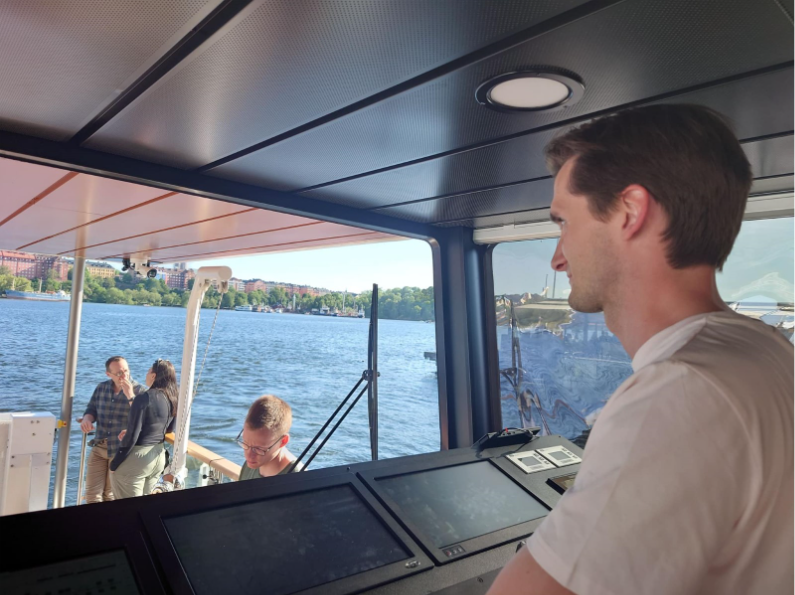
This operational model demonstrates both passenger acceptance and system reliability: the service demonstrates both passenger uptake and operational reliability, turning a cross-water journey that would otherwise take much longer by road into a six-minute shortcut.
The Zeam case proves that waterborne autonomous transport is not experimental. It is in commercial operation and ready to scale to other European cities with underused waterways.
Intelligent navigation that supports and amplifies human expertise
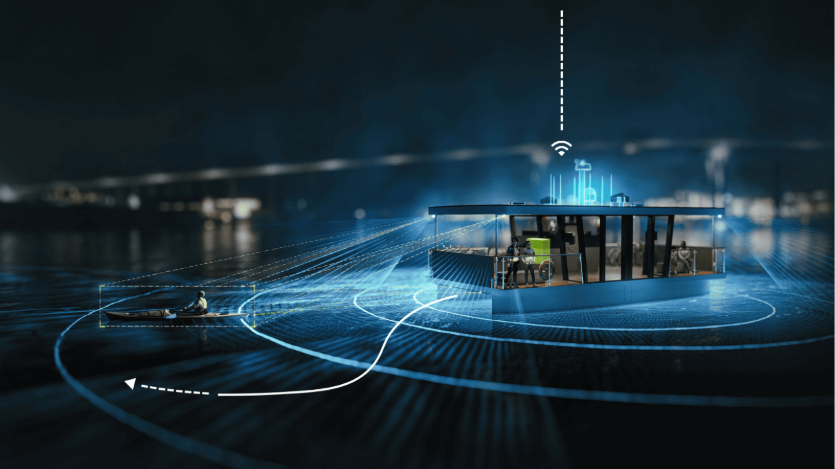
Zeabuz’s approach to autonomy mirrors the cognitive processes of an experienced captain, following a continuous cycle: sense–comprehend–plan–act, with an adicitonal fith setp the company calls “supervise”. This human-centric design philosophy extends to two core product offerings:
- ZeaMate: The autonomous navigation system that handles the full navigation loop, from obstacle detection and collision avoidance to autodocking and speed optimisation, promoting energy savings up to 20%. ZeaMate enables vessels to operate with reduced crew or allows existing crew to focus on value-added tasks, whilst maintaining safety through advanced situational awareness.
- ZeaWatch: The next-generation situational awareness system that acts as “the watchkeeper’s companion.” Through advanced sensor fusion algorithms and AI technology, ZeaWatch consolidates radar, AIS, lidar and camera data into a single, clear picture of the vessel’s surroundings, providing collision alerts and navigational advice.
Central to Zeabuz’s philosophy is human-machine teaming: autonomy doesn’t replace human expertise but amplifies it, enabling one operator to oversee multiple vessels or less experienced crew to perform at expert level. This approach addresses Europe’s maritime skills gap, with reskilling becoming a pressing need, whilst improving operational safety and efficiency.
Building trust with technology that is versatile and verifiable
Zeabuz’s modular, scalable autonomy platform is designed to adapt across vessel types and operational contexts. Beyond urban ferries, the company is expanding into workboat operations and defence and security applications, demonstrated through its membership in both the Ocean Autonomy Cluster (OAC) and in the Nordic Defence and Security Cluster (NORDSEC).
This dual-use approach showcases the strategic versatility of Zeabuz’s technology: the same intelligent navigation capabilities enabling safe urban ferry crossings can be adapted for surveillance, search and rescue, and logistical support. Building trust in such systems requires both technical robustness and transparency. Through the DNV-led COMPASS research project, launched in October 2025, Zeabuz is collaborating with industry partners to develop new assurance methods for autonomous systems, addressing simulation testing, system complexity management, and clear evaluation criteria for autonomous behaviour.
As Zeazbuz’z CEO Øyvind Smogeli noted in an interview, they have taken an assurance-first approach from the outset, recognising that digitalisation shifts the focus from hardware alone to the software layer and how it interfaces with sensors, communications and vessel systems. That is why Zeabuz places strong emphasis on simulation-led testing, rigorous system evaluation, and a modular architecture designed to support independent, third-party verification before scaling across vessel types and operational contexts. This focus on verifiability is what turns autonomy from an often hard concept to translate to the public realm into a capability operators and regulators can trust.
The policy backdrop: waterways as part of an integrated, sustainable transport system for Europe
Zeabuz’s intelligent navigation platform arrives at a moment when European transport policy explicitly recognises the role of waterborne transport in achieving climate and sustainable mobility goals.
The EU’s Sustainable and Smart Mobility Strategy sets milestones to increase inland waterway and short-sea shipping by 25% by 2030 and 50% by 2050, and to make rail and waterborne-based intermodal transport competitive with road-only options by 2030.
Building on this, the NAIADES III Action Plan specifically targets inland waterways’ untapped potential in urban contexts where waterways can “green the last mile of city logistics”(p.5) and serve as “integral parts of urban public transport in many cities” (p.9).
Similarly, the New EU Urban Mobility Framework also makes mention to the potential role of inland waterways for city logistics and water buses as part of public transport services, highligthinh the importance of a multimodal approach and digitalisation.
Lastly, the TEN-T Regulation further reinforces this direction, calling “improvement of digitalisation and automation processes, in particular with a view to increasing safety, security and sustainability in inland waterway transport, including within urban nodes” (p.37).
Zeabuz’s technology directly addresses these policy priorities: it enables the digitalisation that makes waterborne transport reliable enough for daily urban mobility, it optimises operations to improve sustainability, and it provides the automation that helps overcome workforce constraints. All whilst maintaining safety through human-machine teaming.
Looking ahead
EIT Urban Mobility believes Zeabuz has the potential to turn Europe’s underused waterways into a dependable layer of everyday mobility. By providing the intelligent navigation and remote supervisory control software that improves performance, regardless of vessel propulsion mode, Zeabuz helps enable safer, leaner and greener services that can scale across diverse use cases. We look forward to supporting Zeabuz as it strengthens the digital foundations for waterborne sustainable mobility.
Do you want to know more about Zeabuz’s mission and its solutions?
Visit the company website and LinkedIn.
This article is part of Why we invested? Series presenting EIT Urban Mobility equity portfolio.