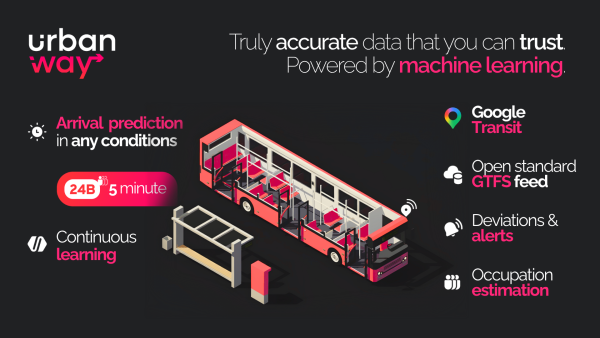
The Urban Way data platform addresses a core urban mobility challenge: low public transit trust caused by unpredictable schedules, a lack of real-time passenger information and inadequate data for demand-driven planning. Traditional systems struggle with real-world edge cases like non-GPS tracked “dark” vehicles or non-standard scheduling.
Inspired by persistent inefficiencies and gaps in current transit prediction tools in Romanian cities, the project’s objective is to transform fragmented operational data into high-fidelity intelligence. It restores passenger trust and optimises municipal routes without requiring expensive hardware overhauls.
Urban Way uses advanced data modelling to embed conditions, such as traffic, weather and time of day, into the transit network graph. Machine learning algorithms with online learning continuously adapt to new data points, ensuring predictions always stay accurate even with network changes. This unique approach even allows the platform to forecast future trips and infer arrival times for non-GPS tracked vehicles by analysing surrounding network conditions. It provides open real-time feeds and application interfaces, an administrative analytics dashboard (featuring bleeding-edge planning and optimisation tools, such as heatmaps, condition simulation and string diagrams), and a passenger-facing mobile application.
Implemented by Zexsoft, a Romanian deep-tech software startup founded by international informatics medallist Șerban Pîrvulescu, the six-month pilot takes place in Bălți, Moldova. It targets the city’s main north-south corridor of the smart bus network and started on 1 July 2026.