The advantages of e-commerce – speed, availability, broad selection and ease – are especially embraced in urban areas. In Switzerland and Germany, over 70% of people live in cities. While delivery demand grows, many consumers remain unaware of the environmental and infrastructural impact of their online shopping habits, especially parcel deliveries in already congested urban environments.
Between 2016 and 2023, parcel volume in Switzerland rose by more than 60% (Post CH/Keystone-SDA, 2024). Many of these deliveries are concentrated in urban areas, intensifying traffic, emissions and land use conflicts. At the same time, driver shortages are making it harder for logistics companies to maintain service quality – an essential need in modern life.
Rather than proposing restrictive measures to curb e-commerce, the MUDAV project aims to strengthen local and sustainable online retail as a valuable complement to traditional shopping, fostering growth that is environmentally responsible and logistically efficient.
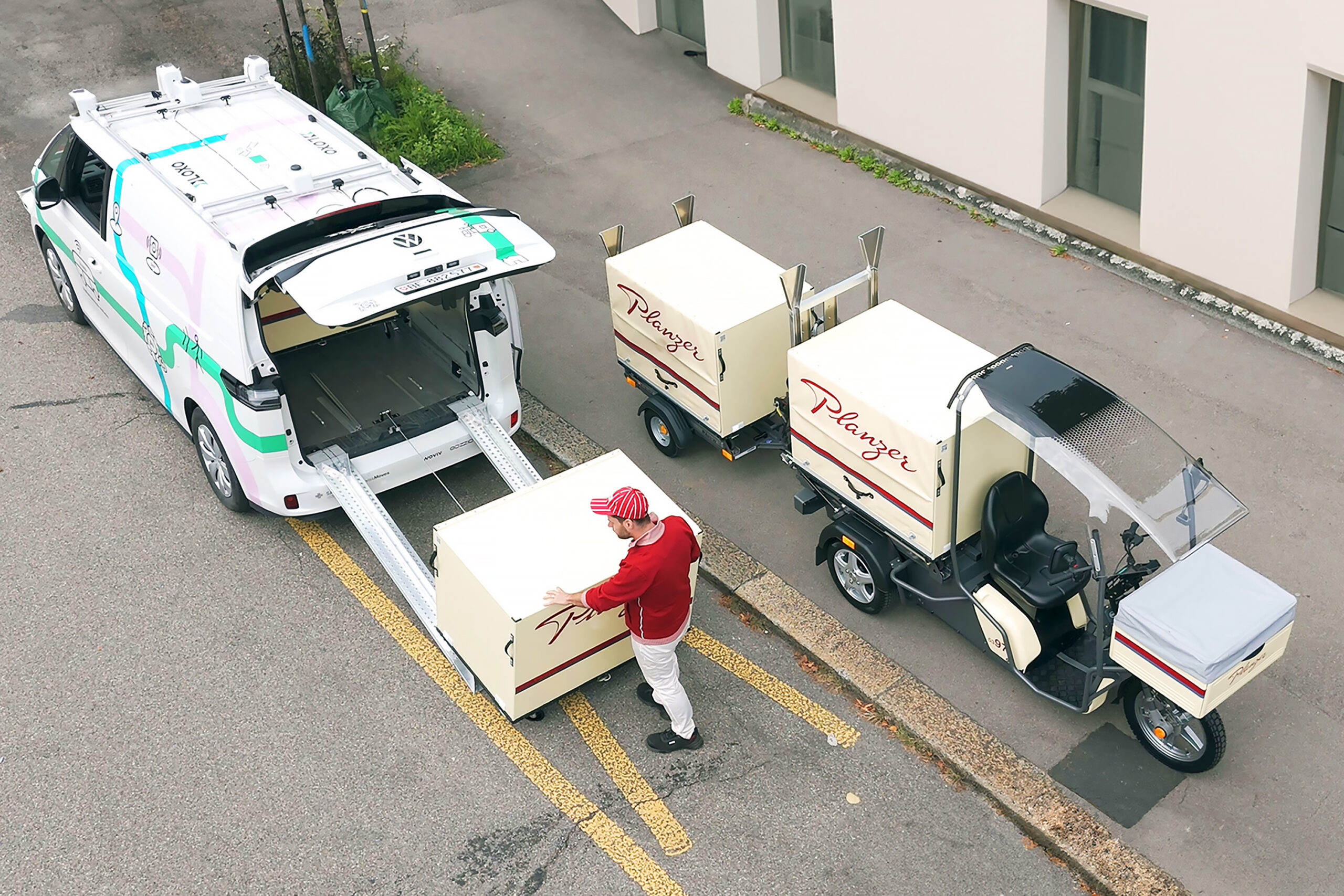
To achieve this, MUDAV is developing a forward-looking city logistics concept based on highly available, low-emission, automated transport solutions. At the core of this concept are fully automated (Level 4) delivery shuttles with larger capacity, designed for use in two key applications: dynamic microhubs, which are temporarily deployed transfer points within city areas, and last-mile grocery delivery. This innovative model is being implemented in partnership with Swiss technology provider LOXO and is currently under pilot in the cities of Bern and Bochum.
The objective is to enable the flow of goods into and out of cities with minimal energy consumption, reduced traffic impact and maximum efficiency, contributing to a more resource-conscious, low-emission urban logistics system. LOXO’s autonomous driving technology must be adapted to larger vehicles to meet the daily volumes of Planzer and REWE. The project’s dynamic nature may also support parking culture.