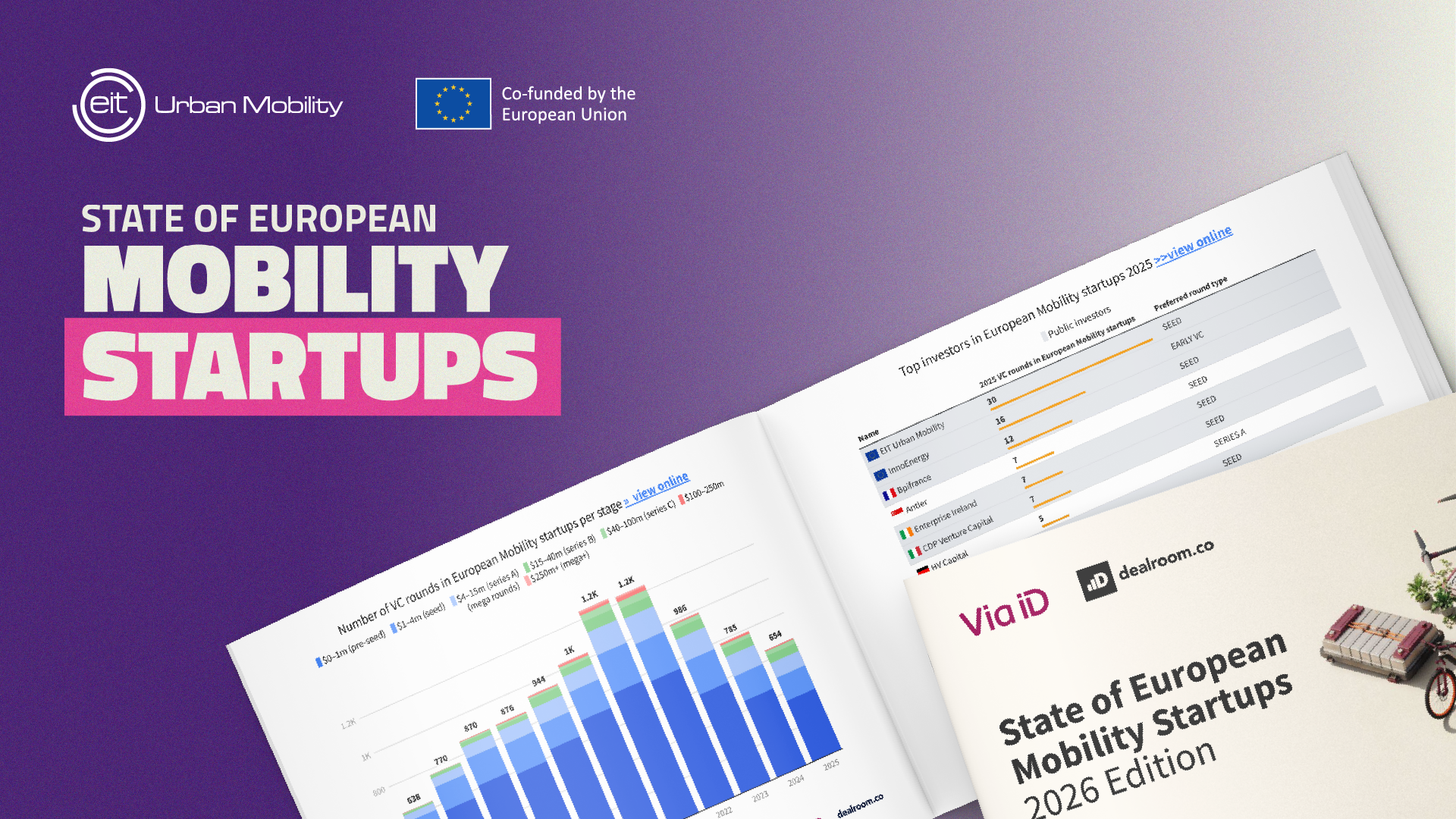
Barcelona, Spain (26 February 2026) – For the third year in a row, EIT Urban Mobility, an initiative of the European Institute of Innovation and Technology (EIT), a body of the European Union, has been recognised as Europe’s most active investor in mobility startups. The recognition comes from the newly released State of European Mobility Startups 2025 report by Dealroom and Via ID, which analyses investment trends shaping the future of mobility across the continent.
In 2025, EIT Urban Mobility has executed 30 deals across new investments and follow-ons. The portfolio now spans over 27 countries with 27% founded by women. Denise Xifara, Director Impact Ventures at EIT Urban Mobility: “Building a diverse, impactful, pan-European ecosystem remains central to our strategy. What sets EIT Urban Mobility apart from conventional investors is the combination of deep sector expertise with one of the largest mobility-focused innovation networks in Europe. This position enables startups not only to access capital, but also to secure strategic partnerships, pilot deployments, and international market entry opportunities.”
The follow-on investment activity within EIT Urban Mobility’s portfolio demonstrates the quality of companies it backs and the confidence of the wider investor community in their trajectories. Futurail recently closed a €7.5 million seed round to advance autonomous train technology, while R3 Robotics raised over €20 million to scale its automated battery disassembly operations. These companies exemplify EIT Urban Mobility’s investment thesis: solutions that are embeddable and scalable, delivering measurable real-world improvements in some of mobility’s most pressing challenges.
Investing for impact and resilience
While financial performance remains essential, EIT Urban Mobility embeds social and environmental impact at the core of its investment strategy. Startups are selected not only for their commercial potential, but also for their ability to deliver measurable improvements in sustainability, resilience, and quality of urban life.
EIT Urban Mobility’s investment strategy is built around five priority domains: electrification and alternative fuels, shared and public transport, sustainable urban logistics, mobility AI and data management, and health and mobility. In electrification, the portfolio goes beyond battery manufacturing to the full lifecycle, including repair, second life, and recycling as demonstrated by companies like NOWOS. In rail and public transport, companies such as Zeabuz, OTIV, and PANTOhealth are demonstrating how AI-driven predictive maintenance and autonomy can strengthen reliability and reduce operating costs at a time when decarbonisation pressures are intensifying.
Denise Xifara: “Capital will continue to favor execution and measurable operational results, with value created through integrated systems rather than standalone innovation. In today’s environment, secure and reliable mobility systems, whether in cybersecurity, energy security, or circularity, are essential infrastructure.” Mobility startups seeking funding and strategic growth support can apply via EIT Urban Mobility’s ongoing open call, with multiple cut-off dates running until 2028.