
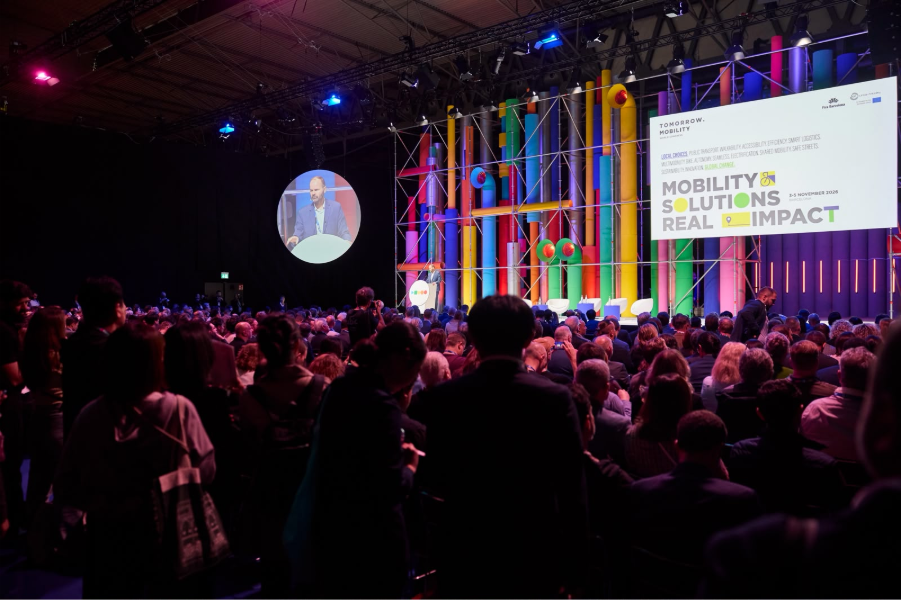
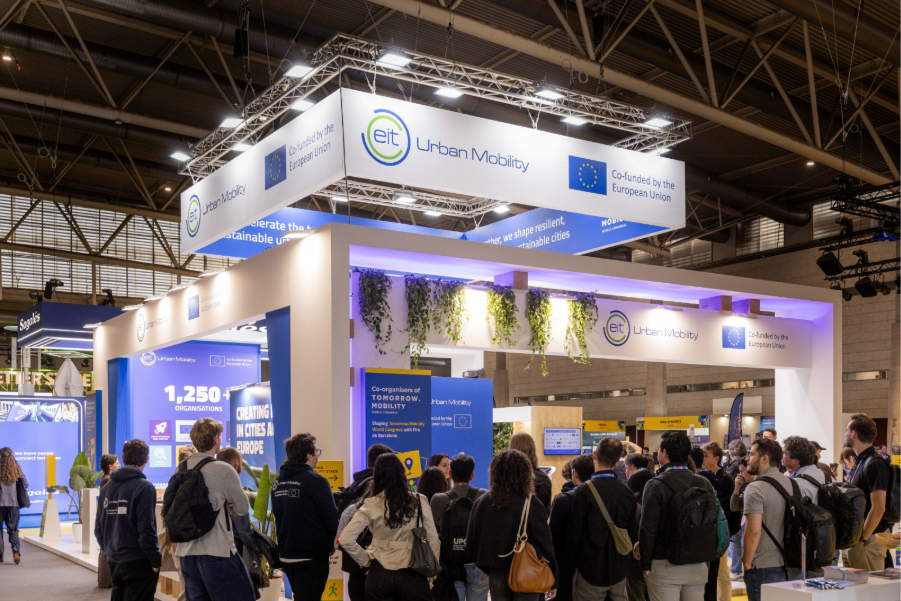
Every year, Tomorrow.Mobility World Congress (TMWC) brings together the stakeholders shaping the future of urban mobility: city leaders, policymakers, public transport operators, researchers, businesses and innovators. Co-organised by Fira de Barcelona and EIT Urban Mobility, and held alongside Smart City Expo World Congress, the three-day event provides a meeting point for the urban mobility ecosystem to exchange ideas, share experiences and explore solutions to the challenges facing cities. The 2026 edition was the largest yet, with TMWC and co-located events attracting more than 29,700 attendees, 1,275 exhibitors and 660 speakers from over 1,000 cities and 140 countries.
The 2026 edition, held in Barcelona from 3 to 5 November, covered a wide range of topics, from the adoption of autonomous vehicles and public transport attractiveness to grid readiness for large-scale electrification and mobility-as-a-service. Across the many presentations, roundtable discussions, site visits, and keynotes, the challenge of moving from innovation to impact was a common theme – aligned with the event motto ‘mobility solutions, real impact.’
From innovation to implementation
A recurring message at TMWC was that technology should be a means to an end, not the end goal itself. During the opening session, Urban solutions. Real impact, Edlam Abera Yemeru, Director of the Knowledge and Innovation Branch at UN-Habitat, stressed the importance of asking “before we use technology we need to ask, what problem are we solving, and more importantly, for whom?” Maria Galindo Garcia-Delgado, Secretary of Digital Policies at the Government of Catalonia, reinforced this idea, arguing that “innovation only matters when it creates a real difference in people’s lives.”
For EIT Urban Mobility, turning innovation into impact means connecting the various stakeholders needed to make change happen. Over the past seven years, the organisation has built what Marc Rozendal, CEO of EIT Urban Mobility, described during the opening session as “the largest pan-European community for urban mobility innovation.” This network is important because cities cannot tackle complex mobility challenges in isolation. They need access to expertise, investment, new technologies and the experience of other cities.
During Innovating in an era of uncertainty, Rozendal emphasised the importance of bringing public and private actors together, explaining that “it is important to find common ground and learn from each other”. He stressed that cities cannot tackle their challenges through public funding alone, highlighting the need for “public and private dialogue” and to “bring private actors into the conversation.” But collaboration must also lead to action: as he stressed, “it is important to go from pilots into scaling across geographies.”
This scalability requires more than funding individual projects and launching standalone pilots. Rather, it requires building ecosystems in which cities, companies, universities and other partners can collaborate, share knowledge and create the conditions for deployment. Teresa Riesgo, General Secretary of Innovation for the Ministry of Science and Innovation of Spain, reinforced this point during the session, highlighting the importance of “knowledge, talent and new ideas.” She explained that putting these ideas into practice depends on “a lot of cooperation not only among public authorities but also different administrations, member states, and regions,” adding that “building ecosystems is required for achieving scale.”
Autonomous vehicles and the challenge of leadership
The discussions around the deployment of autonomous vehicles (AVs) highlighted some of the key questions facing cities as they move from testing new technologies to putting them into practice. While the technology is advancing, the challenge discussed at TMWC was increasingly how AVs are introduced, governed and integrated into urban transport systems.
During Loveable cities: moving into the future, Lukas Neckermann, Co-founder of Urban Places Lab, argued that cities should start with the challenge they are trying to address, rather than the technology itself. As he put it, “autonomous mobility has to solve a problem – so start with the problem, not the solution.” He returned to this point later in the session, stressing that “the only question is what problem are you as a city trying to solve by implementing autonomous mobility.”
Autonomous mobility is often associated with robotaxis, but its potential applications are much broader. In peripheral locations where public transport struggles to provide adequate service to residents, or where driver shortages limit bus services, automation may offer an alternative – but only if addressing a genuine local need.
Malin Broqvist Andersson, Programme Director at Drive Sweden, addressed the question of who should shape this transition during the session Delivering next-generation public transport, arguing that “we know that autonomous vehicles are coming, the real challenge is not technical, its leadership.”
That leadership role will require cities to make difficult decisions about public space, regulation, data and the relationship between public transport and private mobility providers.
At TMWC, speakers presented some of the practical challenges that are already emerging. In Los Angeles, where the city is preparing to host the Olympics in 2028, Charles Small, Senior Advisor to the CEO at LA Metro, described the need to coordinate with autonomous vehicle companies as part of a much wider mobility operation. During Designing resilient, integrated mobility systems, he reflected on the experience of working with AV operators throughout the 2026 World Cup, explaining that “Waymo’s second largest fleet in the country is in LA, and as it turns out AVs don’t do well in these kinds of dynamic situations. We were able to work with them very quickly to address these issues, but it is something that we will have to manage as these innovations evolve.”
Oliver Nahon, Director of Operations at the Swiss Association for Autonomous Mobility (SAAM), highlighted other important questions during Delivering next-generation public transport: which use cases are viable, and how can they be scaled? Drawing on SAAM’s experience he explained, “we have six autonomous vehicle deployments in Switzerland, and they all have different use cases. Each project is a different use case, and this will help us understand which one makes sense, what the business model is – which is fundamental for scaling – and who defines the necessary use cases.” He also pointed to the need to strengthen local authorities’ ability to manage this transition, saying that “we need to bridge the gap of competencies for local authorities to enable the rollout of AVs.”
Cities may not own or operate every new mobility service, but they remain responsible for managing public space and ensuring that different services work together. Dr. Lea Decker, Project Manager and Strategy at New Mobility Solutions Hamburg, highlighted the importance of giving cities the data and knowledge to take on this role. As she explained, “cities need data and knowledge to become system orchestrators.”
Ultimately, however, the success of autonomous mobility deployments will depend on whether it improves the holistic transport experience for people. During Rethinking public transport for changing mobility needs, Judith Schuermans, Head of Public, Shared and Autonomous Mobility at EIT Urban Mobility, emphasised that “the future of transport is not just about tech, but about how we deploy tech to serve people.”
Making the wider transition to sustainable mobility work
The same need for a system-wide approach applies to the transition to electronic vehicles (EVs). The growing availability of EVs is essential to reducing transport emissions, but the success of widespread adoption also depends on the availability of charging infrastructure and electricity network readiness, investment and planning.
At TMWC, EIT Urban Mobility launched Electricity grids in Europe, a study commissioned jointly with ChargeUp Europe and ACEA, with modelling conducted by Siemens. The study estimates that accommodating projected electric vehicle growth could require €24.7 billion in electricity distribution grid investment by 2030. With intelligent EV load management, however, that requirement could fall to around €14.1 billion – avoiding an estimated €10.6 billion in investment. Smart charging will not remove the need for grid upgrades, but it can help make better use of existing capacity.
The study reflects a point Rozendal made during Innovating in an era of uncertainty. He warned that “when I see electric vehicle deployments, it is clear that the grid will not cope with the demand.” However, he was optimistic about the potential to address the challenge, adding that “the good news is that the tech is there…there is new talent coming and, we can handle these changes.”
Measuring progress by impact
Discussions across the three days of TMWC reinforced that the future of urban mobility will not be defined by technology alone. Rather, the future of urban mobility will be shaped by the choices cities make, the partnerships they build and their ability to turn promising innovations into scalable solutions that work across geographies.
This is a transition from merely being willing to experiment to iterating and implementing after pilots. It also means investing in infrastructure and skills, sharing knowledge between cities and ensuring that public and private actors work together towards common objectives.
Closing Urban solutions. Real impact, Constantí Serrallonga, CEO and Managing Director of Fira de Barcelona, captured the ambition for the sector, urging congress attendees to “measure our progress not by ideas, but by the impact they make for our citizens.”