Electrifying Europe’s freight from the inside out
EIT Urban Mobility has made its largest startup investment to date, committing €2.5M to NexDash, a signal of confidence in the company’s integrated approach to decarbonising road freight.
But why does this investment matter? The challenge NexDash is tackling is significant.
Road freight is one of the hardest sectors to decarbonise. Heavy-duty trucks account for more than a quarter of road transport emissions in the EU, yet the industry remains highly fragmented, with thousands of small and medium-sized carriers operating diesel fleets under constant margin pressure.
While electric truck technology is maturing and regulatory pressure is increasing, adoption remains slow. For most operators, the transition requires capital, operational expertise, and the ability to manage a fundamentally different fleet model.
NexDash addresses this challenge by embodying a new generation of logistics companies built on full vertical integration, taking end-to-end responsibility for fleet electrification and operations. By acquiring mid-sized carriers, transitioning their fleets to electric, and managing performance through NexOS – its proprietary AI-driven operating system – the company delivers a scalable, integrated pathway for traditional transport businesses to shift to electric freight, closely aligning with EIT Urban Mobility’s mission to accelerate sustainable mobility across Europe.
Highlights of why we invested in NexDash
- Addressing freight electrification at the system level: Rather than offering incremental improvements, NexDash integrates fleet ownership, energy management, AI-driven operations, and structured financing into a single platform, tackling the orchestration gap that has kept electric truck adoption low despite growing regulatory and economic pressure.
- A buy-and-build model with immediate revenue capture: By acquiring established mid-sized carriers and upgrading them onto NexOS, NexDash secures existing freight contracts and customer relationships from day one. The real upside comes from operational integration and electrification, in a sector where profitability is typically constrained by fragmentation and low single-digit margins.
- NexOS: AI-driven intelligence built for electric fleets: NexOS treats energy as a first-class operational variable alongside time and distance, combining AI-driven energy prediction, route optimisation, and charging optimisation to materially reduce energy and maintenance costs compared to diesel operations.
- Targeting a structural market inflection point: EV truck supply is now scaling across major OEMs, while EU decarbonisation mandates continue to tighten. European road freight remains a highly fragmented, SME-led industry, increasingly constrained by driver shortages, ageing demographics, and rising compliance and fleet electrification costs. Together, these forces are driving a consolidation cycle that is reshaping the sector.
Investing in NexDash reflects EIT Urban Mobility’s belief that decarbonising road freight requires more than better software; it requires operators willing to own the transition end to end. As Johannes Kirschner, Investment & Portfolio Manager at EIT Urban Mobility noted:
“Europe’s road freight sector is entering a pivotal phase, with a growing need for efficiency, resilience, and decarbonisation. NexDash reflects a new generation of companies addressing this shift with a vertically integrated, execution-focused model – combining technology, operations, and infrastructure to advance fleet electrification. We are excited to support the team on the journey ahead.”
NexDash’s model has already moved from concept to execution, with the company’s first carrier acquisition completed in Germany, a mid-sized operator that will be fully transitioned to electric trucks under NexOS. This progress follows the company’s €5 million seed round closed in November 2025, led by Extantia Capital with participation from Clean Energy Ventures and Magnetic Capital.
A Neo-Carrier built on deep founder-market fit
Founded in 2025 by Michael Cassau, NexDash brings together a highly complementary and diverse team spanning unicorn-scaling experience, deep logistics expertise, and enterprise-grade AI engineering. As founder, Michael combines his experience scaling Grover into a leading asset-backed platform with deep expertise in building capital-efficient, high-growth businesses. He is joined by a group of seasoned logistics and operational leaders, including experts who have scaled complex, high-growth companies, alongside professionals with extensive backgrounds in logistics, transport, supply chains, and enterprise technology – creating a uniquely well-rounded team to tackle the transformation of freight.
NexOS: the operating system for electric freight
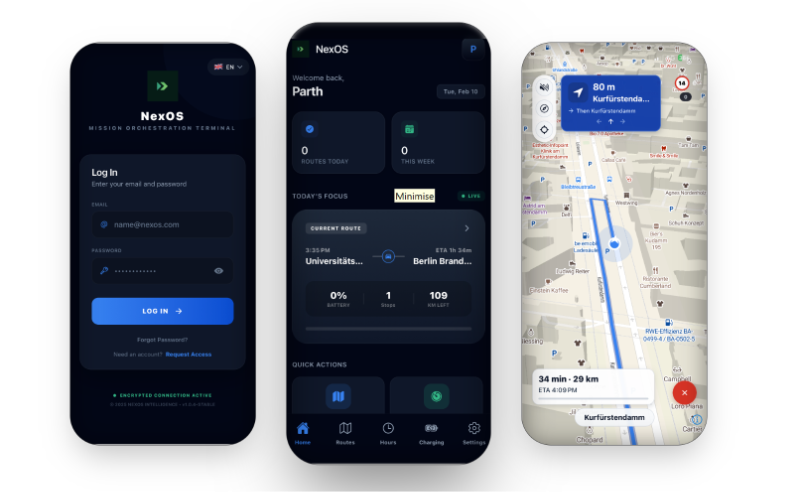
At the core of NexDash is NexOS, a software platform built specifically for the operational realities of electric trucking. Traditional transport systems were designed around diesel fleets, where refuelling is fast, range is predictable, and planning is relatively static. Electric freight introduces a different level of complexity, where energy use, charging availability, and route planning all need to be managed in real time.
NexOS brings these elements together in a single system, combining vehicle data, infrastructure signals, and live operational constraints to help fleets plan and run electric freight more efficiently.
The platform focuses on four main areas:
- Energy-aware operations
NexOS continuously estimates how much energy a trip will require based on vehicle performance, route characteristics, terrain, and weather conditions. This helps reduce uncertainty around range and charging needs, particularly across mixed fleets and changing operating conditions.
- Dynamic route optimisation
The system plans and updates routes in real time, taking into account charging stops, delivery schedules, driver regulations, and live traffic conditions. The goal is not just to find the fastest route, but the most operationally efficient one for electric vehicles.
- Charging and cost coordination
NexOS also helps manage when and where vehicles charge, factoring in electricity prices, depot constraints, and battery health. This allows operators to reduce energy costs while keeping fleets reliably in service.
- Infrastructure intelligence layer
Over time, the platform builds a consolidated view of charging infrastructure across Europe, helping fleets understand where reliable charging is available and how to plan around it.
NexOS is currently being deployed with early fleet partners and is designed to scale from single operators to large, multi-fleet environments. The system is hardware-agnostic, allowing it to work across different truck models and manufacturers as fleets transition toward electrification.
A timely solution for Europe’s freight transition
The conditions for NexDash’s model have rarely been more aligned. European regulation is steadily increasing the cost of diesel-based operations, with EU CO₂ standards and Germany’s CO₂-differentiated toll system making carbon-intensive freight progressively more expensive.
At the same time, the technology transition is reaching an inflection point. Major OEMs, including Daimler Truck, MAN, and Mercedes-Benz, are now delivering series-production electric heavy-duty vehicles at scale, easing the supply constraints that previously limited adoption. In parallel, battery pack costs have declined by ~80–90% over the past decade, supporting continued progress toward total cost of ownership parity with diesel over time.
These shifts are occurring within a structurally fragmented market. European road freight remains dominated by small and mid-sized carriers, many of which are facing sustained pressure from driver shortages, rising operating costs, and the capital requirements associated with fleet electrification. Rather than a single driver, these forces together are expected to accelerate consolidation across the sector.
The European road freight market exceeds €400 billion annually, with Germany representing its largest national segment. NexDash’s initial focus on mid-sized German carriers therefore provides a concentrated entry point into a large and structurally transforming market.
Looking ahead
EIT Urban Mobility sees NexDash as a strategic enabler of freight decarbonisation: a company with the operational model, the technology, and the founding team capable of driving the kind of system-level change that incremental solutions cannot deliver. With its first acquisition closed, NexOS deployed, and a pipeline of further targets at advanced stages, NexDash is transitioning from proof of concept to scalable platform.
We look forward to supporting NexDash as it builds Europe’s leading zero-emission freight network.
Do you want to know more about NexDash and its solutions? Visit the company website and LinkedIn.
This article is part of the Why we invested? Series presenting EIT Urban Mobility’s equity portfolio.