For cities aspiring to have efficient, sustainable and self-driving public bus fleets, moving beyond the need for a safety driver and achieving genuine autonomy remains a major challenge.
To better understand this hurdle and smooth the way for the deployment of fully autonomous fleets, an EIT Urban Mobility-supported project developed and tested a novel solution in Norway and the Netherlands.
The Human-Machine Interaction for Automated Public Transport Buses (InterAct) project — which ran throughout 2025 — showed that an external human-machine interface (eHMI) could make fully autonomous buses more viable, accessible and safer through enhanced communication with other road users.
“It is a bridge for understanding,” highlighted Olav Madland, CEO and Founder of Applied Autonomy, “it provides increased trust in autonomous buses, because people can read or hear what the computer intends to do.”
The eHMI communicates via three external display screens and a loudspeaker, enabling safer navigation without the safety driver. The solution also improves the journey experience for passengers by offering them up-to-date ride information.
By achieving this transparency, the project demonstrated how self-driving buses can become an effective part of a city’s sustainable urban mobility mix.
The importance of soft skills
Led by Dutch Automated Mobility and in collaboration with partners ADASTEC, Applied Autonomy and Vy Buss, the pilot built upon the success of a previous EIT Urban Mobility co-funded project that focused on smaller autonomous shuttles.
“EIT Urban Mobility provides these communities of cities, working together to roll out important solutions,” Madland shared.
“They supported every stage of the project and shared valuable feedback for us to improve the system,” ADASTEC Project Manager Oğuzhan Topgöç reported.
What set the InterAct project apart was that the eHMI was tested on full-size, full-speed electric buses that can carry more passengers and are closer to the ideal conditions of an autonomous public transport fleet.
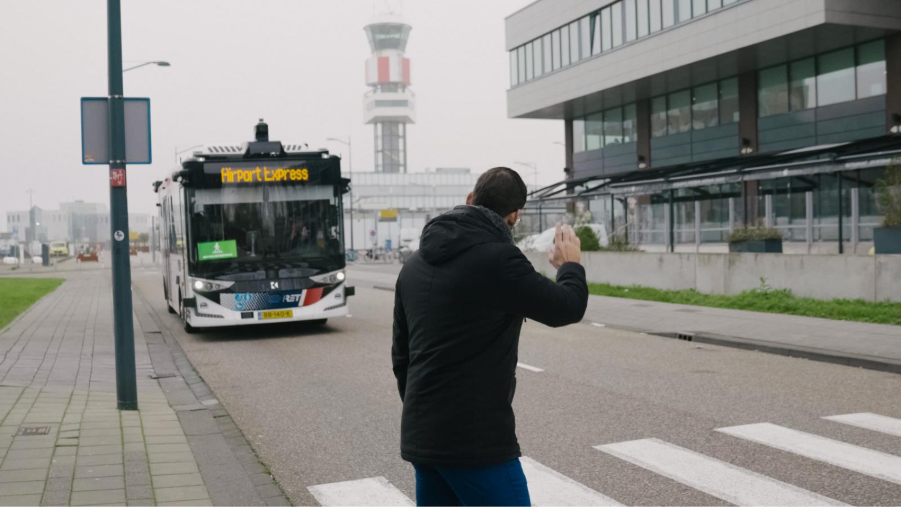
At the heart of the project was the goal of finding automated ways of replacing functions of the safety driver, including key ‘soft skills’ like eye-contact and gestures. These skills are essential for smooth interaction especially with vulnerable passengers, pedestrians and other road users. The eHMI can help replicate that function by communicating what the Automated Driving System (ADS) intends to do. In this way it offers important reassurance to other road users.
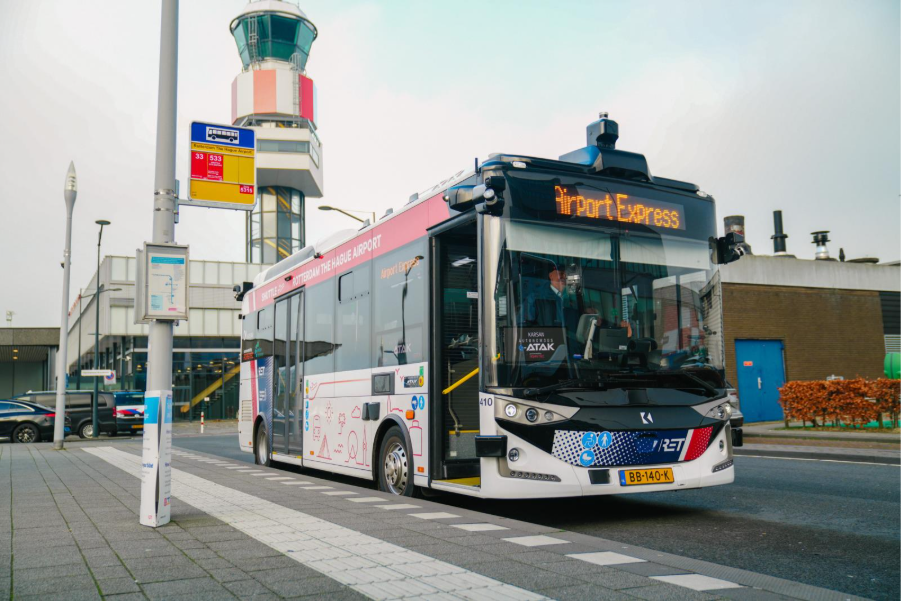
Different scenarios were tested throughout the pilot period, including passenger boarding, emergency situations and pedestrian crossings. If a bus stopped for a pedestrian waiting to use a pedestrian crossing, for example, the eHMI could inform them that the bus had seen them and that it was safe for them to cross the road. Enhancing its ability to communicate further, the eHMI is also multilingual for improved accessibility and safety.
Citizen engagement for increased uptake
“This is a completely new thing,” Madland underlined, “When people are used to it, they will start to trust it and look at it more and more because they see the relevant information.”
To better understand how passengers experienced the eHMI and driverless journey, the pilot incorporated a citizen engagement approach. These methods provided valuable insights into how passengers perceived the innovative system and highlighted the importance of working with end users.
“It’s quite funny; if you don’t tell passengers that it’s an autonomous bus, they don’t notice,” explained Ahmed Hashish, Managing Director of Dutch Automated Mobility. “We believe that to get there, you need to take baby steps. It cannot be a change from day to night in which we completely remove the safety driver and just hope that the people will accept it. We need to actively engage and involve different bus manufacturers and road users in order to make that happen,” he added.
Urgent need
Autonomous vehicles are a potential solution for the increasing driver shortage. With no driver on board anymore, a different way of interaction between other road users and the bus must be established, and that’s where the eHMIs comes in.
“Today, Europe is lacking 150,000 drivers, and it is impossible to recruit them because young people will not take up this role. So autonomous buses are an important part of the future of sustainable mobility,” Madland reported.
As well as supporting the roll out of autonomous bus fleets, driverless vehicles can navigate safely alongside existing public transport, helping to reduce operating costs, decreasing accidents caused by human error and making mobility more accessible.
“Operating self-driving buses should be done all across Europe, to make public transport the backbone of society again,” Hashish underscored.