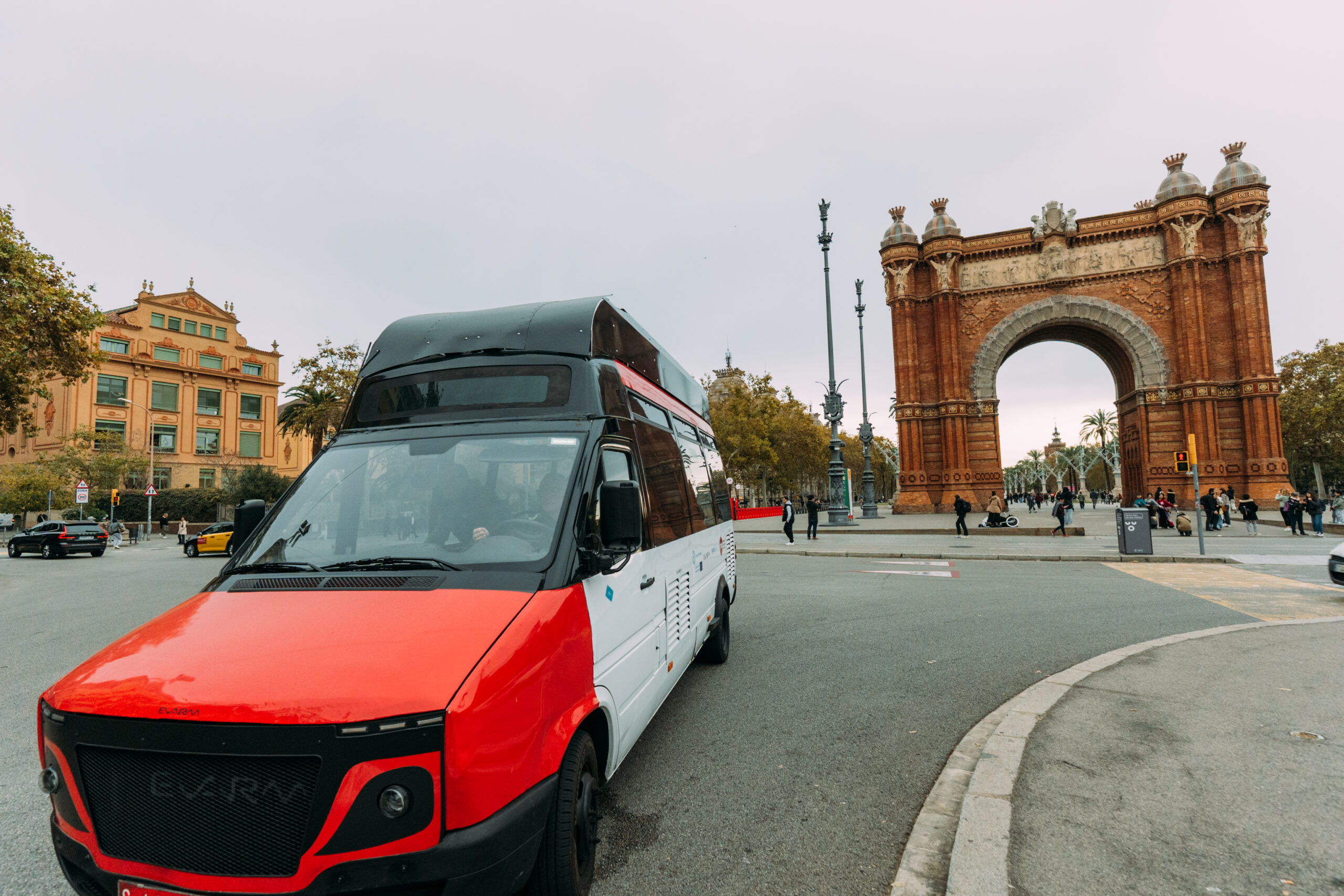
Barcelona’s historic neighbourhoods, with their narrow streets and close proximity between vehicles and pedestrians, present unique challenges for public transport operators. Transportes Metropolitans de Barcelona (TMB), the main public transport operator in the city, operates 1,150 buses, 70 of which are minibuses dedicated to these areas. Because of the environments they operate in “the impact of the noise and the emissions is very high,” explains Mario Canet, Innovation and Projects Manager at TMB.
Added to the unique challenges of operating in historic neighbourhoods is the need for these minibuses to run for up to 16 hours per day without the opportunity for recharging or refuelling while maintaining a reasonable weight and excellent manoeuvrability. Existing electric solutions on the market cannot meet these operational demands at a reasonable cost, prompting TMB to explore alternative zero-emission technologies to help meet its goal of having more than 50% zero-emission vehicles in its fleet by 2030.
Zero-emission operation in demanding duty cycles
For public transport operators, transitioning to fleets of fully electric vehicles can prove difficult to integrate, especially into such demanding schedules. “When you size the fleet with some of these buses, it’s really difficult to meet the challenge of recharging all these vehicles in a short period of time,” says Xavier Ribas, Founder and CEO of EVARM, a Spanish company specialising in the conversion of professional fleets to alternative fuels, in particular green hydrogen powertrain systems. Hydrogen fuel cell technology, by contrast, enables fast refuelling and extended range, making it ideal for long-duty cycles.
Over the lifetime of a minibus, it will emit more than 230 tonnes of CO2 into the environment alongside emissions such as NOx and particulate matter. With no mature solution available that would enable minibuses to meet their demanding duty cycles, operators risk being unable to meet the EU’s 2030 zero-emission targets. Additionally, transitioning large fleets to new zero-emission vehicles takes significant time. With 2030 approaching, a retrofitting solution offers minimum downtime and at a lower cost offering a second-life to existing vehicles.
Enhancing grid resilience
Hydrogen mobility can ease pressure on the electric grid by offering an alternative pathway to decarbonised transport without solely relying on electricity demand. Unlike battery electric vehicles, hydrogen vehicles refuel from hydrogen produced and stored off-grid, reducing peak load stress. This helps balance network capacity, especially where scaling EV charging infrastructure is limited. Hydrogen storage acts as an energy buffer, supporting resilience during demand fluctuations. By diversifying energy carriers, hydrogen mobility enhances system flexibility and reduces dependency on costly grid reinforcements.
HERO — hydrogen electric retrofit for operators
The HERO project, co-funded by EIT Urban Mobility, set out to retrofit an existing diesel minibus from TMB’s fleet with a hydrogen fuel cell powertrain. EVARM, as project coordinator, led the design and integration of a new, highly efficient 100 kW PEM fuel cell developed by EVARM in cooperation with EKPO Fuel Cell Technologies.
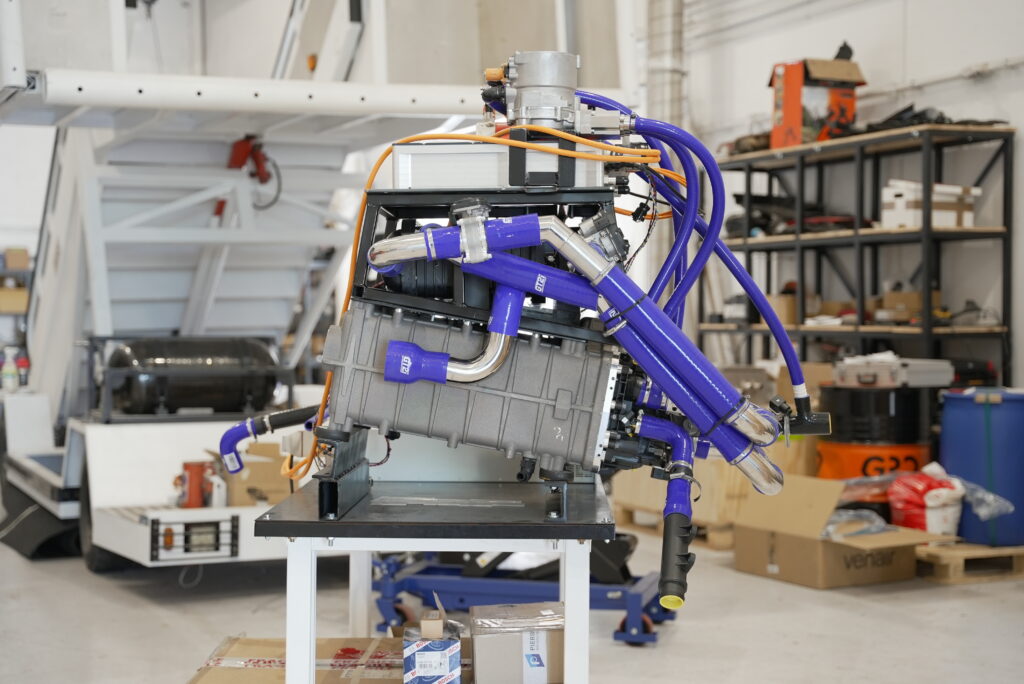
“This is the first fuel cell system engineered and manufactured here in Spain,” says Joachim Vogel, Sales Manager at EKPO Fuel Cell Technologies. Unlike traditional systems that depend on large, heavy batteries, HERO’s design uses the fuel cell as the primary power source, reducing weight and cost while providing consistent power throughout the duty cycle. Inside the stack, which is the core of the system, hydrogen and oxygen meet at a catalyst coated membrane where the electricity is generated to power the engine.
The HERO solution is a standard that can be adapted to many use cases, from minibuses to other kinds of light commercial vehicles, small-to-medium sized trucks, and as a range extender on existing battery buses. It can also be applied to new vehicles and, as in the case of the HERO project, used as part of the retrofit of an existing vehicle. The project’s rapid development was made possible through close collaboration of the project consortium. “Achieving a new fuel cell system within 12 months is the fastest that we at EKPO have ever seen,” Vogel concludes.
A retrofit that works like new
The retrofitted vehicle developed during the HERO project is now able to operate for more than 16 hours a day on a single hydrogen fill, with zero tailpipe emissions — producing only water vapour. It has also significantly reduced noise, improving comfort for passengers, drivers, and residents. “We have removed from the road a polluting diesel bus of more than 15 years and converted it to zero-emission,” says Ribas. By starting with an existing vehicle, HERO demonstrates a cost-effective pathway to decarbonisation. “Retrofitting is much faster and much easier with less downtime and lower cost,” adds Vogel.
Scalable decarbonisation for urban fleets
The HERO project delivers multiple benefits:
- Environmental: Zero CO2 and pollutant emissions, improved air quality, and utilisation of green hydrogen.
- Social: Reduced noise pollution in dense neighbourhoods, improving liveability.
- Economic: Lower costs for public transport operators compared to purchasing new vehicles, and extended fleet life through retrofits.
- Duty cycles: Ability to operate continuously for 16 hours without need for recharging or refuelling.
For TMB, the HERO solution is seen as applicable not only to its fleet of minibuses but also as a replicable model for cities across Europe. “The future of public transport in Barcelona is zero emission vehicles… both electric and hydrogen”. The HERO Minibus has demonstrated its ability to provide high performance (power, torque), range and fast refuelling. Our drivers are very happy with the performance and driveability of the vehicle, says Canet.