
EIT Urban Mobility Academic Research Board | November 2026
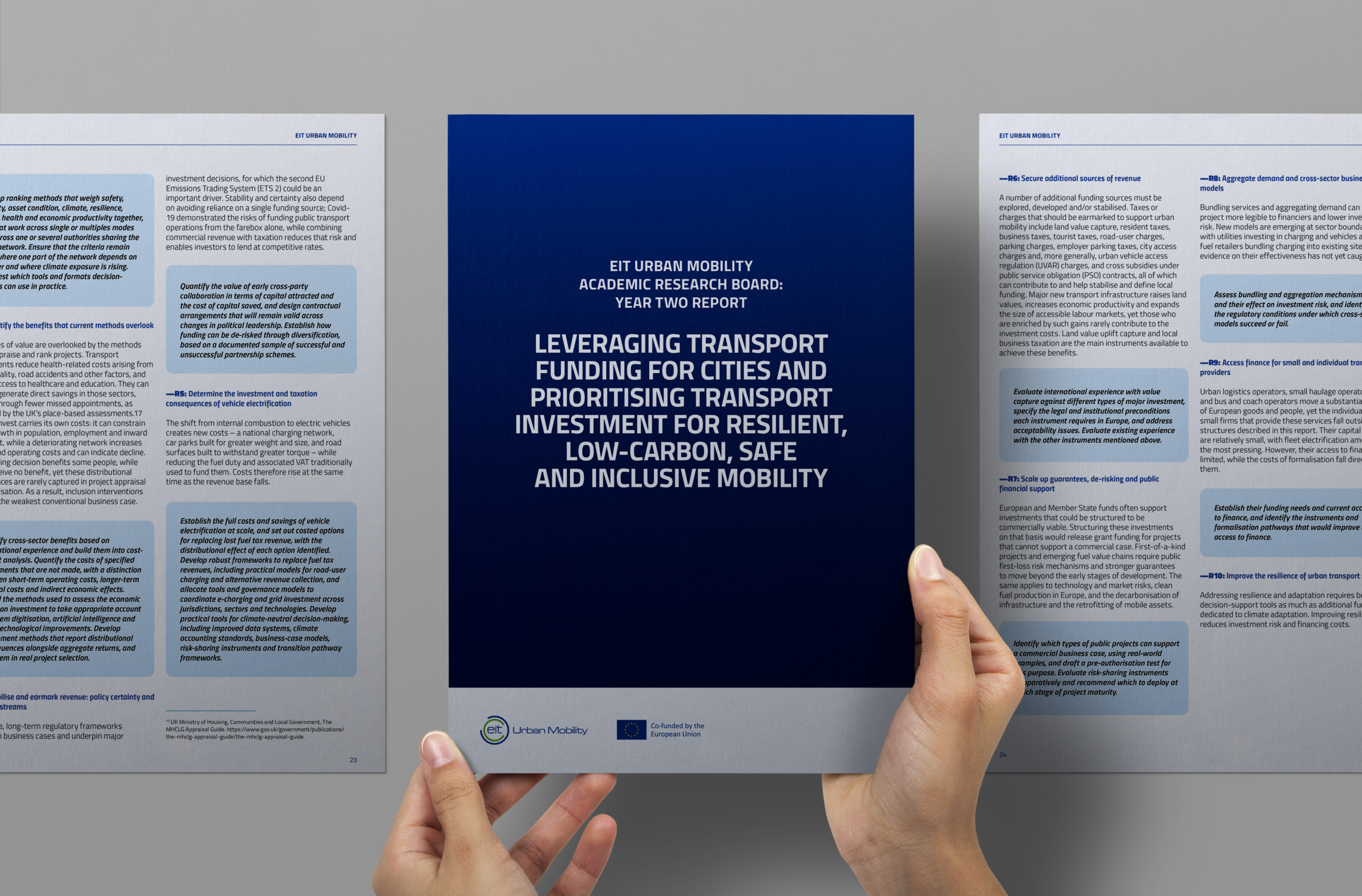
The second report from the EIT Urban Mobility Academic Research Board, titled ‘Leveraging transport funding for cities and prioritising transport investment for resilient, low-carbon, safe and inclusive mobility’, builds on the foundations established in the Board’s inaugural 2025 report on strategic research priorities and gaps. It revisits the five key focus areas identified in that first edition, namely economic productivity, resilience and adaptation, decarbonisation, health, safety and security, and accessibility, equity and inclusion, examining how the investments required to achieve these objectives can be funded, financed and prioritised.
The report explores one of the most pressing challenges facing cities and regions today: how to allocate resources in a way that delivers the greatest social, environmental and economic impact. It examines the funding mechanisms, governance structures and investment approaches needed to support resilient, climate-neutral, safe and inclusive urban mobility systems, while identifying key research and policy gaps that require further attention.
Bringing together leading researchers and experts from Europe and beyond, the Academic Research Board was established by EIT Urban Mobility to provide an independent, evidence-based perspective on the future of urban mobility research and innovation. The Board’s two reports, ‘Strategic Research Priorities and Gaps’ (2025) and ‘Leveraging transport funding for cities and prioritising transport investment for resilient, low-carbon, safe and inclusive mobility’ (2026), form the basis of a future-focused research agenda designed to inform future policy, innovation and education activities while supporting decision-makers across the urban mobility ecosystem.
This second edition highlights the need for more effective and transparent approaches to transport funding and investment, offering 13 recommendations to help cities, industry, researchers and policymakers navigate the transition towards more sustainable, resilient and inclusive mobility systems.