
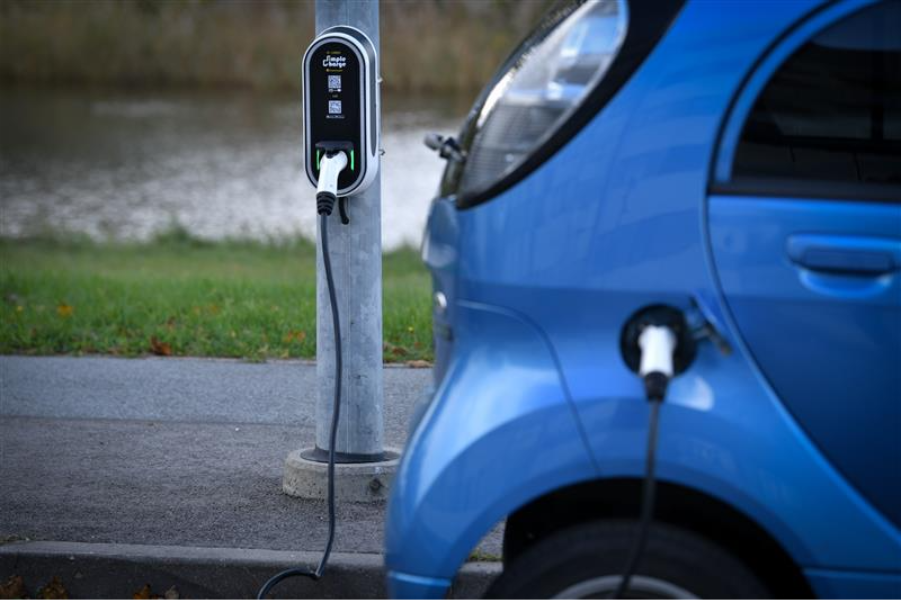
Europe’s transition to electric mobility is accelerating. By 2030, battery electric vehicles are projected to account for 27.3% of Sweden’s passenger car fleet and 15.7% of Germany’s. However, in order to encourage continued growth Europe’s electricity grids need to prepare for the rollout of millions more electric vehicles.
A new study commissioned by EIT Urban Mobility, ChargeUp Europe and ACEA, and conducted by Siemens, finds that smarter management of electricity demand could significantly reduce the cost of preparing Europe’s distribution grids for the growth of electric mobility.
The study, Electricity grids in Europe, estimates that around €24.7 billion in electricity distribution grid investment would be needed by 2030 to accommodate the projected growth in electric passenger cars and light commercial vehicles across the EU27 and three EEA countries. But the study finds that by combining grid investment with digitalisation and intelligent EV load management (commonly known as smart charging) the required investment could fall to around €14 billion, projecting a potential savings of over €10 billion.
EV growth is reshaping Europe’s energy needs
The study analyses the impact of EV adoption on electricity distribution grids across 64 representative European cities, modelling future vehicle uptake, charging behaviour, electricity demand and grid loading.
The findings underline just how quickly the electricity needs of road transport are changing. By 2030, the share of battery electric vehicles (BEVs) is expected to be between 3.4 to 4.9 times higher than in 2024, depending on the country.
The shift is also expected to accelerate among light commercial vehicles. BEVs are projected to represent 22.7% of the light-duty vehicle fleet in Sweden, 9.1% in Germany and 5.9% in Poland by 2030. In Poland in particular, the light duty vehicle fleet is expected to grow almost tenfold over the period.
For cities this growth means that electrification is not simply a transport challenge, but also an infrastructure and energy challenge.
Where vehicles charge matters
One of the study’s important findings is that the impact of EVs on the grid depends not only on the number of electric vehicles, but also on where and when they charge.
The research considers both different charging environments such as homes, workplaces, public locations, en-route charging and commercial depots, and the possible variation of mobility profiles such as commuters, occasional drivers, commercial users and service vehicles.
By 2030, around 55–62% of EV owners in the representative cities are expected to have access to residential charging. This makes access to local, low-voltage distribution grids particularly important to the success of Europe’s electrification journey. At the same time, cities where fewer people have access to private home charging are likely to depend more heavily on public charging infrastructure. This makes coordination between charging infrastructure planning and electricity grid planning increasingly important.
For commercial vehicles, the issue is particularly pressing. As logistics operators electrify their fleets, depots could become significant concentrations of electricity demand. Ensuring that these locations have sufficient grid capacity, while avoiding unnecessary infrastructure investment, will be critical.
Smarter charging can make existing grids work harder
Rather than treating every EV as a new source of electricity demand that requires additional grid capacity, intelligent EV load management can coordinate when and how quickly vehicles charge. Charging can, for example, be shifted away from periods when electricity demand is highest, helping to avoid peaks in local demand and making better use of capacity that already exists.
The study finds that the greatest efficiencies can be achieved when grid reinforcement, digitalisation and smart charging are deployed together. Put simply, Europe does not have to choose between investing in new grid infrastructure and using technology to manage demand more efficiently but rather that the two approaches can work together.
The potential investment needs vary considerably between cities. For example, Berlin is projected to require around €1.1 billion in distribution grid investment by 2030, but Stockholm, Kraków, Barcelona and Rome are expected to require between €123-220 million. While the largest metropolitan areas have the greatest requirements, the study finds that every city analysed will need some level of grid reinforcement to accommodate growing EV demand.
Innovation is already tackling the challenge
The findings are closely aligned with innovations that are already being developed and tested with support from EIT Urban Mobility.
For example, Inbalance Grid, an EIT Urban Mobility portfolio startup, develops intelligent EV charging solutions for businesses and grid operators. Its cloud-based dynamic load management technology is designed to distribute available power across charging points, allowing more chargers to be installed where grid capacity is limited and potentially reducing the need for costly grid upgrades.
Another portfolio startup, DeepVolt, features a Location Intelligence Assistant, an AI-based solution developed to help cities forecast future EV charging demand and optimise the location of charging infrastructure. The project explicitly takes grid capacity and urban constraints into account, helping cities more effectively plan future charging networks.
EIT Urban Mobility is also supporting approaches that make charging demand more flexible. The EVmobCS project focused on developing software that uses real-time electricity emissions data and predictive analytics to optimise charging schedules, shifting charging towards periods when electricity is both more sustainable and cheaper. Additionally, FlexEV is exploring energy flexibility for carsharing and charging infrastructure, by using algorithms to optimise charging based on factors such as electricity prices, solar generation, building consumption and vehicle battery state of charge.
Building the grid and mobility system together
Europe’s transition to electric mobility will require significant investment, but the opportunity exists to implement intelligent systems alongside investment. By combining targeted grid reinforcement with digitalisation and smart charging, Europe can make better use of its existing infrastructure, reduce the cost of electrification and build a more flexible and resilient energy system.
Want to learn more about intelligent EV load management? Access the full report here: Electricity grids in Europe