Giving EV batteries a second life to solve one of electrification’s most immediate bottlenecks
EIT Urban Mobility has invested in Stockholm-based Rebaba. The company builds stationary battery energy storage systems from second-life electric vehicle batteries. As electrification accelerates across Europe, limited grid capacity is increasingly becoming a bottleneck for deploying charging infrastructure and other energy-intensive applications. Rebaba addresses this challenge by enabling cost-effective energy storage where it is needed most.
The electrification of transport and industry is accelerating across Europe, but it keeps running into the same wall: the grid. For EV charging operators, logistics depots, and commercial sites, connecting new infrastructure often means costly upgrades or long waits. On top of that, electricity price volatility is making peak demand charges a serious and growing cost pressure. Yet for most mid-sized commercial operators, storage solutions on the market today remain too expensive to justify without subsidy.
Rebaba is addressing this challenge by giving retired EV batteries a second life as stationary energy storage systems. As EV adoption grows, more batteries are retiring from vehicles each year, typically after 8 to 12 years of use. These batteries still retain 70 to 80% of their original capacity, making them well suited for stationary storage. Rebaba’s platform captures this supply and converts it into modular, cost-competitive energy storage systems for commercial and industrial customers, without relying on subsidies to make the economics work.
Highlights of why we invested in Rebaba
- Making energy storage more affordable: Rebaba’s model is built on repurposing EV batteries to deliver one of the most cost-competitive energy storage solutions on the market, creating a pathway towards more accessible energy storage for commercial and industrial customers.
- A flexible technology platform: Rebaba’s proprietary technology enables batteries from multiple EV manufacturers to be integrated into a single storage solution.
- Clear, subsidy-independent customer value: Rebaba’s systems help commercial and industrial customers optimise energy use, reduce electricity costs and minimise dependence on costly grid upgrades. The solution provides a strong economic proposition that can be adapted to different customer needs and operating environments.
- A capital-efficient and replicable production model: Rebaba’s decentralised “CircularHub” approach avoids large-scale factory investment. The first hub in Stockholm runs at 10 MWh per year, scalable to 40 MWh through incremental steps. The model can be replicated across geographies without high upfront capital.
- Strong regulatory support: The EU Battery Regulation (2023/1542), in force since 17 August 2023, takes a comprehensive lifecycle approach to batteries. From 18 February 2027, digital battery passports will be mandatory for EV and industrial batteries above 2 kWh. This increases traceability across the supply chain and strengthens the commercial case for second-life applications.
Investing in Rebaba reflects EIT Urban Mobility’s view that cost-effective distributed energy storage is one of the most direct levers available to accelerate electrification in urban environments. Grid constraints are already slowing EV charging deployment across Europe, and behind-the-meter storage is a practical tool that commercial and industrial operators can use today. As Peter Vest, Senior Investment & Portfolio Manager at EIT Urban Mobility, highlights:
“Electrification is not only about deploying more chargers and electric vehicles. It is also about ensuring the supporting energy infrastructure can scale alongside them. Rebaba is addressing a growing challenge faced by charging operators, fleet depots and commercial sites: how to access reliable energy storage without prohibitive costs or long waits for grid upgrades. We were particularly impressed by the team’s technical expertise and their ability to turn second-life batteries into a practical solution that supports both electrification and resource efficiency.”
From EV engineering to circular energy storage
Rebaba was founded in Stockholm by Paula Runsten and Felix Kruse. Paula, who serves as CEO, previously worked as an engineer at Tesla, where she gained experience in vehicle testing across hardware and software. Felix brings a background spanning sustainable infrastructure, supply chains and battery value chains, with experience from both Ramboll and Northvolt. Together, the founders combine expertise in electrification, energy systems and battery operations, providing a strong foundation for building circular energy storage solutions based on second-life EV batteries.
The management team brings experience in technology, operations, finance and commercial development. Since the company’s early days, Rebaba has continued to refine its technology and operations, reducing costs while maintaining a strong focus on commercial viability and scalable deployment. This ability to combine technical expertise with commercial execution has helped the company progress from its first-generation system to a more mature platform designed for wider market adoption.

An integrated platform for second-life battery storage
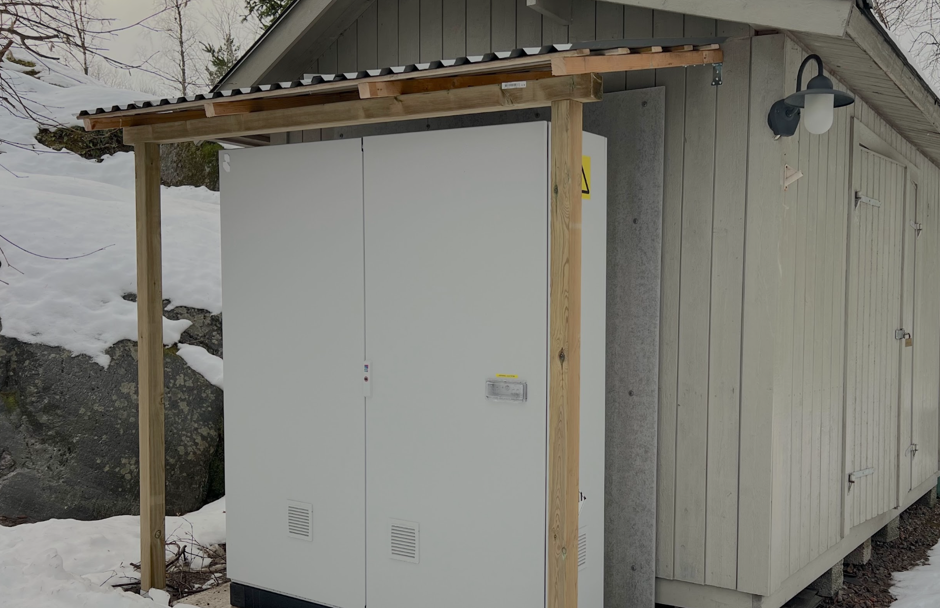
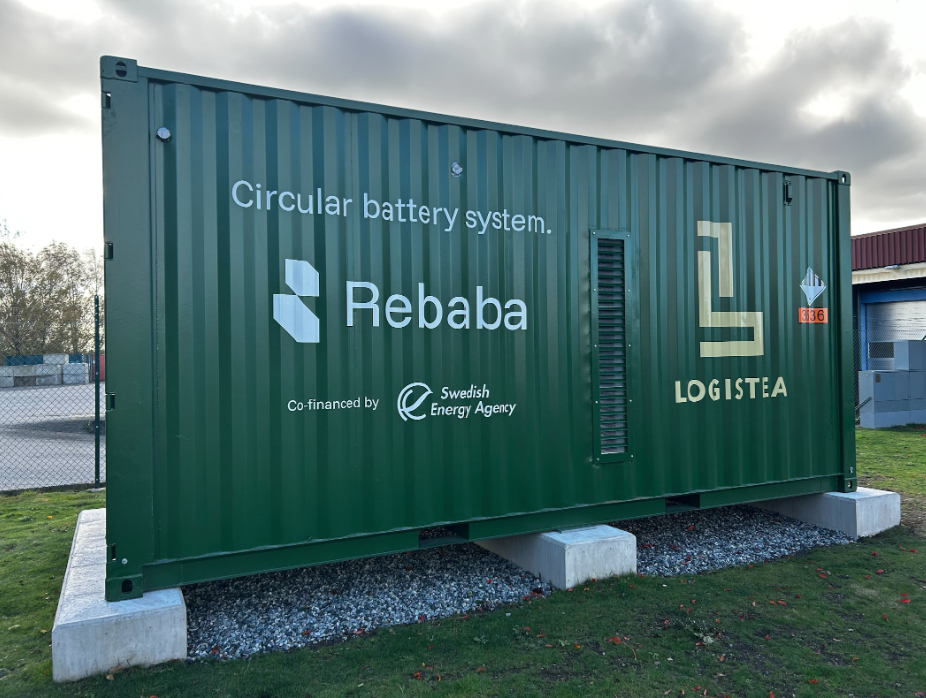
Rebaba offers energy storage systems designed for commercial and industrial customers, from smaller cabinet-based units to larger containerised installations.
What differentiates the company is not simply the use of second-life batteries, but its ability to integrate batteries from many different electric vehicle manufacturers into a single, reliable platform. Through its proprietary control system, “Rebaba Brain”, the company can combine different battery types and connect them with widely used energy infrastructure, creating a flexible and scalable approach to battery storage.
This battery-agnostic architecture allows Rebaba to access a broader supply of second-life batteries while helping customers benefit from lower-cost energy storage solutions. Combined with software that optimises energy use according to local demand and electricity market conditions, the platform helps customers reduce costs, better manage peak demand, and make more efficient use of available grid capacity.
By extending the useful life of EV batteries and turning them into productive energy assets, Rebaba is building a solution that combines circularity with a strong commercial value proposition.
A market defined by cost, with a growing supply advantage
Rebaba is focused on the commercial and industrial battery energy storage market, providing solutions for buildings, industries, EV charging operators and residential applications. Unlike utility-scale storage projects driven by large tenders, this segment is shaped by economic pressures, energy price volatility and growing grid constraints, all of which are increasing demand for behind-the-meter energy storage solutions.
The opportunity is also being reinforced by broader European ambitions around electrification, energy resilience, and circular resource use. As EV adoption grows, so will the availability of batteries reaching the end of their automotive life. Extending their useful life in stationary applications can help reduce waste, improve resource efficiency, and support the growing demand for flexible energy infrastructure. In this context, second-life battery storage has the potential to play an increasingly important role in supporting Europe’s energy and mobility transition.
Looking ahead
EIT Urban Mobility’s value add goes beyond the investment itself. Our ecosystem spans cities, charge point operators, fleet operators, logistics companies, and infrastructure developers. Grid constraints are a shared challenge across this network, and we see concrete opportunities to connect Rebaba with deployment partners in EV charging, and depot electrification. There are also synergies with portfolio companies active in EV charging platforms, fleet electrification, and energy management, where behind-the-meter storage is becoming an increasingly relevant part of the infrastructure stack.
We look forward to supporting Rebaba as it scales across Europe, helping accelerate the deployment of electrified mobility infrastructure while demonstrating the value of a more circular battery ecosystem.
Do you want to know more about Rebaba’s mission and its solutions?
Visit the company website and LinkedIn.
This article is part of the Why we invested? series presenting EIT Urban Mobility’s equity portfolio.