AI-powered solutions for predictive maintenance of electric rail systems
Rail has a central role in Europe’s sustainable mobility ambitions: low-carbon, high-capacity and essential for reducing car and air travel. Yet delivering on that promise depends on something less visible than new lines or faster trains: reliable, safe day-to-day operations. Across much of Europe, maintenance still relies on manual inspections that happen every six to twenty-four months, leaving long windows in which emerging faults go undetected. As networks age and grow more complex, manual methods simply do not scale.
PANTOhealth offers an AI-powered solution for a critical maintenance challenge in electrified rail: the pantograph-catenary system, where the current collector on the roof of the train meets the overhead wire to make electric traction possible. Faults in that interface are disruptive and costly to manage reactively. PANTOhealth’s technology for real-time condition monitoring and predictive maintenance enables operators to shift from reactive, interval-based maintenance to a proactive, evidence-based approach, by continuously collecting data on contact wire geometry, wear and vibration behaviour, and applying advanced analytics to detect anomalies before they develop into failures.
Highlights of why we invested in PANTOhealth
• AI-powered predictive intelligence for electric rail operations: PANTOhealth converts continuous sensor data from overhead line systems and pantographs into actionable predictive maintenance intelligence, enabling continuous fault detection and intervention, minimising the risk of service disruptions and safety incidents. • Designed to integrate into existing operations: PANTOhealth’s solutions can be deployed with dedicated sensor hardware for continuous data collection, or, for operators who already hold historical measurement data, via the software-only OHL Monitoring Panel, extracting predictive maintenance insights without any new hardware investment. • Proven with European rail and tram operators: PANTOhealth’s technology is already deployed with operators such as Leipziger Verkehrsbetriebe on advanced tram maintenance in urban environments, HGK on smart predictive railway maintenance strategies, and HBK on catenary system monitoring, demonstrating real-world traction across different operational contexts. • Growing international market recognition: In March 2025, PANTOhealth signed its first million-dollar contract with one of the largest railway networks in the world, marking a significant step in the company’s international scaling trajectory. • Strong policy alignment: PANTOhealth’s solutions directly support the EU’s push to digitalise and modernise rail infrastructure management, as reflected in the TEN-T Regulation, the Sustainable and Smart Mobility Strategy and the broader effort to improve rail’s reliability and competitiveness as part of sustainable mobility systems.
Investing in PANTOhealth reflects EIT Urban Mobility’s recognition that making electric rail and tram networks more reliable and safer requires more than infrastructure investment. Digitalising maintenance is one of the most direct and scalable levers available: it reduces costs, extends the operational life of critical assets, and keeps services running safely and predictably for the passengers and freight operations that rely on them. As Johannes Kirschner, Investment & Portfolio Manager at EIT Urban Mobility, highlights:
“PANTOhealth exemplifies the kind of deep-tech innovation that can drive systemic improvements across rail and tram systems, enabling more proactive maintenance and more reliable, safer operations. Our confidence is grounded not only in the sophistication of their technology, but in the consistency of their execution over time. In an industry that is historically difficult for startups to enter, they have shown steady development, achieved certified readiness, and progressed into real‑world deployments across multiple markets. This traction reflects both the resilience of the team and their deep understanding of the rail ecosystem. The technology is deeply rooted in the founders’ strong research backgrounds, evident in a rigorous, systems‑level approach that integrates monitoring and simulation from first principles. Today, this foundation enables the platform to support a wide range of customers – from train operators and manufacturers to infrastructure operators and designers – by providing shared, actionable insights across the rail ecosystem.”
From a smartphone on a pantograph to AI-powered rail maintenance
Founded in Berlin in September 2020, PANTOhealth was built from a pragmatic and inventive starting point. In 2018, co-founder and Managing Director Dr. Farzad Vesali, whose PhD focused on pantograph-catenary vibration in electrified trains, tested a first proof of concept by strapping a smartphone to a pantograph and taping a baby monitor camera to an old locomotive. That low-tech experiment confirmed the core insight: continuous, sensor-based monitoring of pantograph-catenary interaction was both feasible and valuable.
That insight has since been developed into a professional platform by a founding team whose expertise spans mechanical engineering, AI and data science, systems analysis, and circular economy modelling. Dr. Mina Kolagar, Co-Founder and Innovation Manager, brings a female leadership perspective in a heavily male-dominated sector, with a solid background in systems analysis, energy systems and impact modelling. Amir Bashari, Co-Founder and Chief Product Officer, contributes deep expertise in mechanical design, vibration analysis and finite element methods, grounding the platform’s sensing and diagnostics capabilities in rigorous engineering practice.
From field data to fault anticipation, an integrated monitoring and simulation platform
PANTOhealth’s platform addresses pantograph-catenary health through two distinct modes of operation: continuous field monitoring and analytical simulation.
The Profiling Suite monitors overhead line geometry, measuring contact wire height, zigzag deviation and wire wear as the unit travels the network, offering precise diagnostic and actionable alerts. The Vibration Suite captures the dynamic behaviour of the pantograph itself, tracking vibration patterns that can indicate wear, misalignment or mechanical stress before these develop into service-affecting faults. Both monitoring tools feed data into the OHL Monitoring Panel, a software layer that aggregates condition data and surfaces maintenance intelligence. The OHL Monitoring Panel is also available as a standalone option for operators who already hold historical measurement data from existing equipment, enabling them to begin extracting predictive insights without new hardware investment.
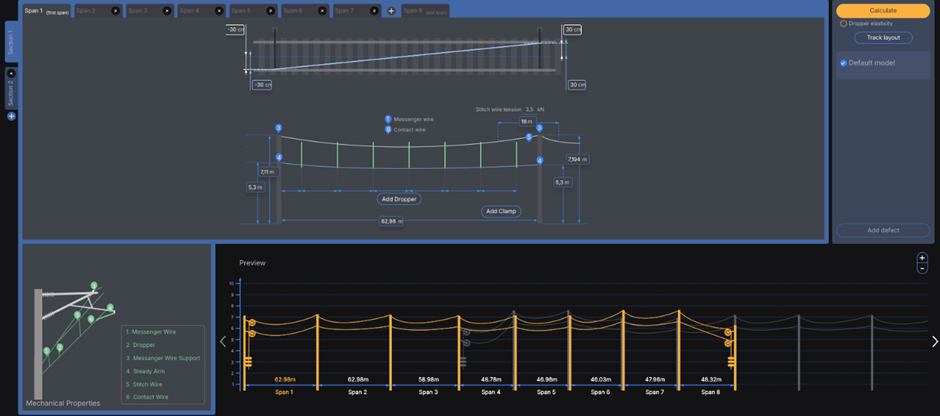
The Simulation Panel takes geometric and mechanical properties of the overhead line and pantograph as inputs to model both static and dynamic catenary-pantograph interaction. Outputs include contact force profiles, wire uplift at masts, elasticity values and compliance evaluation against international standards. This makes the tool useful for two distinct purposes: diagnosing the behaviour of existing configurations and testing how proposed design changes or new pantograph types would perform before any physical intervention.
Continuous monitoring in high-frequency urban rail networks
In high-frequency urban tram networks, where services run through the day and maintenance windows are constrained, the ability to monitor infrastructure continuously rather than periodically is particularly valuable. In collaboration with Leipziger Verkehrsbetriebe, PANTOhealth has deployed and refined its signal-based defect detection on Leipzig’s 300-kilometre tram network, demonstrating that its predictive maintenance approach translates directly into the urban context.
Predictive rail maintenance and Europe’s digitalisation agenda
Europe’s rail networks face increasing pressure to maximise performance from existing infrastructure and resources. The European Court of Auditors has documented the high and persistent costs of rail systems maintenance, costs that constrain how quickly networks can expand capacity and improve services. Shifting from interval-based to condition-based predictive maintenance is therefore not only a technological advance but an economic one.
The Sustainable and Smart Mobility Strategy established infrastructure digitalisation as central to delivering a reliable, competitive rail network alongside physical investment. The TEN-T Regulation translates that direction into binding requirements, explicitly calling for improved digitalisation and automation across rail infrastructure to increase safety, security and sustainability.
PANTOhealth’s AI-driven platform also operates within the governance framework established by the EU AI Act, which sets transparency and reliability standards for AI systems in safety-relevant contexts, a consideration directly applicable to predictive maintenance in rail infrastructure.
Looking ahead
EIT Urban Mobility recognises PANTOhealth as a strategic enabler for the operational reliability that Europe’s growing rail ambitions require. By turning sensor data into actionable insight, PANTOhealth helps extend asset lifetimes, reduce disruptions and improve service quality across electrified rail and tram networks. We look forward to supporting PANTOhealth as it scales its AI-powered monitoring platform across Europe and beyond, helping to ensure that the infrastructure carrying millions of passengers every day remains safe, reliable and ready for the demands ahead.
Do you want to know more about PANTOhealth’s mission and its solutions? Visit the company website and LinkedIn.