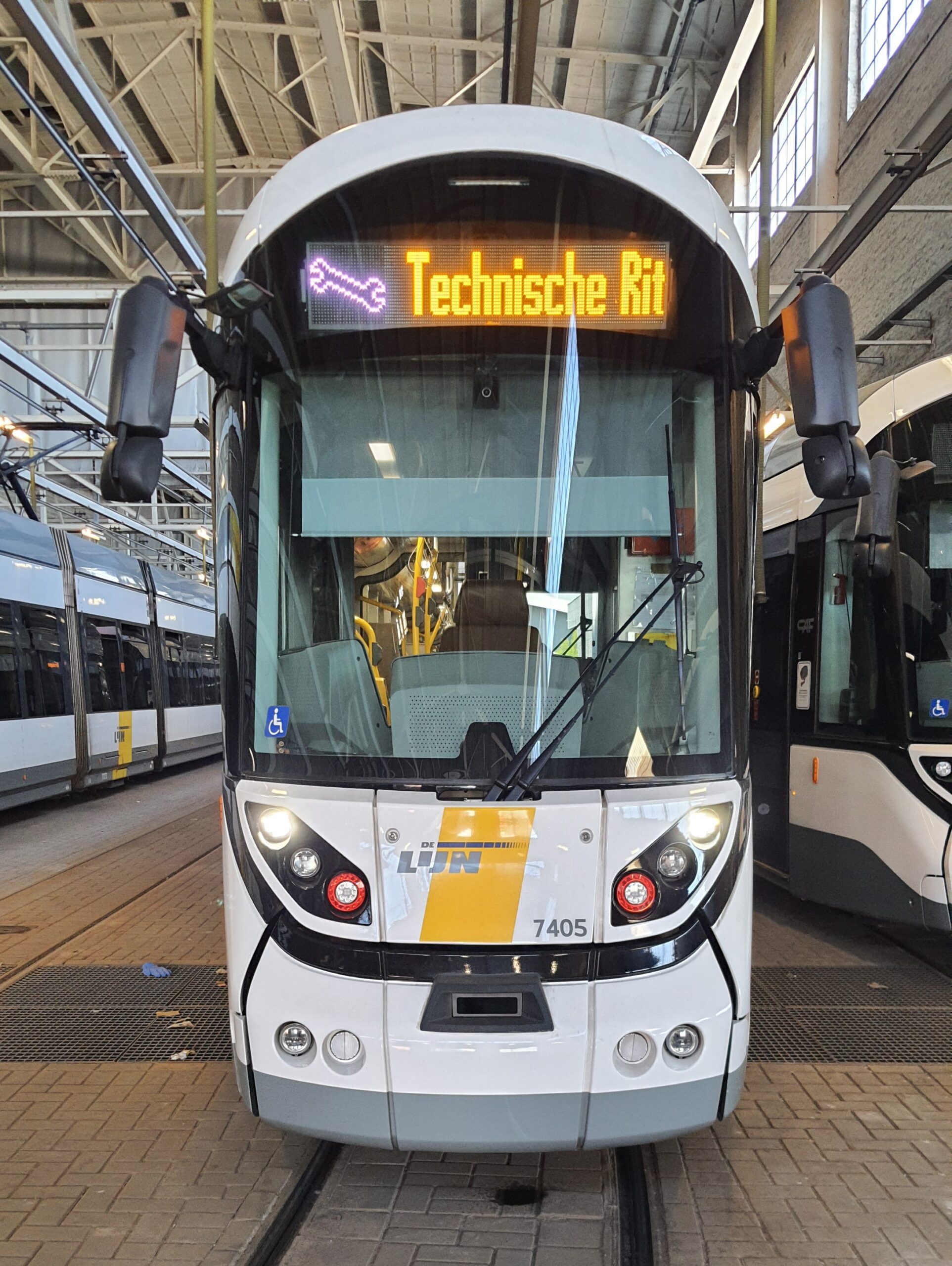
After successful test phase with collision warning, the project ARISE takes the next step towards predictive safety technology. De Lijn looks back positively on a pilot project in Antwerp in which an advanced driver assistance system for trams was tested. The system supports tram drivers in complex urban traffic situations and helps to avoid collisions. Based on these results, a new European project, supported by EIT Urban Mobility is now starting in Ghent that goes one step further with predictive safety technology.
ARISE in Antwerp: innovative collision warning on the Stadslijner
Within the European ARISE project (Advanced Rail Innovation for Safety & Efficiency), with the support of EIT Urban Mobility – an initiative of the European Institute of Innovation and Technology (EIT), a body of the European Union – an advanced driver assistance system was tested on a De Lijn tram in Antwerp in 2025. Antwerp was one of the test cities where the technology was tested in practice, alongside Valencia and Zaragoza, while other partners such as Barcelona and Utrecht, also piloted some testing of the technology.
The system acts as a digital co-pilot that helps the driver to notice risks more quickly. It warns the driver when there is a potential collision hazard and constantly monitors the area around the tram. Visual and auditory signals help the driver to react faster in complex traffic situations with, for example, cyclists, pedestrians and mixed traffic.
The installation on an Antwerp Stadslijner tram showed that the technology can also be used in a busy urban tram network. During the test period, the system was used in daily operation and collected data from thousands of journeys in urban traffic. The warnings helped drivers to detect possible risks more quickly, for example when other road users unexpectedly cross the tram track.
During the tests in the various project cities, more than 400,000 km of data were collected. The system achieved an availability of more than 95 percent and very few false warnings. In the long term, the project aims to contribute to a reduction in the number of tram-related collisions and to fewer disruptions on the tram network.
The tram drivers involved also reacted positively to the test. They indicated that the system is especially useful in complex traffic situations, where extra support can help to react more quickly to unexpected movements of other road users. Additional research with sensors on drivers also showed that the system does not cause any additional physical or mental strain while driving.
ARISE is part of EIT Urban Mobility’s broader objective of making public transport in cities more attractive, safer and more sustainable.
Annick De Ridder, Flemish Minister of Mobility: “Innovation and safety go hand in hand. With projects such as ARISE, De Lijn shows that Flanders is at the forefront of smart mobility. Technology that supports drivers in complex traffic situations not only increases safety, but also the confidence of passengers.”
Ann Schoubs, director general of De Lijn: “Our drivers work every day in a challenging urban environment. With such a driver assistance system, we give them an extra pair of eyes. ARISE has provided valuable insights into how technology can support drivers. We will take these insights into account in the further development of our safety approach.’
Willem Frederik Metzelaar, Regional Director EIT Urban Mobility: “Testing this system in several European cities has proven to be a great strength of the project. By combining diverse operational contexts with a strong knowledge exchange between partners, we have been able to validate the technology in real-world conditions and turn innovation into practical solutions that can be rolled out quickly and effectively across Europe. The projects also underline the value of the knowledge triangle, where a scale-up collaborates with public transport operators and universities to validate its product — not only from a business model perspective, but also in terms of user acceptance — and thus ultimately contribute to safer, more reliable and more comfortable public transport for both passengers and drivers.’
TRACE in Ghent: from warning to predicting
Based on the positive experiences in Antwerp, the new European TRACE project started in February 2026, also supported by EIT Urban Mobility.
TRACE builds on the technology from ARISE, but adds additional features. For example, the system will also be able to detect possible collisions along the side of the tram. The tram will be equipped with extra sensors (lidars) on the side for this purpose, so that the environment is scanned much more widely. Through artificial intelligence, the system will be able to assess the risk of accidents even more accurately and anticipate potentially dangerous situations more quickly.
In addition, the system uses digital route information. This supports the driver in better anticipating complex situations along the route and, among other things, provides warnings when a tram approaches a zone where an appropriate speed is required, such as at switches.
Ghent will be one of the three demonstration cities within the project, together with Karlsruhe and Rotterdam (where a pilot is supported by RET). A total of sixteen trams will be equipped with the system. The first installations are planned for 2026, followed by extensive testing and data collection phases in 2027.
The technology will be reintegrated into existing trams and tested in real operation. A core team of Ghent tram drivers will be actively involved, including for training, feedback and evaluation of the system.
Sam De Smet, Co-Funder of OTIV: ‘TRACE is the result of close cooperation between technology developers and public transport companies. By working directly with operators across Europe, we can refine the system based on real-world experience and real data.”
European cooperation on urban mobility
TRACE runs from February 2026 to January 2028 and brings together technology companies, universities and public transport companies. In addition to De Lijn, OTIV (Belgium), CARNET and UPC (Spain) and AVG (Germany) are involved.
The results of the project will be evaluated in terms of safety, reliability and impact on the operation of the tram network.
With these projects, De Lijn confirms its ambition to continuously strengthen the safety of its passengers and employees through innovation and at the same time contribute to more attractive and sustainable urban public transport.