
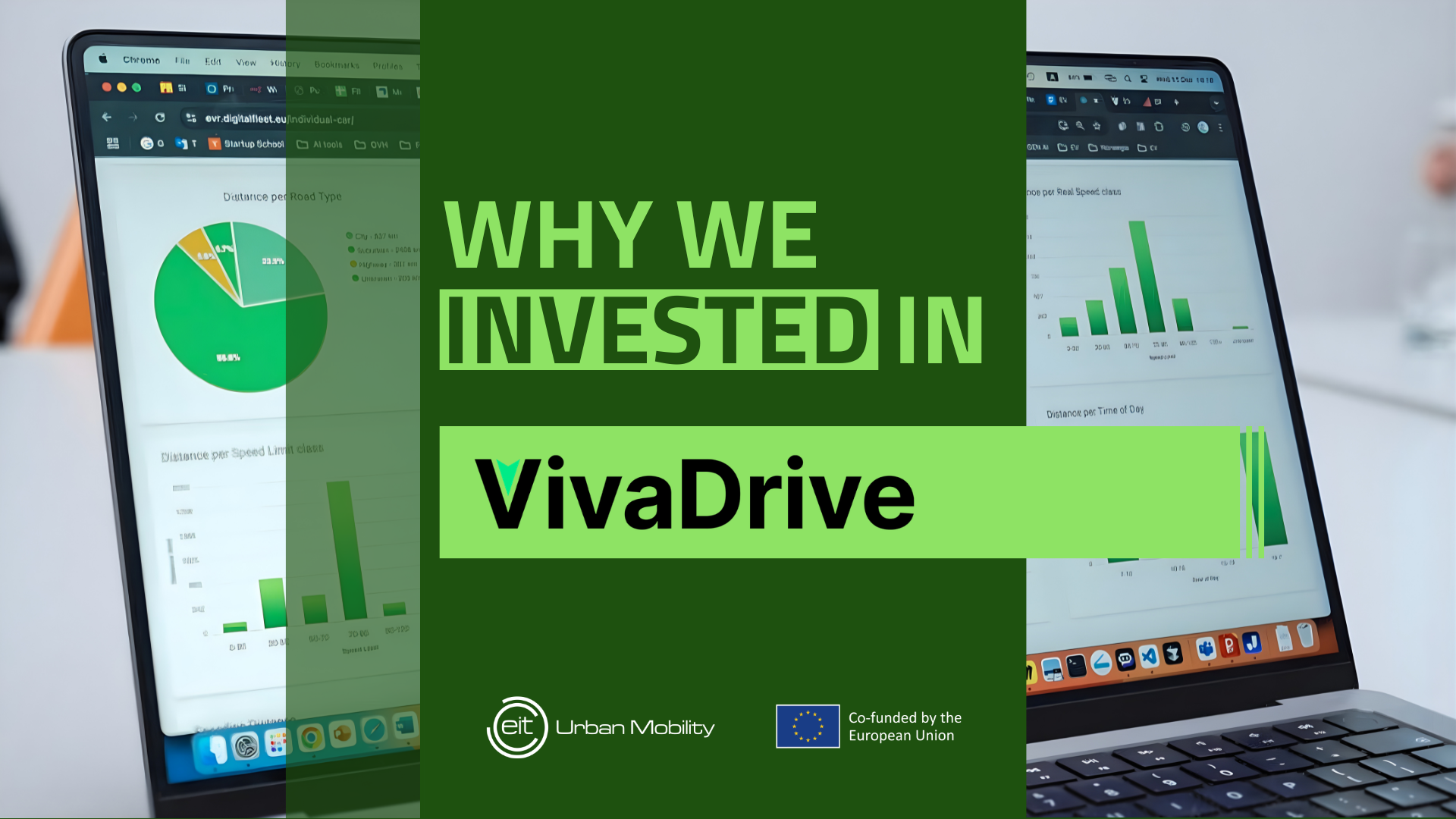
AI-powered platform for effective fleet decarbonisation
Fleet electrification is a cornerstone of Europe’s sustainable mobility transition. Yet for many organisations, the path to zero-emission fleets is riddled with complexity: fragmented data, uncertain return on investment, and operational disruption risks. While CO₂ targets are tightening, practical implementation remains a challenge, especially for mixed fleets operating across diverse geographies and use cases.
VivaDrive, a Polish deep-tech startup, is tackling this challenge head-on. Its AI-powered platform helps organisations make informed, data-driven decisions about fleet electrification, without disrupting daily operations. From vehicle replacement planning to charging infrastructure design and operational transition support, VivaDrive turns complexity into clarity, enabling faster and smarter decarbonisation.
Highlights of why we invested in VivaDrive
- AI-powered fleet decarbonisation planning: VivaDrive uses advanced algorithms to analyse fleet data and recommend optimal electrification strategies, including which vehicles to replace, when, and with what.
- Digital twin simulations for operational readiness: VivaDrive’s platform creates virtual models of fleet operations to test electrification scenarios before implementation, helping organisations avoid costly missteps.
- Charging infrastructure optimisation: VivaDrive helps design charging strategies tailored to operational needs, including location planning, energy demand forecasting, and cost modelling.
- Seamless integration with existing systems: VivaDrive connects with telematics, enterprise resource planning, and fleet management systems to ensure smooth data flow and minimal disruption.
- Total cost of ownership (TCO) and emissions analytics: Users of VivaDrive’s platform gain access to detailed financial and environmental impact assessments, supporting both internal decision-making and external reporting, like ESG.
Policy-aligned for European deployment: VivaDrive’s tools support compliance with EU CO₂ targets and fleet transition mandates, helping organisations align with regulatory frameworks.
As Jan Hauser, Investment and Portfolio Manager at EIT Urban Mobility highlights:
“VivaDrive exemplifies the kind of evidence-based innovation we support at EIT Urban Mobility. Their AI-powered platform transforms fleet electrification and big data management from a daunting challenge into a clear, actionable roadmap for companies across Europe. By removing key barriers to fleet electrification, they’re accelerating the transition to cleaner mobility at scale.”
VivaDrive: Making corporate fleet electrification practical
Founded by Mateusz Maj, VivaDrive applies rigorous data science to make fleet electrification and operations management more evidence-based and reliable.

VivaDrive’s platform was built to address the real-world constraints that fleet managers face, from budget limitations to infrastructure gaps and operational complexity. This approach has also been developed and showcased through EVR project.
At the core is an AI-empowered “fleet digital twin” that brings together two areas fleets typically manage separately: electrification planning and fleet management. On the transition side, the platform supports transport task analytics, EV suitability assessment, charging infrastructure and rollout planning, and financial and emissions modelling (including total cost of ownership). These inputs are used to build a phased deployment plan that reflects operational constraints such as depot locations, route patterns, charging availability and grid capacity.
On the operations side, VivaDrive extends beyond planning into the routines that keep fleets reliable: holistic fleet analytics, AI-powered cost optimisation, process automation, driver communication and improvement tools, and EV fleet and charging management, supporting mixed fleets as electrification scales. VivaDrive’s financial optimisation capabilities can deliver substantial operational savings, up to €100,000 annually for a fleet of 50 vehicles.
A comprehensive platform for fleet transformation
VivaDrive offers a well-rounded suite of capabilities that support fleet operators throughout their decarbonisation journey, including:
- AI-enabled multi-mobility analytics: Supporting diverse vehicle types and operational contexts through a B2B2X model that scales across partners and use cases.
- GenAI capabilities: Leveraging generative AI for enhanced decision support, scenario planning, and operational recommendations.
- ESG and decarbonisation focus: Providing detailed emissions tracking and reporting tools aligned with corporate sustainability commitments and regulatory requirements.
- Advanced insurance functionalities: Integrating risk assessment and telematics-based insurance solutions to optimise fleet safety and costs.
Currently, VivaDrive has more thank 100k vehicles under management, has prestigious partners in Poland and Germany, and an experienced team with a proven track record in Insurtech, automotive, mobility and AI. This approach empowers fleet operators to move from uncertainty to action, with clear, data-backed plans that minimise risk and maximise impact.
Corporate fleet electrification in Europe’s sustainable mobility transition
Europe’s transport decarbonisation targets are unambiguous: a 90% reduction in greenhouse gas emissions by 2050 compared to 1990 levels, as set out in the European Green Deal and Sustainable and Smart Mobility Strategy. The EU’s ‘Fit for 55’ package reinforces this direction by tightening CO₂ standards for cars and vans towards zero tailpipe emissions for new vehicles, even thought in December 2025, the Commission proposed a revision with the Automotive Package that would introduce additional flexibility while stating it maintains a clear market signal towards electrification. Complementary, the Alternative Fuels Infrastructure Regulation (AFIR) sets mandatory targets for rolling out recharging infrastructure across the EU, underpinning the shift to zero-emission fleets.
Within this context, corporate fleets represent a high-impact opportunity within the transition to zero-emission transport. They account for around 60% of EU car registrations and up to 90% of vans registrations and accumulate significantly higher annual mileage than private vehicles. Recently, the European Commission announced a new proposal requiring large companies to meet specific shares of zero- and low-emission vehicle registrations from 2030 onwards, with differentiated national targets. The proposal recognises corporate procurement as critical to creating a predictable demand signal for manufacturers and accelerating the availability of affordable vehicles in the second-hand market. Therefore, by accelerating corporate fleet electrification, Europe can simultaneously drive demand for Made-in-EU electric vehicles and strengthen the competitiveness of European automotive manufacturers.
Yet policy ambition alone does not ensure operational execution. Infrastructure gaps persist across regions, and organisations face practical deployment questions that sit between regulatory targets and day-to-day fleet operations. Innovative solutions that address these implementation challenges, like VivaDrive’s AI powered platform, are essential to translating policy direction into measurable progress on the ground.
Looking ahead
EIT Urban Mobility recognises the value of VivaDrive’s AI-enabled platform in bridging the gap between electrification ambition and operational reality. By providing the decision intelligence fleet operators need to electrify efficiently and manage transitions effectively, VivaDrive helps organisations move confidently from climate ambition to reliable zero-emissions operations in practice. We look forward to supporting VivaDrive as it scales solutions that make sustainable electric fleet operations widely adoptable.
Do you want to know more about VivaDrive mission and its solutions?
Visit the company website and LinkedIn.
This article is part of Why we invested? Series presenting EIT Urban Mobility equity portfolio.