
Making refurbished e-scooters and e-bikes reliable, affordable and desirable
Micromobility has surged across Europe, bringing e-bikes and e-scooters into everyday urban travel. Yet it remains polarising, with ongoing debates around topics such as safety, regulation, public space usage, integration with public transport, fleet maintenance and management for shared services, their potential use for logistics, and life cycle assessment of micromobility devices.
Rhyde addresses two challenges at the heart of making micromobility a well-integrated part of cities’ sustainable mobility systems: accessibility, by making e-scooters and e-bikes more affordable, and circularity, by extending the lifespan of these devices through high-quality refurbishment that keeps them in use for longer. Operating through a direct-to-consumer online marketplace, Rhyde makes circular micromobility become a practical choice for riders.
Highlights of why we invested in Rhyde
- Circularity on two wheels: Rhyde restores used e-scooters and e-bikes to a like-new condition, keeping vehicles and materials in use for longer.
- Built for riders: through a direct-to-consumer online marketplace, with options for both selling and buying, Rhyde helps to keep e-scooters and e-bikes in use for longer.
- Democratising access to clean mobility: Rhyde’s refurbished e-scooters and e-biles are marketed at up to ~50% less than new ones, making them more accessible to consumers.
- Trust signals that unlock adoption: with an easy-to-navigate online marketplace, a 14-day money-back guarantee and a full 1-year warranty, Rhyde reduces the perceived risk of buying refurbished mobility devices, embracing circular economy principles.
- Built for Europe’s mobility transition: Rhyde aligns with EU direction on both safer integration of micromobility devices in urban planning (via the EU Urban Mobility Framework and supporting SUMP guidance) and the broader circular economy push to improve product durability and reparability (including “right to repair” rules and ecodesign frameworks).
For EIT Urban Mobility, effectively scaling micromobility as a part of sustainable mobility systems requires new behaviours, grounded in a circular mindset that normalises repair, refurbishment, and second-life use. Building trust in refurbished models is therefore essential. As Anna Burgués, Investment and Portfolio Manager at EIT Urban Mobility, highlights: “To make micromobility work at scale, we must treat e-scooters and e-bikes as transport assets built to last, easy to maintain, and supported by circular models that build trust for people to adopt them”
Rhyde: pioneering circularity on two wheels
Rhyde is a Madrid-based startup providing high-quality refurbished micro-mobility vehicles to both private users and fleet operators. Led by founder Erik Ojantakanen , Rhyde’s proposition is straightforward: take used e-scooters and e-bikes, restore them through a refurbishment process, and resell them with warranty-backed assurances, so that choosing second-life mobility devices doesn’t mean compromising on quality or reliability for their clients.
Rhyde runs a direct-to-consumer online marketplace offering over a hundred models spanning more than 20 brands. Marketplace users can easily buy refurbished vehicles or sell their own devices back into the platform, making circularity as convenient as conventional online shopping. To build confidence in refurbished products, Rhyde provides a 14-day money-back guarantee and a full one-year warranty, with delivery in 2–5 days across the EU.
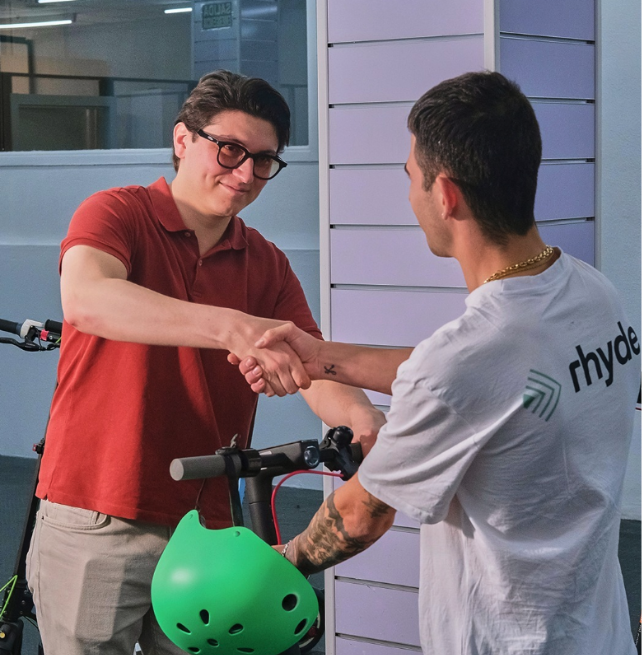
Rhyde’s combination of buyback, refurbishment, and warranty-backed resale, builds the two prerequisites for circular micromobility at scale: reliable supply and trusted quality.
A market ready for refurbishment
Light Electric Vehicles (LEVs), including e-bikes and e-scooters, are scaling quickly in Europe and are increasingly part of everyday urban mobility. In a recent EIT Urban Mobility & InnoEnergy report, LEVs are estimated to have surpassed 10 million units sold in Europe in 2022, and the analysis highlights their potential to cut emissions meaningfully: replacing 13% of daily short-distance urban trips currently made by cars and vans could save at least 30 MtCO2eq, while also supporting industrial growth and job creation (up to ~1 million green jobs) as the European LEV ecosystem expands.
However, for this growth to translate into lasting impact, cities need micromobility that is both well-integrated and built to last.
On the integration side, EU guidance increasingly frames micromobility as something that must be planned for, through safer street design, clear operating rules, and better links to public transport and multimodal hubs, as reflected in the EU Urban Mobility Framework and supporting SUMP guidance on safe use of micromobility devices in urban areas.
On the durability side, Europe is explicitly pushing a more circular, repair-first economy, through measures that promote repair and extend product lifetimes, and through ecodesign requirements that elevate durability, repairability and recyclability. It is important to keep in mind that life-cycle assessments show that the largest share of emissions LEV is embedded upstream – in materials/manufacturing and in logistics such as shipping and collection – while ride-phase electricity is comparatively small. This makes circular models that extend vehicle lifetimes one of the most direct levers for improving micromobility’s real climate performance, ensuring it is well-aligned with sustainable urban mobility goals.
Rhyde’s model directly answers this need: by making refurbished devices reliable and affordable, it helps cities unlock the full climate potential of their micromobility systems while making them accessible to more people.
Looking ahead
EIT Urban Mobility believes Rhyde addresses a critical gap in making micromobility a key part of sustainable urban mobility systems. By extending the lifespan of e‑bikes and e‑scooters through refurbishment, repair, and responsible battery management, Rhyde strengthens the circular foundations Europe needs for low‑carbon urban transport. We look forward to supporting Rhyde as it scales solutions that make clean, affordable, long‑lasting micromobility accessible across Europe.
Do you want to know more about Rhyde mission and its solutions?
Visit the company website and LinkedIn.
This article is part of Why we invested? Series presenting EIT Urban Mobility equity portfolio.